
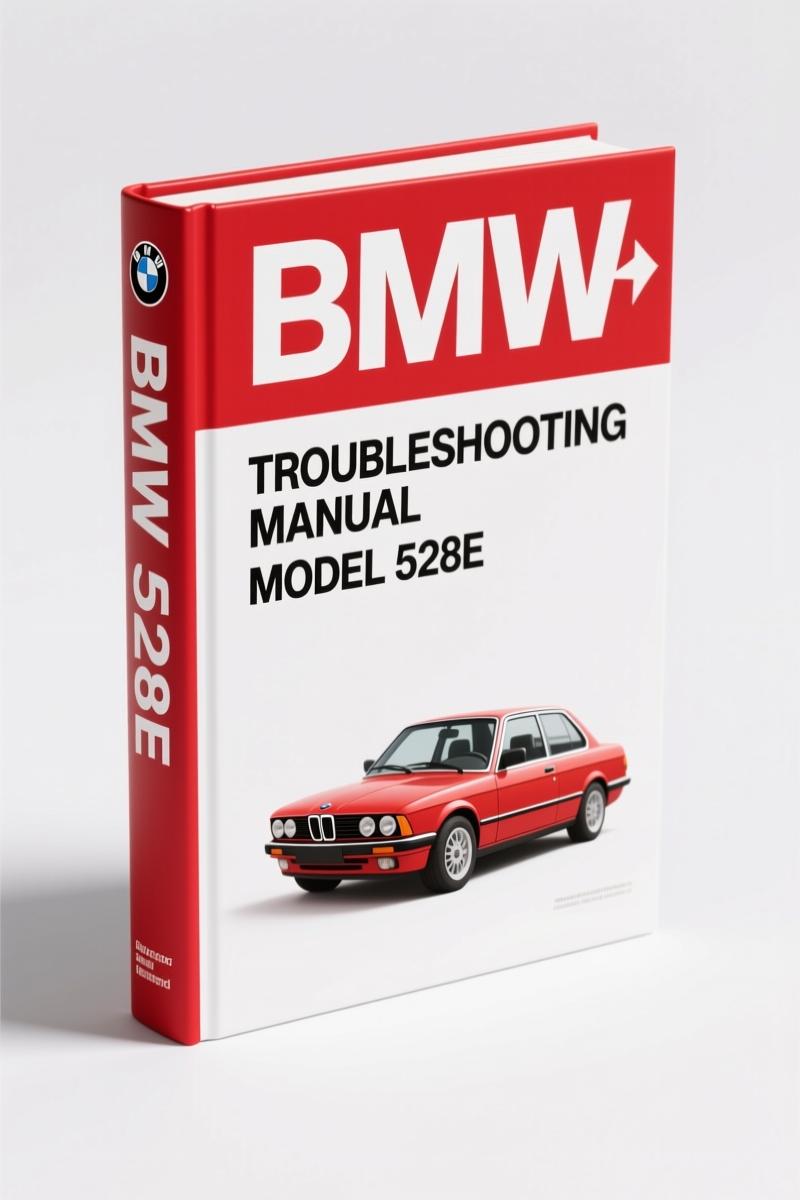
BMW 528e 1982 Troubleshooting Manual – Factory Electrical Diagnostics
Original price was: $43.75.$35.00Current price is: $35.00.
OEM electrical troubleshooting manual for 1982 BMW 528e. 77 pages of factory wiring diagrams, diagnostic procedures, and component locations.
Description
BMW 528e 1982 Troubleshooting Manual
I’ve spent enough time chasing electrical gremlins with aftermarket wiring diagrams that show colors that don’t exist on the car. The BMW 528e 1982 Troubleshooting Manual is the OEM factory book – no translation errors, no generic “typical” circuits. If you’ve ever fought a no-start on an E28 because the fuel pump relay was in the wrong fuse box location, you know exactly why this manual matters. This is the same book BMW dealers used, and it’s 77 pages of wire-by-wire truth.
Systematic Troubleshooting: Where to Start
Page 3 explains how to use this manual – and it’s not a suggestion. Every schematic shows components at rest (ignition off), current flow from fuse to ground, and all wire colors marked with BMW’s abbreviations (BK for black, BU for blue, GN for green). You don’t guess. You follow the path. The Systematic Troubleshooting section lays out a logical sequence: check power distribution first, then the specific circuit. No jumping to conclusions. The manual even includes a Wire Size Conversion Chart on page 5 so you can match metric cross-section to AWG. That matters when you’re splicing a repair and need the right gauge to handle the current without melting insulation.
The manual is organized by function – not by location. Wiper/Washer schematics show all parts in one diagram, not spread across three different pages like some aftermarket books I’ve thrown across the shop.
Fuel Delivery and Evaporative Control
Need to trace why the 528e won’t start after sitting? The Fuel Delivery/Evaporative Control section covers the pump relay, injection system wiring, and evaporative purge valve circuit. One look at the schematic and you’ll see the hot-at-all-times wire from fuse 5 (8 amp) feeding the pump relay coil. If that fuse is blown and someone replaced it with a 10-amp because they didn’t have the right one, you’ll chase it for hours. The manual gives you the exact fuse rating – no guesswork. The Fuel Control section shows the ECU inputs and outputs, including the airflow meter potentiometer signal. This is the factory diagram, not a redrawn version with missing terminals.
The Brake Lining Warning System – Why It Matters
The Brake Lining Warning circuit is a simple wear indicator that grounds the warning light when the pad gets thin. Sounds basic, but I’ve seen aftermarket manuals omit the specific diode that isolates it from the active check control. The factory schematic shows the exact connection to the Check Control module. If you ignore that and just jumper the wires, you’ll get a false warning or worse – miss a real one. The manual also includes the Ignition Key Warning and Seatbelt Warning schematics, all on dedicated pages with component location references.
Fuse Data and Diagnostic Connector – Get It Right
There’s a section called Fuse Data and another called Diagnostic Connector. You need both. The fuse box layout is drawn with each fuse number, amp rating, and circuit name. The diagnostic connector pinout shows which pins are for the engine speed signal, which are for the diagnostic ground, and which are for the starter signal. This isn’t the kind of info you find in a Haynes manual. This is the factory pinout used by BMW techs. If you’ve ever tried to connect a scan tool – or even a test light – to the wrong pin and blown the ECU, you’ll appreciate having the real data.
3 Reasons to Choose OEM Documentation
- Wiring colors and terminal numbers match the actual harness. Aftermarket often uses generic colors like “red/white” when BMW uses “RD/WT” with a specific stripe pattern.
- Ground distribution schematics show all shared ground points. One bad ground can take out the tail lights, the fuel gauge, and the radio. The manual has a dedicated Ground Distribution section.
- Component Locations section gives exact part location with connector views. No flipping between diagrams – the info is on the same page or referenced directly.
That said, I still keep a factory repair manual for torque specs. This troubleshooting manual complements it. Together they cover everything. If you’re working on the fuel injection system, you’ll want the idle speed control section (Idle Speed Control) and the ignition section (Ignition) to see how the ECU interacts with the coil and the reference sensors. The schematic for Starting (Start) includes the safety relay, clutch switch, and starter wiring. One missing ground at the transmission can cause a no-crank – and the manual shows that path.
Does This Manual Cover the Fuel System?
Yes – and more. It covers Fuel Delivery/Evaporative Control, Fuel Control, and the diagnostic connector for the DME (Digital Motor Electronics). If you need to check the charge pressure or the fuel pump relay, the power distribution schematics show the feed from fuse 5 to the relay. The manual also includes the Heater/Air Conditioning section, Central Locking, Power Windows, and Radio/Power Antenna. For a 1982 BMW 528e, this covers all the major electrical systems – 77 pages of focused troubleshooting, not a general service manual that glosses over wiring.
I’ve used this manual in my own shop when a customer brought in a 528e with intermittent wipers. Turns out it was a bad ground at G102, which the Ground Distribution section lists. I found it in under 10 minutes. Try doing that with a generic PDF.
Source Validity – Factory OEM, Not a Reprint
This is a direct scan of the original BMW publication, printed in November 1981, PN 01 00 1 467 790. It is not a third-party rewrite. Compare it to any aftermarket manual – the wire size conversion chart on page 5 is missing from all non-OEM sources I’ve seen. The symbols page (page 4) clarifies how components are drawn: entire component shown, part of a component, solid-state internals. Aftermarket books skip these details. If you’re serious about diagnostics, you want factory specs. Related manuals include the BMW 528e 533i 1983 Troubleshooting Manual for 1983 models, the BMW 528e 533i 1984 Electrical Troubleshooting Manual, and the BMW 528e 535i 1985 Electrical Troubleshooting Manual. For a broader context on vehicle electrical systems, check out the Automotive Industry Overview and Automotive Industry Overview.
- What if I have a 1982 BMW 528e with a different engine? Does this manual cover the M20 engine electricals?
- Yes. The 528e used the M20B27 engine, and this manual covers the ETM (Electrical Troubleshooting Manual) for that specific engine and chassis combination. It includes the ignition, charging, starting, and fuel control circuits unique to the 528e. If you have a 533i or 535i, use the respective year manual listed above.
- Is the manual searchable for specific components?
- No. The PDF is a scanned document with bookmarks, not OCR text search. The table of contents and index are clearly listed. You navigate like a paper manual. That means you actually learn the system layout.
If you own a 1982 BMW 528e and you want to diagnose electrical issues without replacing parts by trial, get the factory data. Access the Factory Manual from AutoRepairManuals and put it on your tablet next to the wiring harness. You’ll thank yourself when the check control lights come on and you know exactly where to probe.
Additional information
| Brand | BMW |
|---|---|
| Language | English |
2 reviews for BMW 528e 1982 Troubleshooting Manual – Factory Electrical Diagnostics
You may also like…
-
Sale!

BMW 525i, 530i, 535i, 540i Service Manual – 459 Pages Factory Specs
Original price was: $73.20.$60.00Current price is: $60.00. -
Sale!

BMW 525i, 530i, 535i, 540i Service Manual 1989-1995 Factory Specs
Original price was: $96.00.$60.00Current price is: $60.00. -
Sale!

BMW M3, 323i, 325i, 325xi, 328i Service Manual – 1258 Pages
Original price was: $93.00.$60.00Current price is: $60.00. -
Sale!

BMW 735i, 735iL, 740i, 740iL, 750iL Service Manual – 987 Pages
Original price was: $102.05.$65.00Current price is: $65.00.
Related products
-
Sale!

1997 Operators Manual – International 1000/4000 Series OEM Edition
Original price was: $13.49.$9.99Current price is: $9.99. -
Sale!
1996 Operators Manual – International 1000-4000 Series (246 pages)
Original price was: $15.28.$9.99Current price is: $9.99. -
Sale!

2011 Parts Catalog – International Truck OE Parts Documentation (1786 Pages)
Original price was: $34.50.$25.00Current price is: $25.00. -
Sale!

2006 Service Manual – International DT 466E, 530E Diesel Engine
Original price was: $67.50.$50.00Current price is: $50.00.
workshop_guy –
This is exactly what I required. The PDF looks clean. It helped me to troubleshoot my BMW 528e engine. Saves me a lot of time.
diy_master –
I am extremely satisfied with this transaction. The document looks clean. Contains detailed bolt torque specs for BMW. Saves me hundreds of money.