
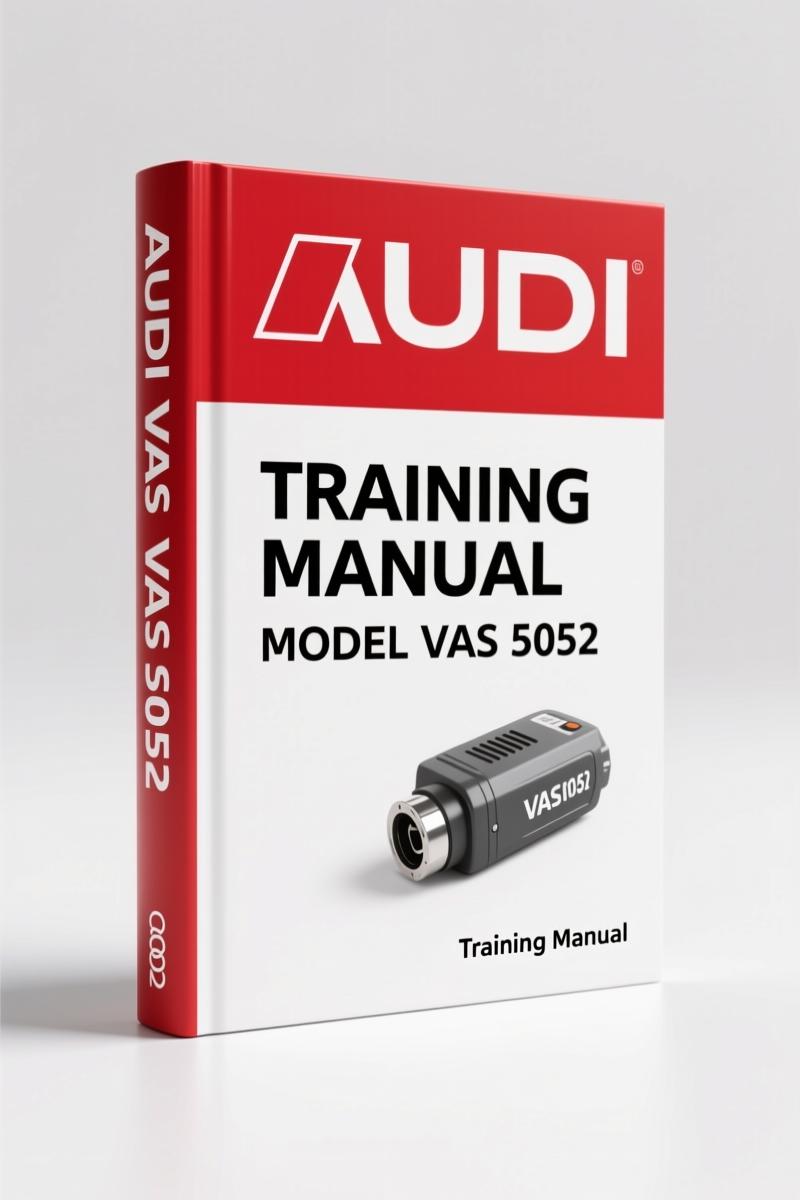
Audi VAS 5052 2001 Training Manual – CAN-Bus & Data Bus Diagnostics
Original price was: $34.50.$25.00Current price is: $25.00.
128-page Audi VAS 5052 training manual covering CAN-bus, LIN, fiber-optic, and Bluetooth data bus systems. Factory diagnostics for certified technicians.
Description
Audi VAS 5052 2001 Training Manual
I’ve seen too many guys chase electrical ghosts on Audi CAN-bus networks, swapping modules and burning hours, because they didn’t understand how the data bus actually routes messages. If you’re working on a modern Audi, you need to know how the VAS 5052 talks to the car. That’s where this Audi VAS 5052 2001 Training Manual comes in. It’s 128 pages of factory training material, printed in 2005 but written for the 2001 tool version. It doesn’t give you torque specs. It gives you the protocol knowledge that separates a parts swapper from a diagnostician.
CAN-bus Fault Diagnosis – The Core of This Manual
Page 24 lays out the CAN-bus fault diagnosis procedure. That’s where you learn to check bus resistance, signal levels, and the correct use of the DSO function on the VAS 5052. I’ve had techs tell me they couldn’t get a signal reading because they were using the wrong voltage scale. This section fixes that. It walks through the diagnostic interface, then hits the fault isolation steps. You don’t guess. You measure. The manual also covers the Data Bus On Board Diagnostic Interface, which is the gateway module that ties the diagnostic tool to every control unit on the network. Without that understanding, you’re just poking wires.
Other Data Bus Technology: LIN, Fiber-Optic, Bluetooth
This manual doesn’t stop at CAN. It covers the LIN data bus, the fiber-optic bus, and Bluetooth. If you’re chasing a door module that won’t wake up, the LIN section explains the master-slave protocol and the signal patterns you’ll see on an oscilloscope. The fiber-optic section is critical for MMI and infotainment diagnosis. And the Bluetooth section – rare for a 2001 manual – shows early adoption of wireless diagnostics. That kind of foresight is why I keep this manual on my shelf. I’ve used the fiber-optic section to diagnose a broken MOST ring in a 2003 A8; the signal-loss pattern was exactly as described.
Diagnosis CAN – Page 95’s Deep Dive
On page 95, the manual covers Diagnosis CAN separately from the powertrain or comfort CAN. That’s important because the diagnostic protocol uses different message IDs and timing. If you’ve ever had a VAS 5052 that could see the control units but couldn’t communicate, this section explains why. It also references the appendices which contain signal tables and troubleshooting trees. The appendices (A and B) list DTCs and CAN-bus message formats that you won’t find in any aftermarket scan tool menu. That data alone saves you hours of searching factory TSBs.
Audi VAS 5052 2001 Training Manual – What This Book Covers
The manual’s own introduction states clearly: “The Self-Study Program is not a Repair Manual.” I respect that honesty. What it is, is a deep dive into the architecture of Audi’s data buses from the early 2000s. It teaches you the logic behind the wiring, not just where to stick a multimeter. Chapters include CAN-bus Overview, CAN-bus Systems, Data Bus On Board Diagnostic Interface, and Other Data Bus Technology (LIN, fiber-optic, Bluetooth). It also covers the CAN-bus fault diagnosis workflow. That knowledge pays off when you’re faced with a car that has aftermarket electronics or a mis-wired trailer hitch. You’ll recognize the symptom patterns because you understand the protocol.
3 Reasons Factory Documentation Beats Aftermarket
First, accuracy of signal specs. I’ve seen aftermarket CAN-bus pinouts that mixed up CAN High and CAN Low. That’s a burned gateway module. Second, factory wiring diagrams include termination resistor values and bus topology. Third, training manuals like this explain the why, not just the what. If you want to understand the Audi VAS 5052 system, you need the OEM source. Related manuals in the same series include Audi multitronic 01J Training Manual – CVT Design & Function (100 Pages), Audi 09L, 0AT, 0B6, 0BQ, 09E 2006 Training Manual – Factory Specs, and Audi Q7 Training Manual – 76-Page Factory Self-Study Programme 361. For an overview of modern CAN-bus systems, see Automotive Industry Overview and Automotive Industry Overview.
FAQ – Two Questions You Might Have
- Can I use this to fix a no-start on a 2004 A4?
- No. This is a training manual for the VAS 5052 diagnostic system, not a repair manual for a specific model.
- What diagnostic tools does this manual cover?
- It focuses on the VAS 5052 vehicle diagnosis and service information system, including its DSO (digital storage oscilloscope) function and CAN-bus diagnostic capabilities. It explains how to interpret signal patterns and fault codes on that specific tool. If you’re using a VCDS or aftermarket scanner, the principles apply but the procedures are tailored to the VAS 5052. The manual also covers the Data Bus On Board Diagnostic Interface and the overall CAN-bus architecture. For a technician used to generic scan tools, this manual will teach you the OEM logic that makes the VAS 5052 a powerful tool when used correctly. The signal specifications and timing diagrams are specific to the 2001-era Audi systems, but the diagnostic reasoning transfers to later models.
If you need to understand how Audi data buses work, stop guessing. Access the Factory Manual and get the real information.
Additional information
| Brand | Audi |
|---|---|
| Language | English |
2 reviews for Audi VAS 5052 2001 Training Manual – CAN-Bus & Data Bus Diagnostics
You may also like…
-
Sale!
Audi A3 2003 Repair Manual – Fuel System Service Documentation
Original price was: $63.45.$45.00Current price is: $45.00. -
Sale!
Audi 100, 200 1989 Workshop Manual – Factory Service for 5-Cylinder Engine
Original price was: $63.45.$45.00Current price is: $45.00. -
Sale!
Audi A8, Q7 Training Manual – Ceramic Brake Systems
Original price was: $54.00.$45.00Current price is: $45.00. -
Sale!
Audi 5000 S 1985 Wiring Diagram – OEM Cooling Fan Circuit Data
Original price was: $86.90.$55.00Current price is: $55.00.
Related products
-
Sale!

1989 Service Manual – International 2000-8000 Electrical Systems
Original price was: $72.00.$50.00Current price is: $50.00. -
Sale!

Technical Manual – International 6.0L Power Stroke FICM Diagnostics
Original price was: $29.80.$20.00Current price is: $20.00. -
Sale!
Acura NSX 1991 Service Manual – 1420 Pages OEM
Original price was: $102.05.$65.00Current price is: $65.00. -
Sale!

1991 Electrical Schematic – 112-Page OEM Wiring Diagram for International 1000-3000 Series
Original price was: $22.75.$17.50Current price is: $17.50.
gearhead88 –
This is exactly what I was looking for. The text is searchable and easy to navigate. It guided me to rebuild my Audi VAS engine. Saved my repair job! Thank you.
Richard G. –
Highly recommended! The document looks clean. Contains precise wiring diagrams for Audi. Saves me so much dollars.