
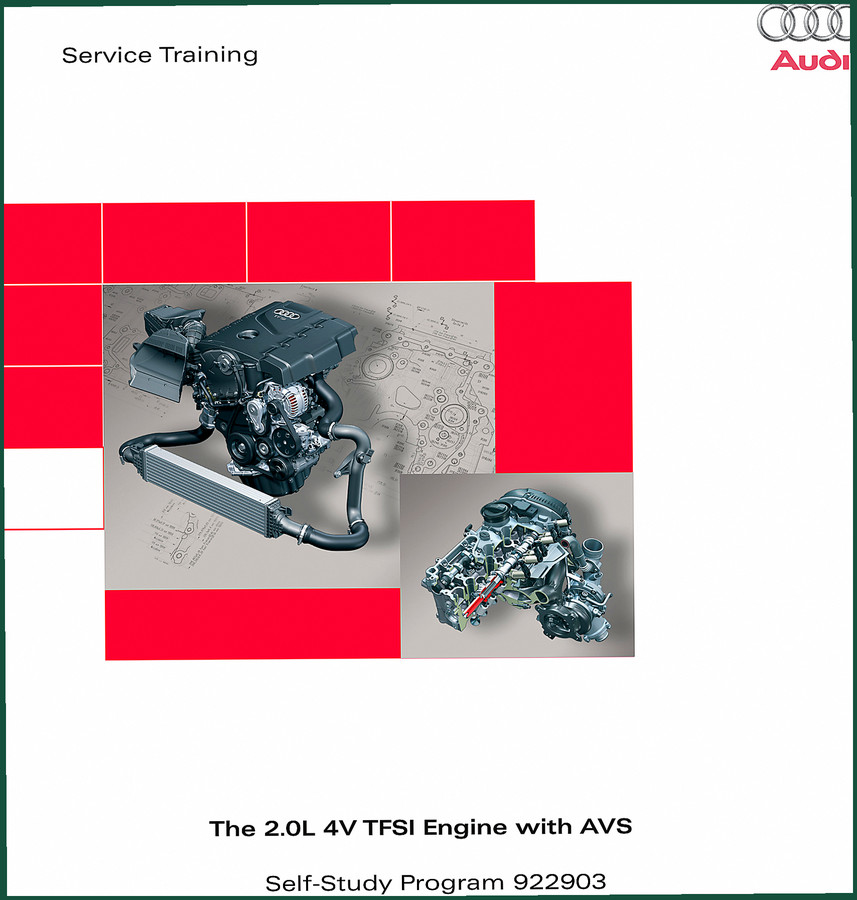
Audi SSP 922903 2009 Training Manual – Factory Specs
Original price was: $47.70.$30.00Current price is: $30.00.
Factory training manual covering the 2.0L 4V TFSI engine with AVS (EA 888 family). 56 pages of design, oil circulation, SULEV emissions data.
Description
Audi SSP 922903 2009 Training Manual – 2.0L TFSI Engine with AVS
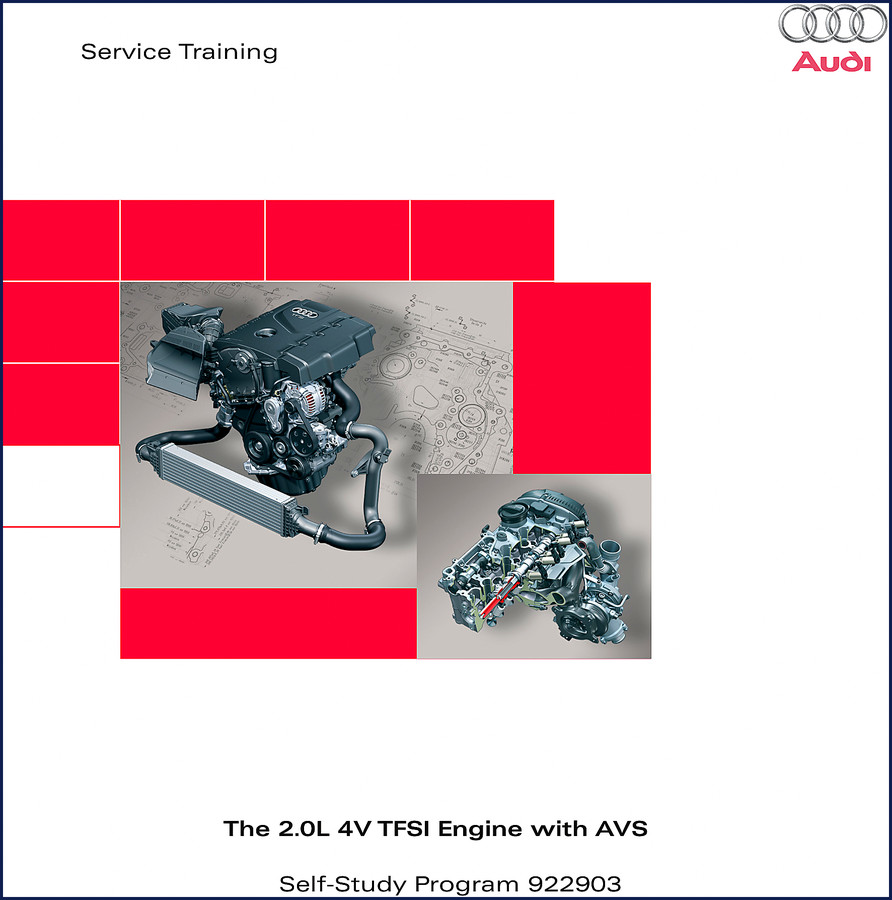
You’re staring at a CAEB engine that’s lost oil pressure at 80,000 miles. The aftermarket wiring diagram shows a crankcase vent that doesn’t match what’s on the bench. You start pulling parts and hoping. That’s the moment you realize the difference between guessing and understanding how Audi designed the oil circuit. The Audi SSP 922903 2009 Training Manual is not a repair manual—it won’t tell you torque values for the head bolts. What it will do is show you exactly why that oil pressure dropped, how the variable valve lift works on the exhaust side, and what the EA 888 family does differently from the old belt-driven engines. 56 pages of factory training material, printed in 2009, covering the 2.0L 4V TFSI with AVS. Know your enemy before you swing a wrench.
2.0L 4V TFSI with AVS: What This SSP Covers
This is not a parts catalog. The Table of Contents starts with Introduction, then tears into Engine Mechanicals (page 4), Oil Circulation System (page 14), SULEV 2.0L TFSI Engine (page 26), Service (page 45), EA 888 Engine Development (page 46), and a Knowledge Assessment (page 51). Each section uses cutaway drawings, flow charts, and component callouts. If you want to understand the chain-driven valvetrain and the Audi Valvelift System (AVS) that changes cam lobe profiles on the fly, page 26 is where the SULEV specifics live. Page 45 summarizes service intervals and inspection points. The SSP format is designed for technicians who need to know function before diagnosis.
Why a Training Manual Belongs on Your Bench
Most DIY engine builders grab a factory repair manual and go straight to the torque spec table. That works when you’re replacing a head gasket. But when you’re trying to figure out why the oil separator is dumping oil into the intake or how the variable cam timing interacts with the AVS, you need the design logic. Audi’s Self-Study Program walks you through the oil circulation system step by step—where the pressure relief valve is, how the piston cooling jets integrate, which passages get blocked when the AVS switches. I’ve seen too many guys replace oil pumps on these EA 888 engines because they didn’t realize the check valve in the cylinder head was stuck. That’s a 30-minute fix if you know what to look for. This manual gives you that map.
Oil Circulation System – Page 14 Deep Dive
The oil circulation chapter is worth the price alone. It details the variable-displacement oil pump, the oil cooler integration, and the dedicated oil supply for the AVS actuators. You’ll see a schematic of the oil gallery routing from the pump to the cylinder head, then to the camshaft adjuster. If you’re dealing with low oil pressure codes (P052A, P052B), start here. The manual also shows the oil separator design—the diaphragm-type separator that often gets misdiagnosed as a bad PCV valve. One diagram and you’ll see why it clicks at idle.
SULEV 2.0L TFSI Engine – Page 26 Specifics
The SULEV 2.0L engine (CAEB in U.S. markets) uses a different turbocharger placement and a cooled EGR system. Page 26 breaks down the exhaust manifold integrated into the cylinder head, the secondary air injection routing, and the revised camshaft timing for low emissions. If you’re trying to sort out an EVAP or misfire code on a 2009-2012 A4 or Q5, this section explains the lambda sensor placement and the catalyst light-off strategy. Not repair steps, but the rationale behind the sensor locations—saves you hours of chasing false EGR flow codes.
Service and EA 888 Development – Pages 45-50
Page 45 covers service intervals—oil change, timing chain inspection, camshaft adjustment test. Page 46 onward tells the story of the EA 888 engine family from the 1.8L Stage 0 to the 2.0L chain-driven CCTA/CBFA and finally this AVS variant. Understanding that evolution helps you spot why some parts interchange and others don’t. The Knowledge Assessment at the end (page 51) is a quick self-test. I’ve used it to train new hires—25 questions that separate the guys who read the manual from the ones who skim it.
One thing that irritates me: the SSP itself states clearly that all values are guidelines for the software version at the time of printing. Don’t use the numbers in here for final torque or adjustment specs—always cross-check against the current repair manual and Technical Bulletins. But for understanding the system architecture, this is the best 30 bucks you’ll spend.
3 Reasons to Trust This OEM Source
First, it’s printed by Audi of America, LLC, dated July 2009. That means the engineering diagrams came straight from the engine development team, not from some third-party illustrator scanning a damaged copy. Second, the 56 pages are packed with cross-sections and hydraulic schematics you won’t find in any aftermarket guide. Third, the Knowledge Assessment forces you to confirm you understood the material—rare in any training document. If you’re serious about diagnosing EA 888 engines, buy the OEM training manual. I won’t use aftermarket alternatives for design theory; they always get the AVS actuator wiring wrong.
- Does this manual include torque specs for the cylinder head?
- No. This is a self-study program, not a repair manual. It explains design and function only. Always use the current repair manual for torque values.
- I own a 2010 Audi A4 with the 2.0T. Will this SSP help me understand the timing chain noise at cold start?
- Absolutely. Look at the Engine Mechanicals section (page 4) and the Oil Circulation System (page 14). The manual shows the chain tensioner layout, the balance shaft chain drive, and the oil supply to the variable cam timing unit. You’ll see exactly how oil pressure affects chain dampening. Pair this with the factory repair manual for the actual timing cover removal procedure, and you’ll fix the noise in under two hours. The SSP shows you why the tensioner leaks down; the repair manual shows you how to replace it.
If you work on the EA 888 family, you also need documentation for the transmissions and other platforms. Check out the Audi multitronic 01J Training Manual – CVT Design & Function (100 Pages)”>Audi multitronic 01J Training Manual – CVT Design & Function (100 Pages) for CVT diagnostics. The Audi 09L, 0AT, 0B6, 0BQ, 09E 2006 Training Manual – Factory Specs”>Audi 09L, 0AT, 0B6, 0BQ, 09E 2006 Training Manual – Factory Specs covers ZF 8-speed and other transmissions. For SUV work, the Audi Q7 Training Manual – 76-Page Factory Self-Study Programme 361″>Audi Q7 Training Manual – 76-Page Factory Self-Study Programme 361 is a solid chassis companion. For broader automotive context, read the Automotive Industry Overview”>Automotive Industry Overview and understand how modern variable valve lift systems compare to earlier designs. If you’re rebuilding a manual transmission from this era, Manual Transmission”>Manual Transmission basics help, but the Audi repair manual is mandatory for the 0B6.
Don’t keep guessing why your 2.0T is running lean or knocking. Access the Factory Manual and see the design intent yourself—then go fix it with confidence.
Additional information
| Brand | Audi |
|---|---|
| Language | English |
2 reviews for Audi SSP 922903 2009 Training Manual – Factory Specs
You may also like…
-
Sale!
Audi A3 2003 Repair Manual – Fuel System Service Documentation
Original price was: $63.45.$45.00Current price is: $45.00. -
Sale!
Audi A8, Q7 Training Manual – Ceramic Brake Systems
Original price was: $54.00.$45.00Current price is: $45.00. -
Sale!
Audi 5000 S 1985 Wiring Diagram – OEM Cooling Fan Circuit Data
Original price was: $86.90.$55.00Current price is: $55.00. -
Sale!
Audi 100, 200 1989 Workshop Manual – Factory Service for 5-Cylinder Engine
Original price was: $63.45.$45.00Current price is: $45.00.
Related products
-
Sale!

2005 Parts Catalog – International NGD 3.0 L Engine (77 pages)
Original price was: $44.70.$30.00Current price is: $30.00. -
Sale!

1992 Electrical Schematic – OEM Wiring Diagrams for International 1000-3800
Original price was: $24.48.$18.00Current price is: $18.00. -
Sale!
1996 Operators Manual – International 1000-4000 Series (246 pages)
Original price was: $15.28.$9.99Current price is: $9.99. -
Sale!
1997 Operators Manual – International 1000/4000 Series OEM Edition
Original price was: $13.49.$9.99Current price is: $9.99.
Robert M. –
I am so happy with this purchase. The text is searchable and easy to navigate. Every spec sheet is provided for Audi SSP. Highly recommended for mechanics.
diy_master –
I am extremely satisfied with this transaction. It is easily zoomable on my phone without losing quality. It helped me to repair my Audi SSP transmission. Saves me hundreds of money.