
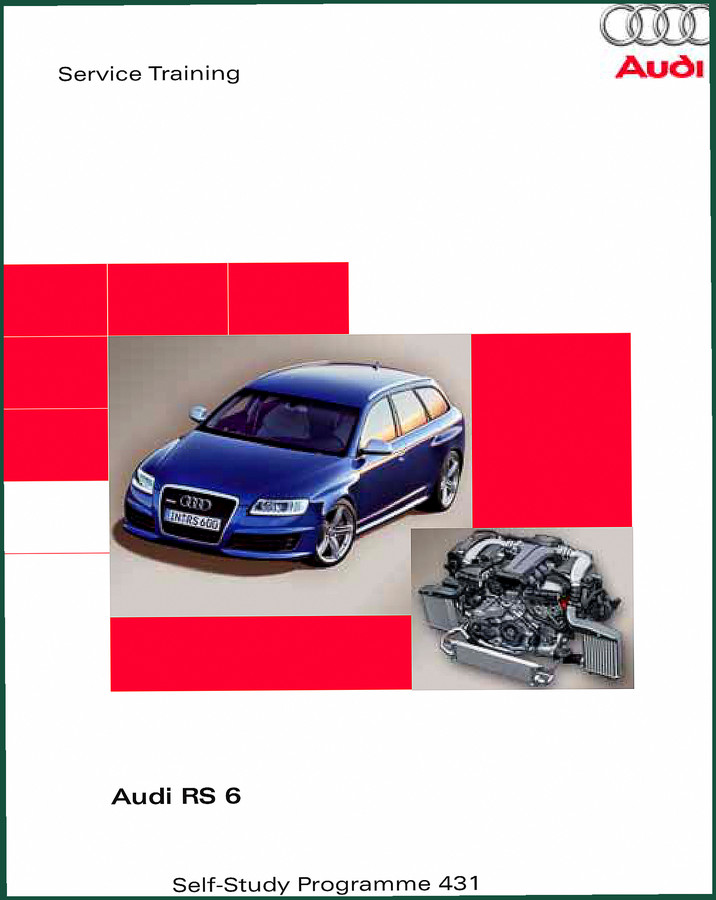
Audi RS 6 Training Manual – Factory Design & Function SSP 431
Original price was: $36.00.$30.00Current price is: $30.00.
Audi RS 6 Training Manual – 44 pages of factory design and function data for V10 twin-turbo, cooling, oil system, DRC.
Description
Audi RS 6 Training Manual – What a Technician Needs to Know
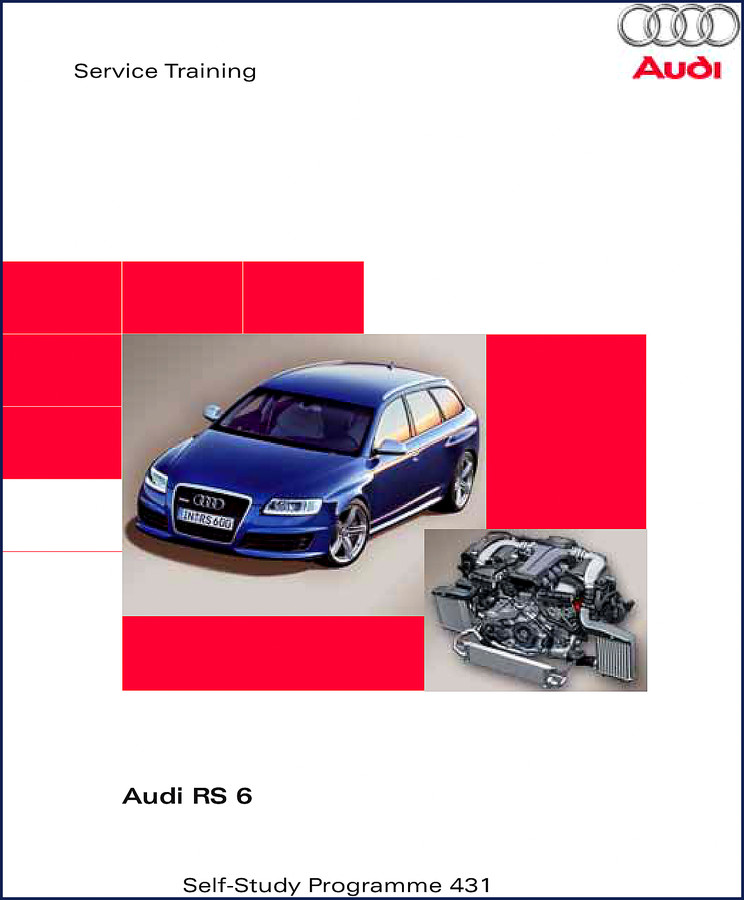
You’ve got a customer with an RS 6 that’s overheating, or the DRC is throwing a code, or the engine management light is on and you’re staring at a wiring diagram that makes no sense because you don’t know what Audi designed that system to do. That’s why this Audi RS 6 Training Manual exists. It’s not a repair manual – Audi’s own disclaimer on page 3 says that flat out. It’s a Self-Study Programme (SSP 431) that teaches you how the systems work so when you crack open the repair manual, you already know what you’re looking at. 44 pages, no fluff, just the engineering story behind the most powerful Audi ever built at the time – a 426 kW (580 bhp) V10 twin-turbo with FSI direct injection. If you skip this, you’ll be guessing why that cooling system has three radiators and two thermostats. I don’t guess.
Engine Mechanicals – V10 Twin-Turbo Design
Starts on page 8. This chapter walks through the differences between the RS 6’s 5.0L V10 and the standard 5.2L V10. Crankshaft, connecting rods, pistons, valve timing. The oil circulation system gets its own section starting on page 12 – critical for understanding why those turbochargers need an air filter port in the oil return line. If you don’t know that port exists, you’ll be scratching your head when the turbo seals fail. The manual explains it. Page 12 tells you exactly how the oil flows through the engine, including the twin turbochargers and the oil cooler circuit.
Cooling System: 3 Radiators and 2 Thermostats
Turn to page 20. The cooling system on this car is not like anything you’ve seen on a standard A6. There are three separate radiators – one main, two auxiliary – plus a two-stage thermostat setup that controls flow to the engine and transmission. The manual shows you the routing, the temperature thresholds, and how the electric coolant pumps kick in after shutdown. Miss this and you’ll be replacing water pumps you didn’t need to replace. The Cooling system chapter also ties into the charge air cooling for the turbos. That’s the kind of detail you need before you start pulling hoses.
Engine Management (Page 26) – Who Controls the Boost?
Page 26 covers the Motronic engine management system. Two knock sensors, two oxygen sensors per bank, and the boost pressure control strategy. The manual explains how the ECU adjusts boost based on intake air temperature and coolant temp. There’s a section on the fuel system – high-pressure pump, fuel rail, injectors. If you’re diagnosing a misfire or a boost leak, start here. This chapter also tells you what to watch for with the FSI direct injection system – carbon buildup on intake valves is a known issue on these engines. The training manual won’t give you a repair procedure, but it will tell you why it happens.
7 Systems Covered in 44 Pages
Every major system on the RS 6 is represented: occupant protection (page 7), body (page 6), engine mechanicals (8), oil circulation (12), cooling (20), engine management (26), automatic gearbox 09E (31), suspension (34) including Dynamic Ride Control – DRC (page 34), brake system (38), wheels and tyres (38), and electrical system (40) with bus topology and headlights (42). That’s 14 sections in 44 pages. Each one is dense with diagrams and explanations. You won’t find torque specs or step-by-step R&R here – that’s what the factory repair manual is for. But you will understand how the system works, which saves you from throwing parts at a problem.
Understand the Electrical System Before You Probe
Page 40 shows the bus topology – which control modules talk on which networks. The RS 6 uses a CAN bus system with multiple gateways. If you’re chasing a communication fault, this diagram tells you exactly which modules are on the drivetrain CAN, the convenience CAN, and the infotainment CAN. Headlights on page 42 cover the adaptive xenon system with dynamic cornering. The manual explains the self-leveling sensor and the headlight control module. Probe the wrong wire because you assumed it was a standard HID setup and you’ll fry a module. This chapter keeps you from making that mistake.
Now, if you’re working on these cars regularly, you need the companion repair manual for actual torques and procedures. But the Training Manual is the foundation. Start here, then move to the Audi RS 6 Self Study Programme 244 for an earlier model year comparison. Or pair it with the Audi multitronic 01J Training Manual – CVT Design & Function (100 Pages) if you’re doing transmission work. And if you need the 09E gearbox specs, grab the Audi 09L, 0AT, 0B6, 0BQ, 09E 2006 Training Manual – Factory Specs. For context on where Audi fits in the broader market, check the Automotive Industry Overview and if you’re comparing transmissions, read about the Manual Transmission differences.
FAQ
- Is this manual a repair manual?
- No. It’s a Self-Study Programme – it teaches design and function, not repair steps.
- Can I use this to replace the engine or set timing?
- No. You need the factory repair manual for torque values, gasket sealing procedures, and component-specific R&R instructions. This training manual will help you understand why the engine has two thermostats and where the oil jets point at the pistons, but it won’t tell you how many ft-lbs to tighten the head bolts. For that, you need the official Audi repair literature. Use this to learn the system, then apply that knowledge when you work from the repair manual. You’ll cut diagnosis time in half because you won’t be guessing what the system is supposed to do. The 44 pages are packed with diagrams and cutaway views that show you oil passages and coolant flow paths you’d never see otherwise. I’ve used these SSPs for years – they’re the missing piece between “parts changer” and “diagnostician.”
If you’re serious about working on the Audi RS 6, this is the starting point. Don’t approach that 5.0L V10 blind. Access the Factory Manual now and study the systems before your next job.
Additional information
| Brand | Audi |
|---|---|
| Language | English |
3 reviews for Audi RS 6 Training Manual – Factory Design & Function SSP 431
You may also like…
-
Sale!
Audi 5000 S 1985 Wiring Diagram – OEM Cooling Fan Circuit Data
Original price was: $86.90.$55.00Current price is: $55.00. -
Sale!
Audi A3 2003 Repair Manual – Fuel System Service Documentation
Original price was: $63.45.$45.00Current price is: $45.00. -
Sale!
Audi A8, Q7 Training Manual – Ceramic Brake Systems
Original price was: $54.00.$45.00Current price is: $45.00. -
Sale!
Audi 100, 200 1989 Workshop Manual – Factory Service for 5-Cylinder Engine
Original price was: $63.45.$45.00Current price is: $45.00.
Related products
-
Sale!
2004 Acura TSX Wiring Diagram – 73-Page Factory Electrical Schematics
Original price was: $15.88.$9.99Current price is: $9.99. -
Sale!

2011 Parts Catalog – International 7400 SFA 6X6 – 1886 Pages of OEM Part Numbers
Original price was: $32.00.$25.00Current price is: $25.00. -
Sale!

1994 Troubleshooting Manual – International 1000-4000 FBC
Original price was: $60.00.$50.00Current price is: $50.00. -
Sale!

2012 Service Manual – Body Builder Electrical Systems 480 Pages
Original price was: $48.28.$34.00Current price is: $34.00.
Charles W. –
Perfect OEM spec sheet. The pages are clean and easy to navigate. A must-have for any Audi RS mechanic doing repairs. I will definitely buy again.
Michael T. –
Excellent factory service manual. Immediate link after checkout process. A must-have for any Audi RS owner doing repairs. I will definitely buy again.
pro_mechanic –
I am extremely satisfied with this purchase. The file quality is excellent. It helped me to rebuild my Audi RS electrical system. Saves me a lot of time.