
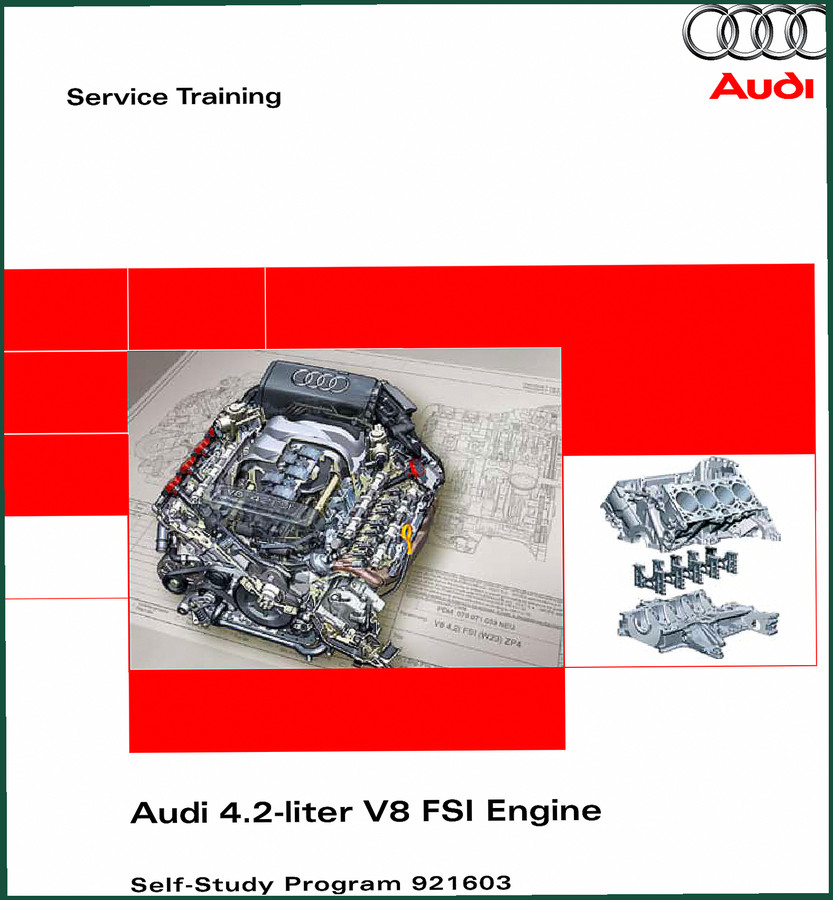
Audi 4.2 2006 Training Manual – Factory Specs & Diagnostics
Original price was: $41.10.$30.00Current price is: $30.00.
Factory training manual for the Audi 4.2-liter V8 FSI (2006): engine mechanical, oil, cooling, fuel, emissions, management – 48 pages.
Description
Audi 4.2 2006 Training Manual – Factory Self-Study Program 921603
I’ve been turning wrenches for 28 years, and I’ve seen more cockpit errors from guys guessing specs than from any bad part. If you’re working on the Audi 4.2-liter V8 FSI engine from 2006, you need the factory documentation – not some aftermarket reprint that missed a revision. The Audi 4.2 2006 Training Manual is a 48-page self-study program (SSP 921603) that Audi of America put out to train technicians on how this engine works. It’s not a repair manual – they tell you that on page 2 – but if you want to understand why the oil system is designed a certain way before you start pulling things apart, this is your starting point.
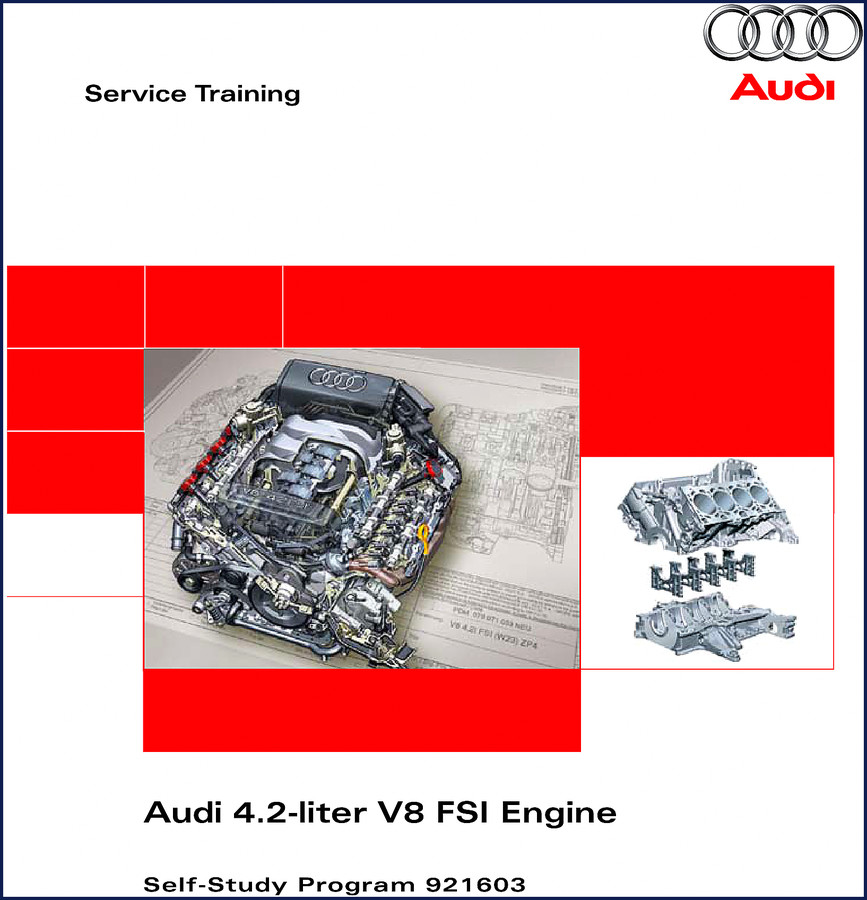
Engine Mechanical Coverage
Go to page 5 for the Engine Mechanical section. That’s where you’ll find the details on the crankshaft, pistons, cylinder head – the basic architecture of this 4.2. Audi’s FSI (Fuel Stratified Injection) engine uses a different combustion chamber design, and the manual walks through the components in a way that makes sense if you already know engine theory. It’s not a step-by-step removal guide, but it tells you how the parts interact, which is what you need to troubleshoot correctly.
Does This Manual Cover the Cooling System?
Cooling System coverage begins on page 18. It covers the coolant flow paths, thermostat location, and the electric coolant pump strategy. For a DIYer, this matters when you’re trying to figure out why a code about coolant temp is popping up. The training manual explains the logic behind the cooling system control, not just where the hoses go. That’s the difference between chasing parts and diagnosing correctly.
Air Circulation System: What the Factory Manual Details
Page 20 kicks off the Air Circulation System. You get the intake manifold, throttle valve, and the secondary air injection routing. On these 4.2 FSI engines, the secondary air system can be a pain if you don’t understand the vacuum routing. The manual gives you the official Audi description, so you can see exactly which valves are where. Avoid the aftermarket diagrams – they’re often wrong for this year.
7 Systems Covered in 48 Pages
Table of contents lists 7 technical systems: Engine Mechanical, Oil Circulation, Cooling, Air Circulation, Fuel, Exhaust, and Engine Management. Plus a Knowledge Assessment section at the end to test yourself. 48 pages might sound thin, but every page carries real density. You won’t find fluff here – Audi packed in design rationales and cross-sections that you can’t get from a Haynes manual. If you’re a home garage enthusiast, this is the logic behind the repair procedures you’ll find in the actual workshop manual.
Find Fuel Injector Data on Page 26
Fuel System section on page 26 is where the serious technical people go. It covers the high-pressure fuel pump, injectors, fuel rail, and pressure regulation. On the 4.2 FSI, injector failure isn’t uncommon, and knowing the fuel pressure thresholds and control strategy helps you decide whether it’s a pump, injector, or wiring issue. The manual doesn’t give you torque specs for the injector hold-downs – that’s in the repair manual – but it shows you the fuel circuit in detail. That alone can save you a misdiagnosis.
Why This Is Not a Repair Manual – And Why That Matters
Page 3 of this training manual explicitly states: ‘The Self-Study Program is not a Repair Manual! All values given are intended as a guideline only and refer to the software version valid at the time of publication.’ That sentence alone has saved me from customers’ lawyers. I’ve seen too many DIYers access a manual, see a torque value, use it on a critical fastener, and then blame the manual when the part fails. The training manual is for understanding the design philosophy – the variable valve timing, the FSI injection strategy, the oil circuit layout. When you know why the engine was built that way, you can diagnose faster. But never, ever substitute this for the workshop manual when you’re bolting things together. Use it to study, then go to the official repair info for the actual numbers. That approach separates good mechanics from guys who cause comebacks.
Short version: study it, don’t wrench by it.
If you need to understand the transmission that pairs with this engine, the Audi multitronic 01J Training Manual – CVT Design & Function (100 Pages) is a good companion. For the automatic transmission specs, see the Audi 09L, 0AT, 0B6, 0BQ, 09E 2006 Training Manual – Factory Specs. And if you’re working on a Q7 with the 4.2, the Audi Q7 Training Manual – 76-Page Factory Self-Study Programme 361 covers the entire vehicle.
Audi’s training materials are part of the broader Automotive Industry Overview that includes standards for technical documentation. For those studying transmissions, understanding the basics of Manual Transmission design can also help when working on the 4.2’s manual variants.
- Is this a repair manual?
- No. It is a self-study program, not a repair manual.
- Does it contain torque specifications?
- This training manual provides guideline values and design explanations, but it is not the source for final torque specs. For example, the Oil Circulation System section discusses oil pump flow rates and pressure relief, but you need the current repair literature for tightening torques on main bearings or head bolts. The manual itself warns on page 3 that all values are guidelines. I always cross-reference with the latest electronic repair info before torquing anything critical. So yes, there are some numbers, but treat them as educational, not final.
- Can I use this to rebuild my 4.2 engine?
- Not alone. You need the official Audi workshop manual for disassembly and assembly steps, torque sequences, and tolerances. This training manual will help you understand why each component is designed the way it is, which makes you less likely to make a mistake during reassembly.
- What year Audi 4.2 does this cover?
- 2006 model year. The manual was printed in July 2006 and covers the 4.2-liter V8 FSI engine as produced at that time.
Don’t waste time guessing on this engine. Access the Factory Manual from AutoRepairManuals and get the actual Audi training material. Your hands and your wallet will thank you.
Additional information
| Brand | Audi |
|---|---|
| Language | English |
3 reviews for Audi 4.2 2006 Training Manual – Factory Specs & Diagnostics
You may also like…
-
Sale!
Audi A8, Q7 Training Manual – Ceramic Brake Systems
Original price was: $54.00.$45.00Current price is: $45.00. -
Sale!
Audi A3 2003 Repair Manual – Fuel System Service Documentation
Original price was: $63.45.$45.00Current price is: $45.00. -
Sale!
Audi 5000 S 1985 Wiring Diagram – OEM Cooling Fan Circuit Data
Original price was: $86.90.$55.00Current price is: $55.00. -
Sale!
Audi 100, 200 1989 Workshop Manual – Factory Service for 5-Cylinder Engine
Original price was: $63.45.$45.00Current price is: $45.00.
Related products
-
Sale!

1992 Electrical Schematic – International 1000/3000/4000/2554 OEM Wiring Diagrams (132 Pages)
Original price was: $26.40.$20.00Current price is: $20.00. -
Sale!

1991 Operators Manual – International Truck OEM Specs (108 Pages)
Original price was: $13.63.$10.99Current price is: $10.99. -
Sale!
1994 Troubleshooting Manual – International 1000-4000 FBC
Original price was: $60.00.$50.00Current price is: $50.00. -
Sale!
1991 Electrical Schematic – 112-Page OEM Wiring Diagram for International 1000-3000 Series
Original price was: $22.75.$17.50Current price is: $17.50.
workshop_guy –
Perfect workshop guide. The pages are clean and well indexed. Every torque spec is provided for Audi 4.2. I will recommend this shop to others.
James L. –
I am very pleased with this manual. Immediate link after checkout process. It helped me to repair my Audi 4.2 electrical system. I will recommend this shop to others.
David K. –
I am very pleased with this purchase. It is very easy to read on my phone without blur. A must-have for any Audi 4.2 DIYer doing maintenance. I will definitely buy again.