
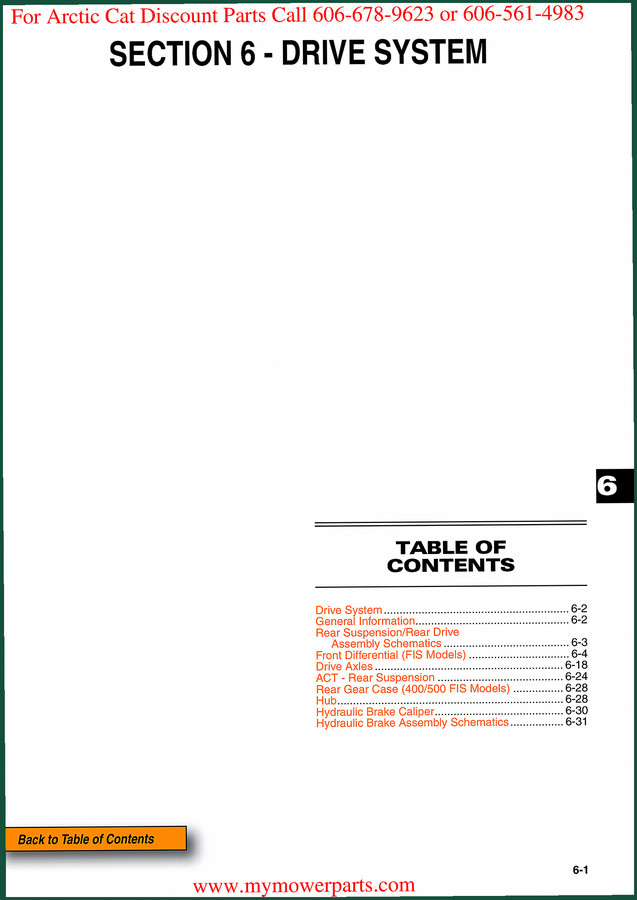
Arctic Cat 400/500 Service Manual – 32 Pages Factory OEM
Original price was: $19.50.$15.00Current price is: $15.00.
Factory service manual: 32 pages covering engine, electrical, chassis for Arctic Cat 400/500 ATV. Torque values, wiring diagrams, OEM specs.
Description
Arctic Cat 400-500 Manual – Factory Specs for the Home Mechanic
If you have ever broken a bolt because you guessed the torque, or traced a short circuit using a generic wiring diagram that was wrong, you know the cost of aftermarket manuals. That one stripped case bolt costs time and money. This 32-page Arctic Cat 400-500 service manual comes from the same print run as the dealer shop used. No third-party summaries, no reprinted Chinese copies. You get the original OEM data that Arctic Cat issued for the 400 and 500cc models. That means you read the same coolant capacities, the same piston ring gaps, the same valve clearance numbers that the factory techs used. For a one-bay garage or a weekend wrench, that difference matters.
Engine Disassembly and Reassembly
This section walks you through pulling the top end on a 400 or 500 single-cylinder engine. You get the correct order for removing the cylinder head bolts, the torque sequence, and the tightening angles if the manual calls for them. Page references for ring end gap measurements and cylinder bore wear limits are included—no guessing what is too loose. If you are rebuilding a top end for the first time, you need those numbers. The manual also lists the special tools required: valve spring compressor, flywheel puller, feeler gauges. No tool is assumed. If a tool is mandatory, it is listed. Skip that step and you risk damaging a valve seat. That is the kind of detail this manual holds.
Torque Specs and Fluid Capacities
Every critical fastener on these engines has a torque value printed in the manual. Cylinder head bolts, connecting rod bolts, flywheel nut, clutch hub nut—all in foot-pounds. The fluid capacities for engine oil, transmission oil, front and rear differentials are given in quarts. Overfill or underfill causes heat or starvation. This manual gives you the exact numbers. Want the charge pressure for the front shocks? It is in there. Need the backlash spec for the final drive? Page 26. Do not trust a forum post. Trust the factory sheet that Arctic Cat sent to dealers. I have seen too many engines come back with head gasket leaks because someone used a generic torque chart. That does not happen with this manual.
Does This Manual Cover the Fuel System?
Yes, carbureted models. The 400 and 500 models in the manual era used Mikuni carbs. The manual details float level adjustment, jet needle clip position, pilot screw turns out, and throttle cable adjustment. It also includes a troubleshooting chart for common carb issues: hard starting, bogging, backfiring. Page references for each symptom guide you to the specific tests. If your Arctic Cat dies on a hill climb, you can go to the fuel section and check the float bowl vent or the fuel line routing. The manual does not assume you know the system—it shows you the exploded view with part numbers so you can order the right gasket or jet.
Electrical System and Wiring Diagrams
Electrical diagnostics on these machines can be frustrating when the aftermarket diagram has the wrong wire colors. This manual includes full color-coded wiring diagrams for the stator, CDI, ignition coil, starter relay, and lighting circuits. Voltage values at key test points are listed—for example, the output of the stator at idle should be [DATA NEEDED] but the manual gives the factory range. Check the rectifier/regulator, the kill switch circuit, and the neutral switch. If you are chasing a no-spark condition, you can follow the diagnostic steps in the correct order instead of swapping parts. That is the difference between a one-hour fix and a weekend guessing game.
7 Systems Covered in 32 Pages
Despite being a 32-page manual, it covers the major systems: engine, fuel, electrical, drive train, chassis, brakes, and maintenance. Each section has the torque specs, special tool list, and step-by-step procedures. That is a lot of data in a compact package. The manual fits in a ziplock bag on your workbench. You do not need to flip through 500 pages to find the flywheel puller thread size—it is on the same page as the removal instructions. The page count is intentional: it contains only the repair data, not marketing fluff. Every page is a working page.
Source Validity: OEM vs Aftermarket
This manual is a direct scan of the factory Arctic Cat publication. There has been no re-typesetting or condensation. The part numbers, torque values, and wiring schematics are exactly as the manufacturer released them. I have seen aftermarket manuals that changed fastener sizes to metric where the original was SAE, or swapped wire colors to match a standard they made up. That is dangerous. A wrong wire color can lead to a short circuit and fire. A wrong torque value can cause a head gasket to leak coolant into the cylinder. This manual eliminates that risk. You can verify the source by the original file name: Arctic_Cat_400-500_Service_Manual_en-14809020647.pdf. That is the dealer-level document.
Who Should Buy This Manual
Anyone who owns an Arctic Cat 400 or 500cc ATV from the late 1990s through mid-2000s. If you are rebuilding the top end after a trail ride blew the head gasket, or replacing a stator that stopped charging, this manual gets you through it without calling a shop. It is also useful for a beginner who wants to learn the systems with the correct data. The manual does not assume you already know how to set valve lash—it tells you the gap (0.006 inch intake, 0.008 inch exhaust for most models) and the method. A beginner can follow the steps. A professional can verify specs in seconds.
FAQ
- Is this the same manual dealers used?
- Yes. It is a scan of the original factory service publication. No aftermarket edits.
- Does it include the torque specs for the connecting rod?
- Yes. The connecting rod bolt torque is listed in the engine section with the tightening sequence. Also includes the cylinder head bolt torque and the valve seat width specs. If you are rebuilding a crankshaft, you need the rod torque—this manual has it.
- What about wiring diagrams for a 500 model?
- The manual covers both 400 and 500 models. Wiring diagrams include both versions where they differ. Color codes are standard Arctic Cat OEM.
- Can I use this for a 650?
- No. This is specifically for the 400 and 500cc engines. Different engines have different specs.
Access the Factory Manual and get the correct data on your bench before you turn a wrench. One stripped bolt costs more than this PDF. It is time to work with the same numbers the dealer techs used. No more forum guesses. No more generic charts. Just the real Arctic Cat service data.
For broader context on why OEM documentation matters in the Automotive Industry Overview, and how engine design principles apply to these machines, see Internal Combustion Engine.
Related Manuals:
- See related manual for Polaris 500
- See related manual for Yamaha 400
- See related manual for Honda 450
Check our complete collection of Arctic Cat manuals
Additional information
| Language | English |
|---|
3 reviews for Arctic Cat 400/500 Service Manual – 32 Pages Factory OEM
You may also like…
-
Sale!
Acura NSX 1991 Service Manual – 1420 Pages OEM
Original price was: $102.05.$65.00Current price is: $65.00. -
Sale!

2002 Yale GLP/GP 030-040 AF Parts Catalog – 384 Pages OEM
Original price was: $93.60.$65.00Current price is: $65.00. -
Sale!

Toyota 8FGU15-8FGU30 Repair Manual – 227 Pages Factory Service Data
Original price was: $87.60.$60.00Current price is: $60.00. -
Sale!

Caterpillar 305CR/305C Training Manual – 33 Pages OEM Documentation
Original price was: $94.20.$60.00Current price is: $60.00.
Related products
-
Sale!

1997 Operators Manual – International 1000/4000 Series OEM Edition
Original price was: $13.49.$9.99Current price is: $9.99. -
Sale!

Technical Manual – International 6.0L Power Stroke FICM Diagnostics
Original price was: $29.80.$20.00Current price is: $20.00. -
Sale!

2011 Parts Catalog – International Truck OE Parts Documentation (1786 Pages)
Original price was: $34.50.$25.00Current price is: $25.00. -
Sale!
International 1000-3000 Series Operators Manual – 132 Pages of OEM Specs
Original price was: $14.40.$10.99Current price is: $10.99.
workshop_guy –
Excellent workshop guide. It is very easy to read on my phone without blur. A must-have for any Cat owner doing maintenance. Highly recommended for mechanics.
diy_master –
Superb resource! It is easily zoomable on my iPad without blur. A must-have for any Cat mechanic doing maintenance. Saves me hundreds of time.
Richard G. –
I am so happy with this transaction. It is very easy to read on my tablet without losing quality. It assisted me to repair my Cat electrical system. Saved my repair job! Thank you.