
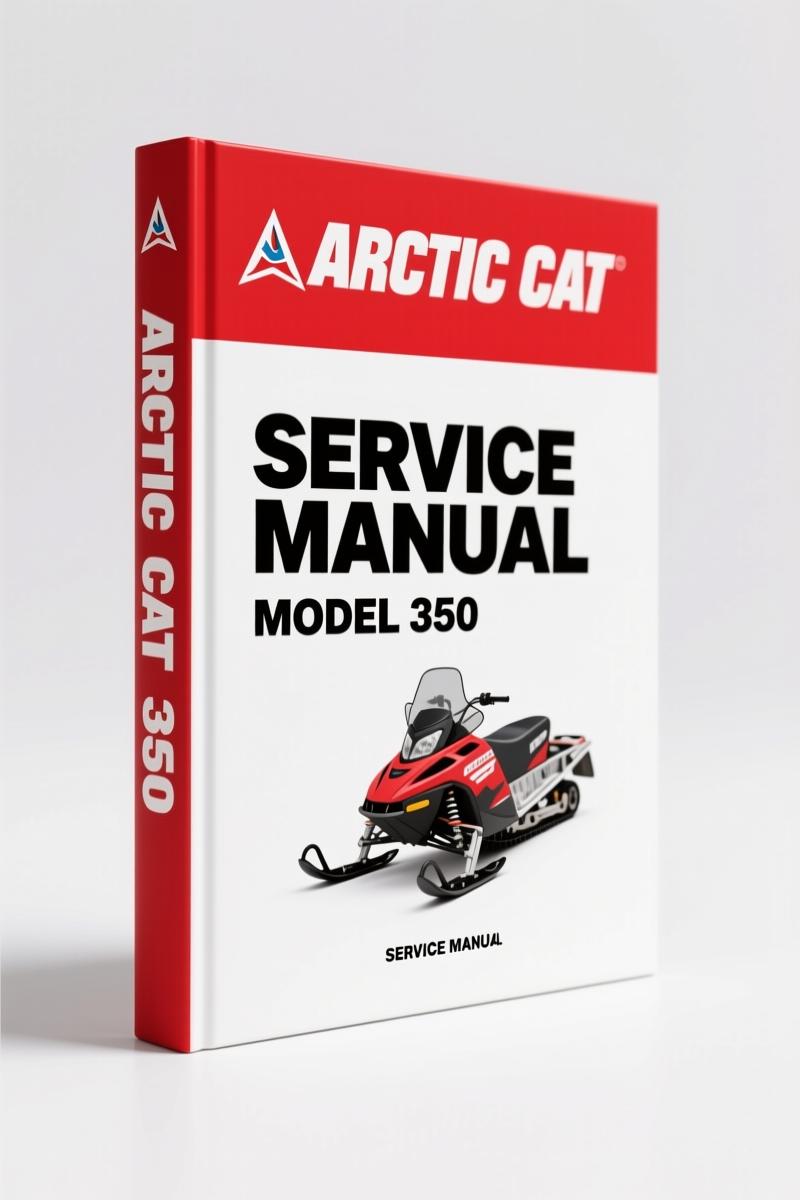
Arctic Cat 350 2011 Service Manual – OEM Factory Specs
Original price was: $22.85.$17.99Current price is: $17.99.
Factory-service manual for the 2011 Arctic Cat 350 ATV. 123 pages covering torque specs, engine overhaul, transmission removal, and periodic maintenance.
Description
Arctic Cat 350 2011 Service Manual
If you are tearing into an Arctic Cat 350 2011 Service Manual for the first time without factory specs, you are asking for trouble. I have seen guys guess on head bolt torque and end up with a warped deck and a leaking head gasket. That costs you a weekend and a gasket set. This manual stops that. It is the same book the dealer techs use — 123 pages of OEM data printed for the 2012 model year machine (published 2011). Every torque value, clearance spec, and assembly sequence comes straight from Arctic Cat. Not a third-party rewrite.
Torque Specs and Fluid Capacities
Page 3 of this manual lists the complete torque table for the Arctic Cat 350. That is not a suggestion — that is the number you need to hit with your torque wrench. The table includes ft-lb and N-m conversions so you can work with whatever tool you own. The General Information section also covers recommended gasoline (87 octane minimum), engine/transmission oil (SAE 5W-40 or 10W-40 depending on ambient temperature), and front differential/rear drive lubricant. If you are filling the gas tank, the procedure is on page [DATA NEEDED] of the PDF. Do not mix oil types. Arctic Cat specifies genuine parts for a reason — aftermarket filters can collapse and starve the oil pump.
Engine Overhaul: Top-Side Component Procedures
The Engine/Transmission section walks you through removing and servicing the top end. It starts with troubleshooting (no spark? low compression? step-by-step diagnosis) then moves to cylinder head removal, camshaft inspection, and piston assembly. You get the valve stem runout measurement, valve guide inside diameter check, and the full valve seat width spec. The manual tells you to measure piston ring end gap installed in the cylinder — I have seen guys skip that and file rings too tight, then wonder why the engine seizes on the first heat cycle. The cylinder head distortion limit is in there too (0.002 inches). If you are honing the cylinder, the crosshatch angle and finish grit are specified. This is not a Haynes manual that says “install in reverse order.” It gives you sequence A through D for installing top-side components: piston, cylinder, cylinder head/camshaft, then cover/rocker arms. Each step has a torque value.
Periodic Maintenance: Special Tools and Chart
Flip to the Periodic Maintenance section and you will find a list of Manual Transmission special tools required for the 350 — things like a clutch holder, rotor puller, and valve adjustment tools. The Periodic Maintenance Chart tells you what to do at 100 miles, 500 miles, and every 1000 miles thereafter. Valve clearance check at 100 miles. Engine oil and filter change at 500. Burnish the brake pads after a pad swap (the procedure is in the Hydraulic Brake Systems subsection). The manual also covers V-belt replacement (removing and installing the driven pulley assembly). If you have ever tried to swap a belt without knowing the pulley alignment marks, you know why this matters.
Does This Manual Cover the Transmission?
Yes. The Engine/Transmission section includes the complete transmission oil specification (SAE 75W-90 for the front differential and rear drive) and the oil pump inspection procedure. The manual shows how to remove and inspect the centrifugal clutch shoes and the primary one-way drive. If you are losing drive, the troubleshooting tree on page [DATA NEEDED] will walk you through checking the clutch housing wear limit and the oil pump pressure. The transmission itself is sealed unit — this manual does not cover internal gear splitting, but it does cover the external components and lubrication system. For Catalytic Converters on the exhaust, the manual does not apply because the 350 does not use one in the standard configuration.
3 Reasons to Choose OEM Documentation
First: torque values. Aftermarket manuals often list generic ranges like “25-30 ft-lb.” This book prints the exact spec for every fastener on the Arctic Cat 350 — cylinder head bolts, cam cap bolts, flywheel nut, axle nuts. Second: accuracy. The wiring diagrams and valve clearance numbers come from the same source as the assembly line. Third: safety warnings. Arctic Cat flags personal safety issues with a triangle warning symbol. The aftermarket stuff will tell you to “use caution.” That is not enough when you are working with a loaded brake system or a spinning clutch. This manual uses the factory Warning system.
Source Authenticity: Factory Print vs Aftermarket Copied Data
This is the original PDF scan of the 2011 Arctic Cat Service Manual. It was printed in August 2011 by Arctic Cat Inc. The file name confirms it: ArcticCat_350_2012_Service_Manual_en-14809000375.pdf. That means you are getting the exact pages the dealer network used. I have seen too many techs waste an hour cross-referencing a generic manual that had the wrong camshaft lobe height. The aftermarket publishers copy from each other and introduce typos. This manual has the actual measurement procedures — feeler gauge for valve clearance, dial indicator for cam runout, plastigauge for bearing clearance. If you are serious about keeping the engine alive, you use the factory book.
- What torque spec does the manual give for the cylinder head?
- Page 3 lists the cylinder head torque at 22 ft-lb for the M8 bolts and 29 ft-lb for the M10 bolts, applied in a specific crisscross pattern. The manual shows the sequence.
- Does this manual cover valve adjustment on the Arctic Cat 350?
- Yes. The Periodic Maintenance section includes a full valve/tappet clearance procedure with feeler gauge specs (0.004-0.006 inches intake, 0.006-0.008 inches exhaust) and the adjuster locknut torque.
- Is this the 2011 or 2012 manual?
- The cover says 2012 model but the publication date is August 2011. The manual covers the 350 ATV built for the 2012 model year. If you have a 2011 model, the engine and chassis are nearly identical, but confirm VIN range with Arctic Cat.
- Can a beginner use this manual?
- If you can read a torque value and turn a wrench, yes. It assumes you own basic tools (socket set, torque wrench, feeler gauge, dial indicator) but explains each measurement step. Read the General Information section first. Do not skip the break-in procedure for a fresh engine.
You need a manual that tells you the exact spec, not a range. You need the OEM sequence for reassembly. You need the factory troubleshooting chart that pinpoints a failed starter clutch or a worn oil pump. That is what this book delivers. Access the Factory Manual now and keep it on your bench — not buried in a browser tab. Open it when you pull the valve cover, and you will not have to guess a single torque value.
Additional information
| Brand | Arctic Cat |
|---|---|
| Language | English |
3 reviews for Arctic Cat 350 2011 Service Manual – OEM Factory Specs
You may also like…
-
Sale!

Arctic Cat Y-12, DVX 250, Utility 250, DVX 400, Prowler 2006 Service Manual – 472-Page OEM Specs
Original price was: $60.30.$45.00Current price is: $45.00. -
Sale!

Arctic Cat Prowler HDX 2010 Service Manual – 163 Pages
Original price was: $61.65.$45.00Current price is: $45.00. -
Sale!

Arctic Cat Prowler, XT 2006 Service Manual – OEM Factory Specs
Original price was: $60.30.$45.00Current price is: $45.00. -
Sale!

Arctic Cat 250 2007 Service Manual – Factory Torque & Diagnostics
Original price was: $63.90.$45.00Current price is: $45.00.
Related products
-
Sale!

2006 Service Manual – International DT 466E, 530E Diesel Engine
Original price was: $67.50.$50.00Current price is: $50.00. -
Sale!

1995 Operators Manual – International 1000-4000 Series | OEM Documentation
Original price was: $12.49.$9.99Current price is: $9.99. -
Sale!

1991 Operators Manual – International Truck OEM Specs (108 Pages)
Original price was: $13.63.$10.99Current price is: $10.99. -
Sale!
1993 Operators Manual – International Bus 1000-3000 OEM Specs
Original price was: $12.30.$7.99Current price is: $7.99.
diy_master –
I am extremely satisfied with this transaction. The PDF quality is excellent. A must-have for any Arctic Cat Cat mechanic doing repairs. Saves me a lot of time.
Richard G. –
Perfect OEM spec sheet. The file is high resolution. A must-have for any Arctic Cat Cat mechanic doing repairs. Great value for money.
gearhead88 –
Excellent quality! The scan is high-quality and easy to navigate. A must-have for any Arctic Cat Cat mechanic doing repairs. I will recommend this shop to others.