
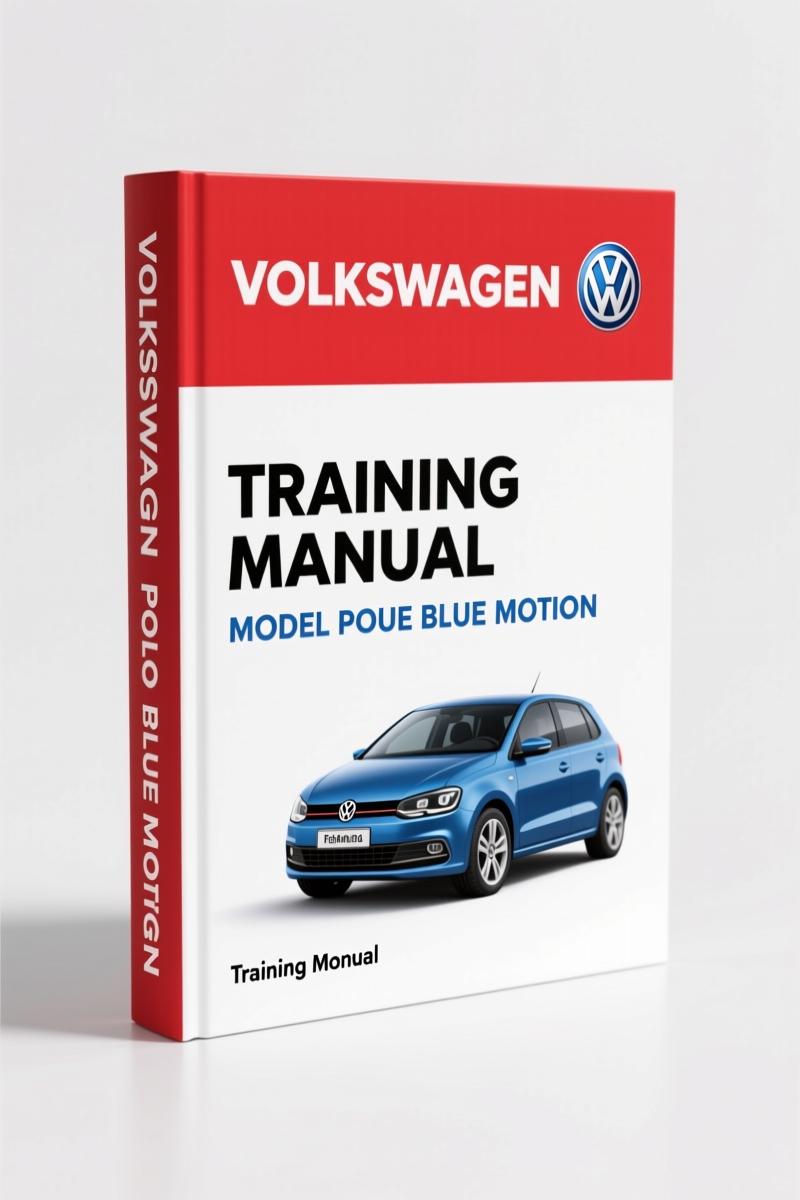
Volkswagen Polo Blue Motion Training Manual – Factory Specs for 1.2l TDI
Original price was: $46.80.$30.00Current price is: $30.00.
Factory Volkswagen training manual for Polo Blue Motion 1.2l TDI engine – 56 pages on cylinder block, fuel system, emissions, and service tools.
Description
Volkswagen Polo Blue Motion Training Manual – Factory Specs for the 1.2l TDI
I’m Mike Callahan. Twenty-eight years turning wrenches in San Antonio, and I’ve seen more head gasket failures from wrong torque than from bad parts. If you’re cracking open a Volkswagen Polo Blue Motion with the 1.2l three-cylinder TDI, you need the right numbers. Not guesses. Not aftermarket translations. This Training Manual is what Volkswagen themselves handed out to techs – 56 pages of factory design and function details. It won’t teach you how to rebuild the whole car, but it will show you exactly how that common rail fuel system works, where the crankshaft thrust bearings sit, and what the ECM expects from every sensor. The only thing worse than a broken bolt is a broken bolt you have to explain to a customer.
1.2l 55kW TDI Engine – What This Manual Covers
Page 4 opens with the introduction to this three-cylinder diesel. Developed from the 1.6l TDI, it replaced the old 1.4l unit injector engine. Fuel consumption sits at 3.3l/100km – that’s about 71 U.S. mpg, for anyone running the numbers in imperial. The manual walks through the entire engine architecture: cylinder block, crankshaft, cylinder head, head cover, balancer shaft module, toothed belt drive, and ancillary component drive. If you’re chasing a noise from the timing side, the balancer shaft section alone could save you pulling the pan off a second time. Every component is laid out with cross-sections and callouts.
Engine Components: Cylinder Block, Crankshaft, and Valve Train
Starting at page 6, the manual goes deep into the iron cylinder block and the forged crankshaft. The crankshaft has four main bearings and an integrated gear for the balancer shafts. That balancer module is driven off the crankshaft and spins at twice engine speed – page 8 shows the exact gear mesh pattern. The cylinder head uses four valves per cylinder with hydraulic lifters. The valve timing is fixed by the toothed belt, and the manual gives the installation positions so you don’t get the cam timing off by a tooth. I’ve seen that mistake leave a valve kissing a piston. The cylinder head cover integrates the oil separator – a common failure point that gets misdiagnosed as a blown turbo seal. This manual shows the internal passages. That kind of detail keeps you from replacing parts that aren’t broken.
Fuel System: Common Rail Injection Breakdown
Pages 14–20 cover the fuel system. This is where most DIY guys get lost. The 1.2l TDI uses a CP1.2 high-pressure pump (max rail pressure around 1,600 bar), piezo injectors, and a pressure control valve. The manual explains the low-pressure circuit, the fuel filter with water separator, and the return lines. If you’re dealing with a no-start or rough idle, the sensor descriptions (rail pressure sensor G247, fuel temperature sensor G81) give you the resistance values and signal ranges. A generic manual would say “check wiring” – this one tells you what the signal should look like on a scope. That cuts diag time by half. The common rail system also includes an intake manifold with swirl flaps (page 13) and low-temperature EGR to keep NOx down. Understanding that loop is critical before you throw a EGR delete kit on and wonder why the ECM goes into limp mode.
Service Tools and Workshop Equipment – Don’t Start Without Them
At the back of the manual, the Service section lists the special tools needed for any serious work. Timing belt tensioner tool, injector puller, crankshaft holding fixture, and the adapter for the diesel injection pump. No generic substitutes – the manual gives the VW part numbers. A stripped camshaft gear from using the wrong sprocket holder is a $500 mistake you can avoid by reading pages 45–50. The manual also covers the start/stop system (a tiny section but important for the Polo Blue Motion), the glow plug system, and the diesel particulate filter regeneration strategy. If you’re a home garage guy, you’ll want to check the tool list before you disassemble anything.
Source Authenticity: OEM Training Manual vs Aftermarket Reprints
This is a genuine Volkswagen Self-Study Programme (SSP 465). It’s not a scanned copy from a third-party service – it’s the original training document from VW, printed for dealer technicians. The pages are clean, the diagrams are factory vector art, and the specs haven’t been rewritten by someone who never held a wrench. I’ve had aftermarket manuals list the wrong ring gap for this exact engine. That costs you a re-ring and a head gasket job. With this OEM manual, you’re working from the same source material VW uses. For related documents, check out the Volkswagen 2.3-ltr. V5 Training Manual – OEM Factory Specs and the Volkswagen Passat 2005 Training Manual – Technical Overview if you work on other VW platforms. The VW SSP 264 2000 Training Manual Brake Assist System OEM is also a good addition for brake system diagnostics.
Outside the VW circle, the Automotive Industry Overview shows how other manufacturers structure their training documents – but nothing beats the specificity of a factory source. Automotive Industry Overview standards may differ, but OEM manuals remain the gold standard for accuracy.
Frequently Asked Questions
- Does this manual cover the entire Polo Blue Motion, or just the engine?
- It covers the 1.2l TDI engine design and function only. Body, transmission, and chassis are not included. Use a separate workshop manual for those systems.
- Will this manual tell me the torque specs for the cylinder head bolts?
- Yes, but it presents them as design values. For current head bolt torque sequences and angles, you need the current service literature referenced on page 2. This manual is a study guide, not a repair manual.
- Can I use this to diagnose a crankshaft noise on my Polo?
- Absolutely. The crankshaft section shows bearing locations, the balancer shaft drive, and the oil pump chain. The manual helps you pinpoint whether the noise is from the crank itself or the balancer module.
- What about the fuel injection system – are there wiring diagrams?
- There are block diagrams for the engine management system, but no full wiring schematics. The sensors (rail pressure, differential pressure, etc.) are described with their function and mounting locations. For pinouts, you need the vehicle-specific wiring diagram manual.
If you’re working on a Volkswagen Polo Blue Motion and need to understand exactly how the 1.2l TDI is built, this 56-page training manual is the foundation. It won’t hold your hand through every bolt removal, but it gives you the factory knowledge to do the job right. Access the Factory Manual now and keep it on your tablet next to the lift.
Additional information
| Brand | Volkswagen |
|---|---|
| Language | English |
3 reviews for Volkswagen Polo Blue Motion Training Manual – Factory Specs for 1.2l TDI
You may also like…
-
Sale!

Volkswagen Phaeton Training Manual – Auxiliary Heater System (52 pages)
Original price was: $55.80.$45.00Current price is: $45.00. -
Sale!

Volkswagen Passat 1995 Repair Manual – Factory Wiring & Engine Specs
Original price was: $57.20.$40.00Current price is: $40.00. -
Sale!

Volkswagen Golf Jetta GTI Service Manual – 4954 Pages Official Specs
Original price was: $95.55.$65.00Current price is: $65.00. -
Sale!

Volkswagen Serie C 2003 Service Manual – OEM Factory Specs
Original price was: $53.60.$40.00Current price is: $40.00.
Related products
-
Sale!

1992 Electrical Schematic – OEM Wiring Diagrams for International 1000-3800
Original price was: $24.48.$18.00Current price is: $18.00. -
Sale!

Service Manual – International HS 2.8L Engine – 130 Pages of Factory Specs
Original price was: $56.40.$40.00Current price is: $40.00. -
Sale!

Technical Manual – International DT 530 & HT 530 (118 Pages)
Original price was: $37.00.$25.00Current price is: $25.00. -
Sale!
1996 Operators Manual – International 1000-4000 Series (246 pages)
Original price was: $15.28.$9.99Current price is: $9.99.
Robert M. –
Highly recommended! The file looks clean. Contains clear wiring diagrams for Volkswagen. Saved my weekend project! Thanks.
James L. –
I am very pleased with this transaction. Instant access after checkout process. A must-have for any Volkswagen Polo DIYer doing maintenance. Saves me hundreds of time.
John S. –
Great OEM spec sheet. The PDF is very clear. Every spec sheet is provided for Volkswagen Polo. Saved my repair job! Thanks.