
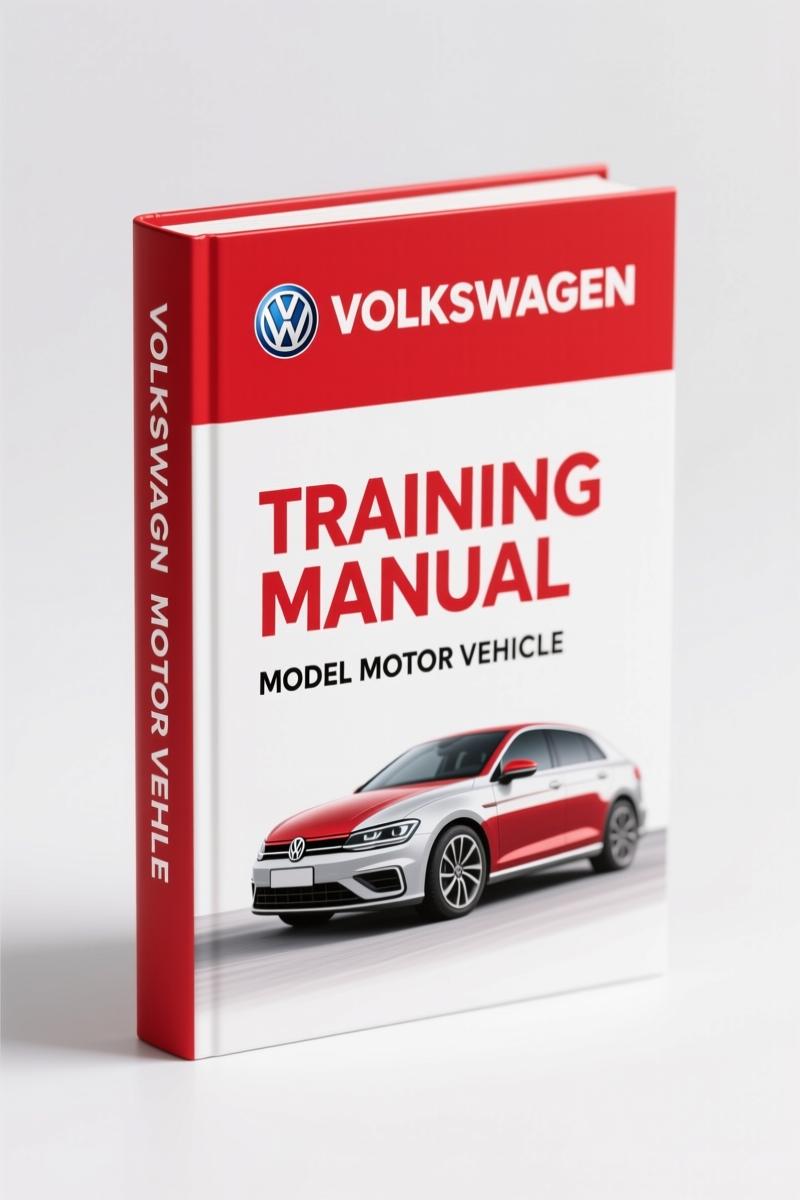
Volkswagen Motor Vehicle Training Manual – A/C Fundamentals 76 Pages
Original price was: $29.25.$22.50Current price is: $22.50.
OEM Volkswagen training manual on motor vehicle air conditioning fundamentals. 76 pages covering refrigerant circuit, system control, and diagnostics.
Description
Volkswagen Motor Vehicle Training Manual – The A/C Bible for Techs Who Care
Pull up a chair. You are staring at a compressor that won’t engage, a condenser fan that cycles at the wrong speed, or a cabin that won’t cool below 80°F. You need theory behind the charge, not a guess. That’s where this Volkswagen Motor Vehicle Training Manual comes in. At 76 pages, it is a self-study programme (SSP 208) straight from Volkswagen, not a third-party rehash. It teaches the physics of the cooling system, the function of every component in the refrigerant circuit, and the safety precautions you must follow before you crack a line. Real OEM documentation, not a translation of some online forum post.
Most aftermarket manuals skip the fundamentals and jump straight to bolt-torque tables. This one starts with why air conditioning matters for active safety and customer demand. If you have ever fought with a system that lost charge because you misidentified the expansion valve versus restrictor type, this manual ends that confusion. It covers the magnetic clutch, fluid container and drier, evaporator, and the new-generation expansion valve in plain language with cutaway diagrams. The 76 pages are packed with applied physics and refrigerant R-134a data—pressure-temperature relationships that let you interpret manifold gauge readings without guessing.
The Physics of the Cooling System
Chapter two dives into the thermodynamics of the refrigeration cycle. Understanding why the compressor raises pressure and temperature, then the condenser rejects heat, then the evaporator absorbs heat is what separates a technician who repairs from one who replaces parts. Volkswagen’s training manual explains the refrigerant circuit principle using both an expansion valve and the alternative restrictor/collecting tank design. On page 6, you get the pressure-enthalpy chart basics. This is not a workshop manual, but it gives you the diagnostic framework so you know which component failed when pressures are off. Look at the comparison between expansion valve and restrictor systems—page 12 onward details each branch of the circuit. You will learn why the fluid container and drier must be replaced after a compressor failure, a detail many DIYers overlook until the new compressor locks up again.
Cooling Fan Circuit: Engine and Condenser Cooling
Page 40 covers the radiator fan control unit J293, the circuit that pulls air across both the condenser and the radiator. A failed fan leaves your A/C head pressure sky-high, pops the compressor relief valve, and vents refrigerant. Volkswagen breaks down the fan stages and control logic. If you are working on a VW with intermittent A/C on hot days, check this circuit before condemning the compressor. The manual lays out the fan control unit’s functions clearly, so you can diagnose open loops or bad relays with a multimeter. Related diagnostics for other VW models: Volkswagen 2.3-ltr. V5 Training Manual – OEM Factory Specs and Volkswagen Passat 2005 Training Manual – Technical Overview expand on engine-specific fan control variations.
Refrigerant Circuit with Expansion Valve vs Restrictor
Two circuits exist. The expansion valve system uses a metering valve controlled by superheat; the restrictor system uses a fixed orifice and a collecting tank. Each behaves differently under load. Page 12 starts with the expansion valve circuit: compressor, condenser, fluid container and drier, expansion valve, evaporator. Then from page 24 onward, the restrictor system: the restrictor itself and the collecting tank. If you mix up the service procedures between the two, you risk slugging liquid back to the compressor or starving the evaporator. The manual shows you the component locations and operating characteristics, so you charge the system correctly and verify performance with the correct subcooling or superheat targets.
Does This Manual Cover Temperature Control?
Yes, and it goes deep. Chapter 7, starting on page 42, covers manual and automatic temperature control, system overview, control unit with operating and display unit, main temperature sensors, auxiliary signals, positioning motors, air ducting, and air distribution. If you are retrofitting or repairing automatic climate control, you need this chapter to understand the airflow doors and sensor feedback. Page 64 shifts to technical service: safety precautions, function influencing factors, fault diagnosis through pressure testing and self-diagnosis (OBD codes within the HVAC module). The manual also includes a glossary of key cooling system terminology on page 72. For brake system specifics on later VW models, see VW SSP 264 2000 Training Manual Brake Assist System OEM.
Who Needs This Manual?
DIY owners who pull a vacuum pump for the first time. Shade-tree mechanics who want to stop guessing refrigerant charge amounts. Professional techs who mentor apprentices and need a clear textbook-style explanation of vapor-compression refrigeration. Beginners who are afraid of high-side pressures—this manual removes that fear by teaching the safety protocols and system behavior. The manual also gives an overview of the automotive industry’s shift to refrigerants and future electric vehicle A/C systems (read more at Automotive Industry Overview and Electric Vehicles Guide for broader context).
Why OEM Beats Aftermarket
I have torqued enough bolts in San Antonio to know that aftermarket manuals often publish generic diagrams. This Volkswagen training manual is original factory training material. The schematics, component cross-sections, and refrigerant circuit flow paths match the actual parts in the car. No translation errors. No simplified “generic” expansion valve that doesn’t match your VW. It is the same book VW dealership techs studied. The 76 pages are dense with exactly the information you need to understand before you open a service bay door. If you want to understand cooling beyond “gas goes in, cold air comes out,” this is your document.
- Is this a repair manual with torque specs and step-by-step removal instructions?
- No. This is a training manual (SSP 208). It covers theory, component function, and circuit behavior, not disassembly procedures. Use it alongside a Workshop Manual for repairs.
- How many pages and does it include R-134a data?
- 76 pages. Yes, the refrigerant section on pages 8–11 covers R-134a properties, pressure-temperature tables, and the phase diagram. Good for interpreting gauge readings under different ambient temperatures.
Stop chasing parts when the real problem is lack of understanding. Grab the factory literature that teaches you cold, hard fundamentals. Access the Factory Manual and keep it in your tablet or printed binder. Your A/C system will thank you, and so will your customers.
Additional information
| Brand | Volkswagen |
|---|---|
| Language | English |
2 reviews for Volkswagen Motor Vehicle Training Manual – A/C Fundamentals 76 Pages
You may also like…
-
Sale!

Volkswagen Passat 1995 Repair Manual – Factory Wiring & Engine Specs
Original price was: $57.20.$40.00Current price is: $40.00. -
Sale!

Volkswagen Serie C 2003 Service Manual – OEM Factory Specs
Original price was: $53.60.$40.00Current price is: $40.00. -
Sale!

Volkswagen Golf Jetta GTI Service Manual – 4954 Pages Official Specs
Original price was: $95.55.$65.00Current price is: $65.00. -
Sale!

Volkswagen Phaeton Training Manual – Auxiliary Heater System (52 pages)
Original price was: $55.80.$45.00Current price is: $45.00.
Related products
-
Sale!

1994 Troubleshooting Manual – International 1000-4000 FBC
Original price was: $60.00.$50.00Current price is: $50.00. -
Sale!
2004 Acura TSX Wiring Diagram – 73-Page Factory Electrical Schematics
Original price was: $15.88.$9.99Current price is: $9.99. -
Sale!
1993 Electrical Schematic – International 1000/3000/4000 Bus Chassis OEM Wiring Diagrams
Original price was: $29.26.$22.00Current price is: $22.00. -
Sale!
1991 Electrical Schematic – 112-Page OEM Wiring Diagram for International 1000-3000 Series
Original price was: $22.75.$17.50Current price is: $17.50.
gearhead88 –
I am very pleased with this transaction. It is very easy to read on my laptop without losing quality. It assisted me to repair my Volkswagen Motor electrical system. Highly recommended for mechanics.
David K. –
This is just what I needed. The scan is high-quality and easy to navigate. A must-have for any Volkswagen Motor mechanic doing repairs. I will recommend this shop to others.