
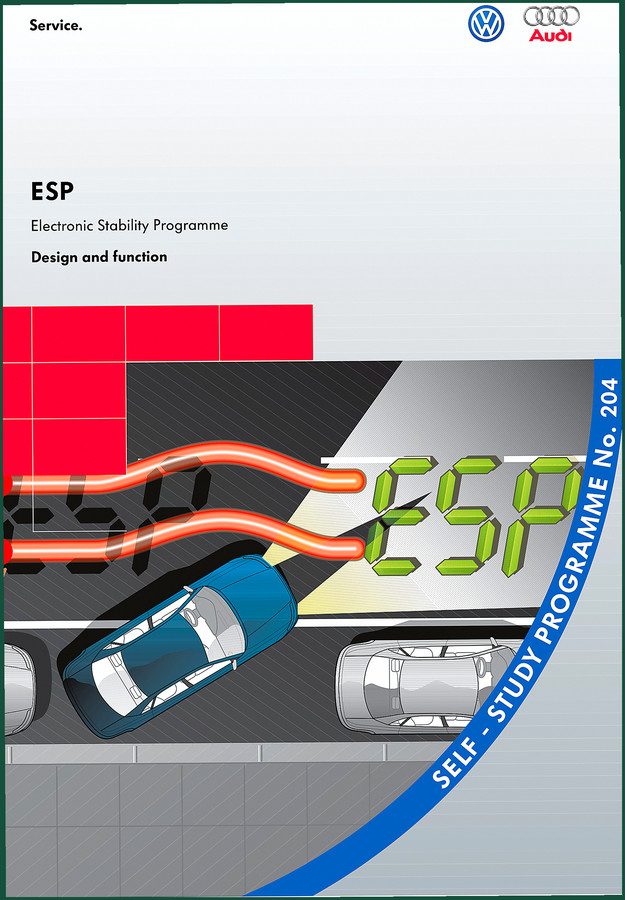
Volkswagen ESP Training Manual – OEM Factory Diagnostics
Original price was: $41.10.$30.00Current price is: $30.00.
Factory Volkswagen ESP Training Manual (64 pages). Covers Bosch & ITT system design, self-diagnosis, functional diagrams. OEM-level technical documentation.
Description
Volkswagen ESP Training Manual – OEM Factory Training for Electronic Stability Programme
I’ve been turning wrenches longer than some of you have been alive. And I’ll tell you straight: nothing screws up a brake job faster than bad data on a stability control system. This Volkswagen ESP Training Manual is a 64-page factory document, not some aftermarket reprint. It’s the same book VW techs used when I was still learning. You want to understand how the Electronic Stability Programme works before you start swapping parts? This is where you start. The manual title says “Self-Study Programme No. 204” – that’s because it’s a training resource, not a workshop manual. But if you’re diagnosing ESP faults, you need the physics and system logic first. Aftermarket documentation? I’ve seen wiring diagrams that belong on a cereal box. Not here.
Basic Physical Principles – The Foundation of ESP Diagnostics
The manual starts with the basics – and I mean real basic. Page 7 covers the physical principles that make ESP work: friction, yaw, lateral acceleration, slip angles. You’d be surprised how many techs skip this. Then when the car won’t stop pulling left after an alignment, they blame the ABS module. Page 9 dives into driving dynamic control – understeer, oversteer, and how the system intervenes. If you don’t get that, you’ll never understand why a steering angle sensor reading off by 2 degrees makes ESP light come on. This section is pure gold. No fluff – just the math that explains why the system behaves the way it does.
BOSCH and ITT Automotive – Two System Versions in One Manual
Most aftermarket manuals treat ESP like it’s one generic black box. Not this one. Volkswagen used two different ESP suppliers – BOSCH (starting page 14) and ITT Automotive (starting page 36). Each has a separate system overview, design and function breakdown, functional diagram, and self-diagnosis section. That’s four chapters of content you won’t find in a single Chilton book. The VW Audi ESP Design and Function page on AutoRepairManuals links directly to the factory training data. If you’re working on a Golf with BOSCH 5.3, you turn to page 14. If it’s an ITT MK60, page 36. Simple. The functional diagrams on page 32 (BOSCH) and page 56 (ITT) show the exact sensor inputs and actuator outputs. Wire colors, connector pinouts – all there.
Self-Diagnosis: Following the Factory Procedure
Page 34 and page 58 cover self-diagnosis for both systems. This isn’t a generic DTC chart. It’s the factory test routine – how to access control unit, read measured values, and interpret actuator tests. For example, the ESP control unit checks the yaw rate sensor, lateral acceleration sensor, steering angle sensor, and wheel speed sensors. The manual tells you which values to monitor with VAG-COM or equivalent scan tool. I’ve seen guys replace a hydraulic unit when the problem was a misaligned steering angle sensor. The self-diagnosis section would have caught that in five minutes. If you want to cut down diagnostic time, this is where you live. Related to this, the Volkswagen 2.3ltr V5 Training Manual – OEM Factory Specs”>Volkswagen 2.3ltr V5 Training Manual covers drivetrain systems that interact with ESP. Also check the Volkswagen Passat 2005 Training Manual – Technical Overview”>Passat 2005 Training Manual for full vehicle integration. The VW SSP 264 2000 Training Manual Brake Assist System OEM”>SSP 264 Brake Assist Manual complements the ESP training perfectly.
What This Manual WON’T Do – And Why That’s a Good Thing
I need to be clear: this is not a workshop manual. It doesn’t list torque specs, fluid capacities, or removal procedures. The cover says it explicitly: “The Self-Study Programme is not a Workshop Manual.” What it gives you is the engineering knowledge behind ESP. You need both. Once you understand how the system works, a repair manual makes sense. Without this understanding, you’re guessing. The manual references the Automotive Industry Overview”>Automotive Industry Overview for context on evolution of brake systems, and it mentions Manual Transmission”>Manual Transmission briefly in the driving dynamics section. But the core is ESP design and function. If you’re a DIYer wanting to fix an ESP light, this manual alone won’t get you through the repair. But it will tell you exactly what to test, what signals to look for, and how the system decides to activate. That’s more than most shops have.
64 Pages of OEM Training – Every Page Counts
The entire manual runs 64 pages, from introduction through service. Chapter names exactly as they appear: Introduction, Basic physical principles, Driving dynamic control, Overview, BOSCH (system overview, design and function, functional diagram, self-diagnosis), ITT Automotive (same structure), and Service. The Service chapter (page 60) gives you general service hints – bleeding procedures, special tools, and retrofit notes. No filler. No fluff. Every diagram is from Volkswagen’s own engineering department. This is the same material used in dealer training centers. Trying to diagnose a VW ESP problem without this is like rebuilding an engine without knowing the firing order. Get the full factory data.
Frequently Asked Questions
- Can I use this manual to replace an ABS pump on my Golf?
- No. This is a training manual, not a workshop manual. It will not give you torque specs or removal steps. You need a separate factory repair manual for that.
- Does it include wiring diagrams for ESP?
- It includes functional diagrams (pages 32 and 56) that show the electrical connections between control unit, sensors, hydraulic unit, and actuator. Not full vehicle wiring, but enough to trace signal paths. For detailed pinouts, check the self-diagnosis sections.
- Is this the same manual used in VW dealer training?
- Yes. Self-Study Programme 204 was developed by Volkswagen AG for technician training. It covers ESP versions from BOSCH and ITT Automotive as used in VW and Audi vehicles. The content is identical to what dealer techs study.
- How do I use the self-diagnosis section to troubleshoot an ESP light?
- First, read pages 34–35 (BOSCH) or pages 58–59 (ITT). The manual lists which measured value blocks to check: wheel speeds, yaw rate, lateral acceleration, steering angle. Connect VCDS or equivalent, go to the ESP control module address 03, then navigate to Measured Values – Input signals. Compare actual values to specified ranges in the manual. If steering angle sensor shows 10° with wheels straight, you’ve found your fault. This procedure is factory-specified and rarely fails.
Look, I’m not selling you a manual that holds your hand through bleeding brakes. I’m selling you the engineering knowledge that separates a parts-changer from a real technician. The Volkswagen ESP Training Manual is a 64-page OEM document that explains exactly how Electronic Stability Programme operates. If you’re working on modern VW/Audi and the ESP light is on, you need this. Access the Factory Manual from AutoRepairManuals and stop guessing.
Additional information
| Brand | Volkswagen |
|---|---|
| Language | English |
2 reviews for Volkswagen ESP Training Manual – OEM Factory Diagnostics
You may also like…
-
Sale!

Volkswagen Passat 1995 Repair Manual – Factory Wiring & Engine Specs
Original price was: $57.20.$40.00Current price is: $40.00. -
Sale!

Volkswagen Golf Jetta GTI Service Manual – 4954 Pages Official Specs
Original price was: $95.55.$65.00Current price is: $65.00. -
Sale!

Volkswagen Serie C 2003 Service Manual – OEM Factory Specs
Original price was: $53.60.$40.00Current price is: $40.00. -
Sale!

Volkswagen Phaeton Training Manual – Auxiliary Heater System (52 pages)
Original price was: $55.80.$45.00Current price is: $45.00.
Related products
-
Sale!

1993 Operators Manual – International Bus 1000-3000 OEM Specs
Original price was: $12.30.$7.99Current price is: $7.99. -
Sale!
1993 Electrical Schematic – International 1000/3000/4000 Bus Chassis OEM Wiring Diagrams
Original price was: $29.26.$22.00Current price is: $22.00. -
Sale!

1991 Operators Manual – International Truck OEM Specs (108 Pages)
Original price was: $13.63.$10.99Current price is: $10.99. -
Sale!
1994 Troubleshooting Manual – International 1000-4000 FBC
Original price was: $60.00.$50.00Current price is: $50.00.
James L. –
Five stars! It is very easy to read on my iPad without blur. It helped me to repair my Volkswagen ESP transmission. Highly recommended for mechanics.
Robert M. –
Great workshop guide. The text is searchable and easy to navigate. It assisted me to troubleshoot my Volkswagen ESP engine. I will definitely buy again.