
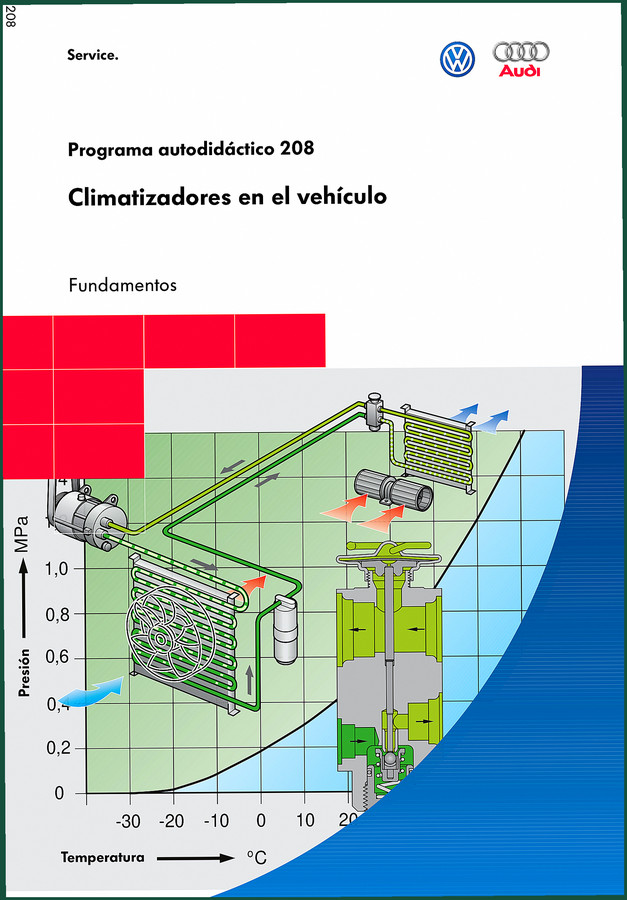
Volkswagen 208 Technical Manual – A/C Fundamentals
Original price was: $28.80.$22.50Current price is: $22.50.
Factory-level understanding of A/C systems: R134a, compressor, expansion valve, and service safety protocols in 37 pages.
Description
If you’ve ever chased an intermittent AC cutout or blown a compressor because a clutch gap was off, you know the frustration of guessing. Factory documentation for the Volkswagen 208 Technical Manual doesn’t treat AC as a black box. It walks through the refrigeration cycle from first principles — the physics of pressure and temperature, the behavior of R134a, and why an expansion valve that looks fine can still starve an evaporator. This is the 37-page self-study program (Programa autodidáctico 208) Volkswagen gave its own techs before they touched a recovery machine.
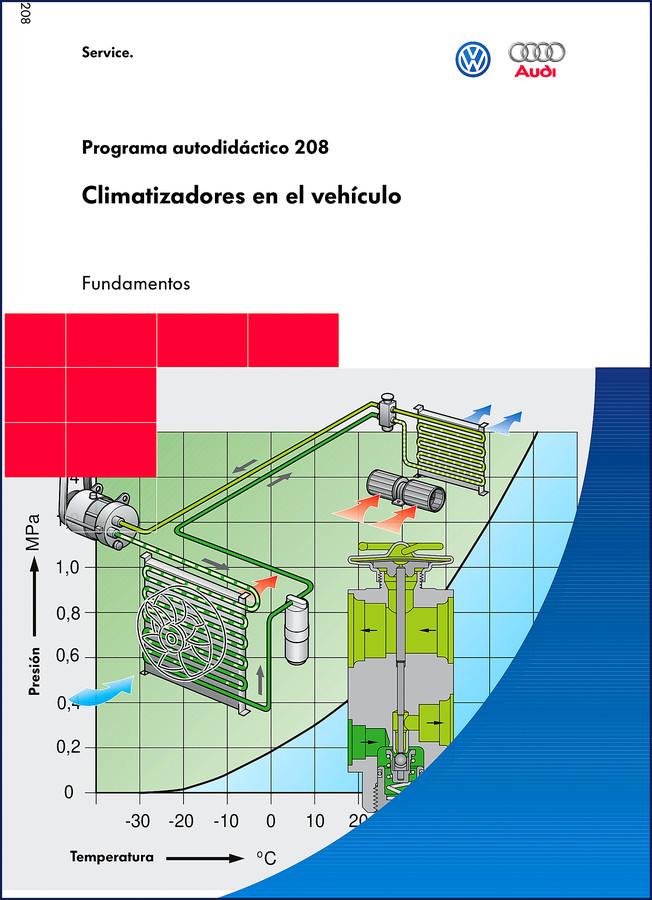
Spanning pages 4 through 72, the manual covers refrigerant theory, refrigeration circuit layouts (expansion valve and orifice tube systems), compressor operation, condenser and evaporator function, system regulation including protection components, radiator fan management, and a dedicated service section with safety procedures and pressure-based diagnostics. It stays at the conceptual level — no part numbers or vehicle-specific torque values — but that’s not a flaw. Techs who skip the physics end up misdiagnosing pressures on the gauge set or replacing components that were actually fine. This manual fixes that gap.
What This 37-Page Volkswagen 208 Technical Manual Actually Covers
Four major sections: Refrigeration Physics (page 6), Refrigerant (page 8), Refrigeration Technique (page 12), and System Regulation (page 32). The physics section explains the pressure-temperature relationship of R134a using a real p-t diagram. Page 8 covers refrigerant properties and handling. The refrigeration technique chapters break down every component in the loop — compressor with electromagnetic clutch, condenser, receiver/drier, expansion valve (including the newer generation), evaporator, and the orifice tube version with accumulator. Then system regulation covers fan management, temperature control (manual and automatic), servomotors, air distribution, and recirculation. The service technique section starting on page 64 includes safety measures, operating influences, pressure test diagnostics, and OBD self-diagnosis.
Refrigeration Physics: Why You Need to Understand the Basics
You cannot interpret gauge readings without grasping what happens inside the accumulator or why subcooling matters. This manual devotes four pages to applied physics — latent heat of vaporization, pressure/enthalpy diagrams, and what happens when refrigerant changes state. That’s the difference between swapping a compressor because head pressure is high and realizing the condenser fan resistor is shot. The manual uses MPa scales, so for reference: 1.0 MPa is about 145 psi. Keep that in mind when reading the charts.
Refrigerant (Agente Frigorífico): R134a and Service Hazards
One of the earliest chapters covers R134a specifically — its boiling point, critical temperature, and why it replaced R12. More importantly, it touches on the service implications: pressure limits, handling precautions, and the environmental regulations that affect recovery. If you work on VW cars from the late 90s and 2000s, this is the refrigerant they used. The manual also explains the oil return characteristics and why overcharging oil kills efficiency.
System Regulation and Temperature Control: Manual vs. Automatic
Two distinct regulation strategies are covered: manual HVAC and automatic climate control. The manual explains the control modules, temperature sensors (interior, ambient, evaporator), and servomotor actuation. Page 40 covers the radiator fan control module J293, which is a common failure point on VWs. The automatic regulation section includes a system overview and the interaction between sun load sensor, footwell temperature, and fresh air flap position. For diagnostics, understanding these signals is what separates replacing a control head from finding a broken wire in the door boot.
Service Technique: Safety and Diagnostics
Starting on page 64, this section lists safety measures for working with high-pressure refrigerant and the electrical system. It also covers pressure test diagnostics — reading the high and low side to identify restrictions, compressor issues, or overcharging. Self-diagnosis via the HVAC control head or scan tool is outlined. This is where you learn to tell the difference between a failed expansion valve and a clogged receiver/drier without throwing parts at it. For related repair data on fluid capacities and bolt torques, check Volkswagen Fluid Capacities and Repair Data for your specific model.
Who Should Use This Manual?
Beginners who want to understand why an AC system works — not just which tube to replace. Home garage enthusiasts who own a VW 208 (or any similar era VW with R134a) and want to diagnose their own AC without guessing. Also useful for experienced techs who haven’t touched AC theory since trade school and need a refresher on refrigeration cycles. This is not a step-by-step repair guide for a specific vehicle; it’s the background knowledge that makes repair manuals make sense. Pair it with a factory repair manual for your exact model, like 2001 Volkswagen GTI GLS 1.8L 4-Cylinder Turbo Manual or the VW 1.8L 4-Cylinder Turbo 5-Valve Article Text for engine-related work. For a broader look at the industry, the Automotive Industry Overview can provide context on how AC systems evolved.
FAQ
- Does this manual include torque specs for AC components?
- No. This is a self-study program on fundamentals, not a repair manual. You need a separate factory manual for torque values.
- What refrigerant does it cover?
- The manual focuses on R134a and its properties — pressure-temperature relationship, oil compatibility, and service precautions. It does not cover R1234yf or R12 in detail. If your vehicle uses R134a, this manual will explain the refrigeration cycle and diagnostic theory behind it. The physics chapters are transferable to other refrigerants, but the specific data points (like boiling point at given pressures) are for R134a. For example, at 0.2 MPa (about 29 psi), R134a boils at around -10°C (14°F). That’s the kind of data you’ll work with.
- Can I use this to fix my VW AC right now?
- Only if you already know which components are in your car and have a repair manual for vehicle-specific steps. This manual teaches you how the system works, not which screw to turn.
- Is this the same as a factory repair manual?
- No. Volkswagen calls it a self-study program (Programa autodidáctico). It is supplementary training material. You still need the official service documentation for repair procedures, wiring diagrams, and torque values. For transmission info, see Manual Transmission resources.
Bottom line: if you want to stop chasing AC ghosts and start diagnosing from understanding, pick up the Volkswagen 208 Technical Manual. It covers the fundamentals that most quick-fix guides skip. Access the Factory Manual from AutoRepairManuals and keep it on your bench next to your gauge set.
Additional information
| Brand | Volkswagen |
|---|---|
| Language | English |
2 reviews for Volkswagen 208 Technical Manual – A/C Fundamentals
You may also like…
-
Sale!

Volkswagen Phaeton Training Manual – Auxiliary Heater System (52 pages)
Original price was: $55.80.$45.00Current price is: $45.00. -
Sale!

Volkswagen Passat 1995 Repair Manual – Factory Wiring & Engine Specs
Original price was: $57.20.$40.00Current price is: $40.00. -
Sale!

Volkswagen Golf Jetta GTI Service Manual – 4954 Pages Official Specs
Original price was: $95.55.$65.00Current price is: $65.00. -
Sale!

Volkswagen Serie C 2003 Service Manual – OEM Factory Specs
Original price was: $53.60.$40.00Current price is: $40.00.
Related products
-
Sale!

2011 Parts Catalog – International 7400 SFA 6X6 – 1886 Pages of OEM Part Numbers
Original price was: $32.00.$25.00Current price is: $25.00. -
Sale!

1996 Operators Manual – International 1000-4000 Series (246 pages)
Original price was: $15.28.$9.99Current price is: $9.99. -
Sale!

2006 Service Manual – International DT 466E, 530E Diesel Engine
Original price was: $67.50.$50.00Current price is: $50.00. -
Sale!

2011 Parts Catalog – International Truck OE Parts Documentation (1786 Pages)
Original price was: $34.50.$25.00Current price is: $25.00.
David K. –
Perfect OEM spec sheet. The scan is high-quality and well indexed. Every torque spec is included for Volkswagen 208. Saves me hundreds of time.
Richard G. –
I am very pleased with this purchase. The pages are clean and easy to navigate. Every wiring layout is included for Volkswagen 208. Saves me a lot of dollars.