
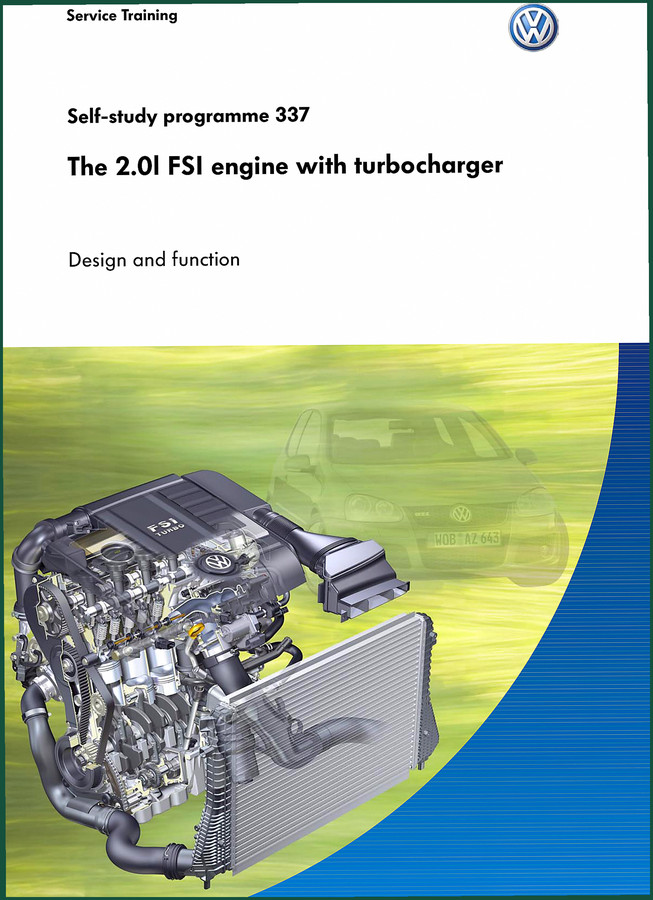
Volkswagen 2.0L FSI Training Manual – OEM Turbo Engine Design
Original price was: $56.63.$37.50Current price is: $37.50.
Factory training manual for Volkswagen 2.0L FSI turbo engine: 28 pages of design, management, and service data from OEM self-study programme.
Description
Volkswagen 2.0L FSI Training Manual – SSP 337
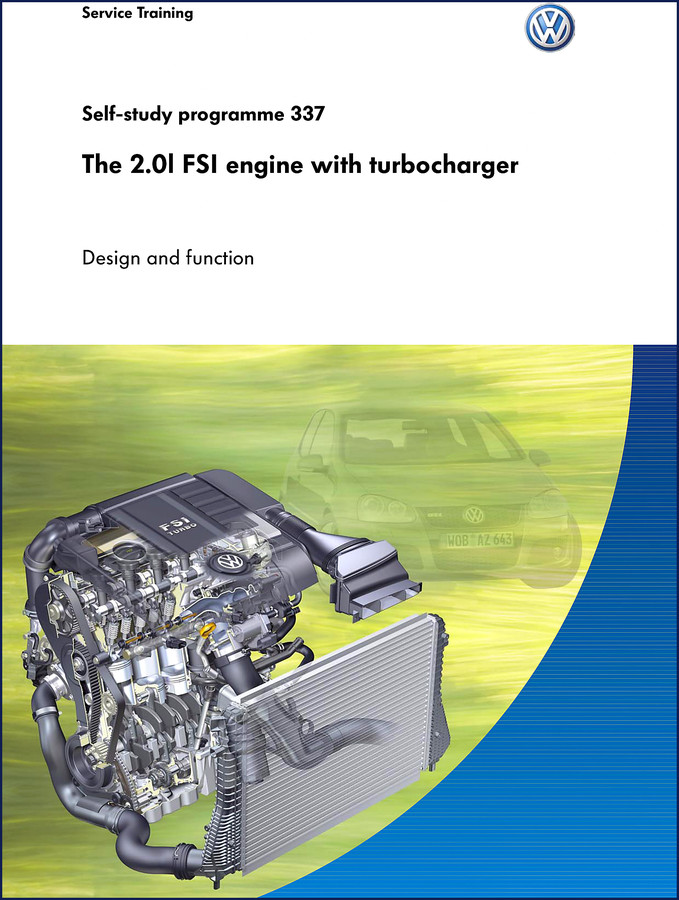
If you are diving into a Volkswagen 2.0L FSI engine with a turbocharger, the Training Manual (SSP 337) is what you want on your bench. I have seen too many guys open a generic aftermarket PDF and then wonder why the turbo comes off wrong or the balancer shaft gear rattles. This is the factory self-study programme – 28 pages of what VW actually teaches their own techs. It is not a service manual, but it explains the design and function so you understand why the torque sequence matters before you pick up a wrench.
The manual starts with an introduction to the 2.0l turbo FSI engine, derived from the AXW code. The exhaust manifold and turbocharger form a single unit – a clamping flange attachment that is customer-service friendly. The crankshaft mechanics, pistons, and conrods were beefed up for boost. That decoupled drive chain sprocket on the balancer shaft gear? Page 5 shows how it works like a dual-mass flywheel. Skip that understanding and you risk chain noise or a balancer failure at 60k miles.
Go ahead and pair this with the Volkswagen 2.3-ltr. V5 Training Manual – OEM Factory Specs”>Volkswagen 2.3-ltr. V5 Training Manual – OEM Factory Specs if you work on the older five-cylinders. For the 2005 Passat platform, the Volkswagen Passat 2005 Training Manual – Technical Overview”>Volkswagen Passat 2005 Training Manual – Technical Overview covers the chassis side. And the brake system on these cars? The VW SSP 264 2000 Training Manual Brake Assist System OEM”>VW SSP 264 2000 Training Manual Brake Assist System OEM gives you the ABS and ESC logic.
Engine Mechanics: What the Turbo FSI Changes
Pages 4 through 6 walk through the bottom end. The piston and conrod are specific to the turbo – higher compression strength, different wrist pin offset. The crankshaft has been adapted to handle the torque spike. The manual explains the balancer shaft gear with that decoupled drive chain sprocket – a design that cuts vibration without a separate balance shaft. If you are rebuilding one, you need the factory orientation of the balance shaft timing marks. Aftermarket manuals often leave this out. You will find it on page 6 of the Training Manual.
Engine Management: 3 Systems You Must Understand
The engine management section (pages 12–23) covers the critical controls. First, the turbocharger air recirculation valve N249 – it prevents compressor surge when you lift off the throttle. Second, the solenoid valve for charge pressure control N75 – it regulates wastegate duty. Third, the continuously variable valve timing on the inlet camshaft (42° crankshaft adjustment range). The manual shows the airflow path and sensor positions. You will not find this level of detail in a Haynes. For a broader look at modern engine control trends, check the Automotive Industry Overview”>Automotive Industry Overview for context on direct injection evolution.
Does the Training Manual Cover Service Procedures?
No – and do not confuse this with a workshop manual. The self-study programme is for understanding design and function. The service section (page 24) only gives an overview of the clamping flange and turbocharger removal. For actual torque specs and repair sequences, you need the corresponding service literature (usually a Bentley or ELSA). But this Training Manual is essential before you touch a turbo FSI because it explains the reasoning behind the bolt patterns and sealant locations. The test your knowledge section (page 26) is worth working through – it flags common oversights that VW expects their techs to know.
3 Reasons to Use OEM Training Documentation
First, factory illustrations. The cutaway view on page 4 showing the exhaust manifold and turbo as one unit – aftermarket diagrams often draw them as separate parts. Second, the torque sequence logic is implied in the assembly order. Third, the warning note on page 2 states these contents are not updated, but for a 2005-era engine the design has not changed. I have seen aftermarket manuals swap the intake and exhaust cam specs on the 2.0T. That costs a valve job. Stick with OEM. For background on manual transmission variants that bolt to this engine, see Manual Transmission”>Manual Transmission on Wikipedia.
Test Your Knowledge: Page 26 Practical Questions
This is not fluff. The quiz covers turbocharger charge pressure, balancer shaft alignment, and valve timing adjustment. If you cannot answer those after reading, you are not ready to crack this engine open. I recommend taking the quiz, then reviewing the engine management diagrams again. It will save you a diag session later.
- Is this manual the same as a repair manual?
- No. It is a design and function training guide. Use it before you touch the vehicle, then follow a factory service manual for repairs.
- Does it include torque specifications?
- Not as a numbered list. The assembly illustrations show bolt positions and tightening order. For torque values you need the separate service literature.
- What engines does it cover beyond the 2.0L FSI turbo?
- Only the 2.0l turbo FSI (engine codes BPY, BWA, etc.). It references the 2.0l naturally aspirated FSI (AXW) for comparison but does not cover that engine in full.
- Will this help me diagnose a no-boost condition on a 2006 VW Jetta 2.0T?
- It will explain how the N75 and N249 valves work, the charge air system layout, and the recirculation valve bypass. That alone cuts diagnostic time in half. Pair it with a wiring diagram from an ELSA manual and you will nail the problem.
Here is a 28-page Training Manual that tells you exactly how the engineers designed the 2.0L FSI turbo. No generic aftermarket rewrite – just factory training material. Access the Factory Manual and put it on your tablet while you work the next FSI turbo.
Additional information
| Brand | Volkswagen |
|---|---|
| Language | English |
2 reviews for Volkswagen 2.0L FSI Training Manual – OEM Turbo Engine Design
You may also like…
-
Sale!

Volkswagen Serie C 2003 Service Manual – OEM Factory Specs
Original price was: $53.60.$40.00Current price is: $40.00. -
Sale!

Volkswagen Golf Jetta GTI Service Manual – 4954 Pages Official Specs
Original price was: $95.55.$65.00Current price is: $65.00. -
Sale!

Volkswagen Phaeton Training Manual – Auxiliary Heater System (52 pages)
Original price was: $55.80.$45.00Current price is: $45.00. -
Sale!

Volkswagen Passat 1995 Repair Manual – Factory Wiring & Engine Specs
Original price was: $57.20.$40.00Current price is: $40.00.
Related products
-
Sale!

2005 Parts Catalog – International NGD 3.0 L Engine (77 pages)
Original price was: $44.70.$30.00Current price is: $30.00. -
Sale!

1995 Operators Manual – International 1000-4000 Series | OEM Documentation
Original price was: $12.49.$9.99Current price is: $9.99. -
Sale!
1992 Electrical Schematic – OEM Wiring Diagrams for International 1000-3800
Original price was: $24.48.$18.00Current price is: $18.00. -
Sale!

2011 Parts Catalog – International Truck OE Parts Documentation (1786 Pages)
Original price was: $34.50.$25.00Current price is: $25.00.
David K. –
This is exactly what I needed. The PDF is high resolution. A must-have for any Volkswagen 2.0L owner doing maintenance. Saved my repair job! Thank you.
Thomas B. –
Excellent factory service manual. Quick access after payment. Every wiring layout is included for Volkswagen 2.0L. Great value for money.