

Toyota Torque Converter Training Manual – Factory Diagnostics
Original price was: $46.20.$30.00Current price is: $30.00.
Factory Toyota training manual covering torque converter components, flow types, and failure diagnosis. 15 pages, OEM certified.
Description
Toyota Torque Converter Training Manual
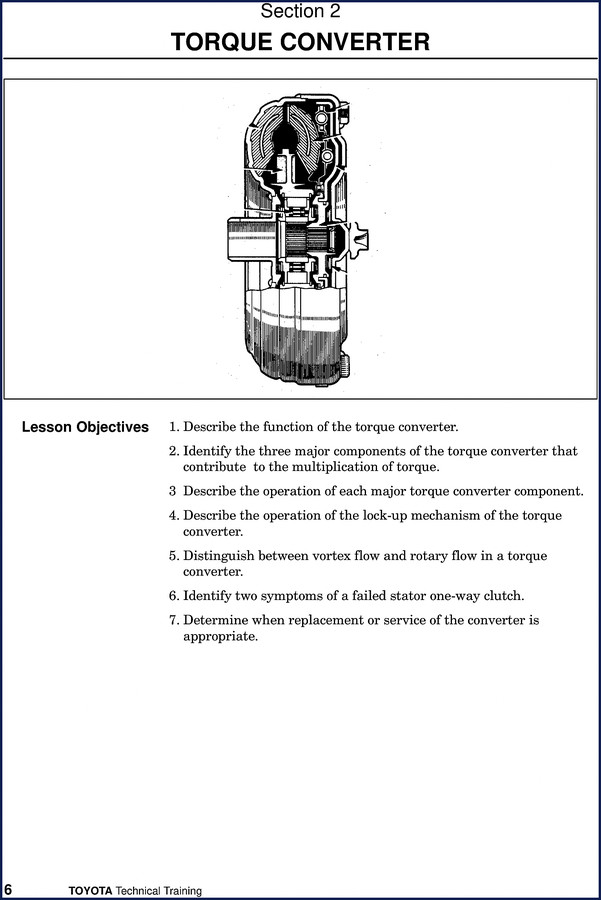
If you’re chasing a torque converter shudder or a stator that won’t lock up, you don’t need a generic write-up. You need the factory training material. I’ve been wrenching long enough to know that skipping the fundamentals costs you billable hours. This Toyota Torque Converter Training Manual is 15 pages of hard data—no filler, no third-party guesses. It comes straight from Toyota Technical Training, and it’s meant for techs who want to understand what’s happening inside that bellhousing before they start throwing parts at it.
The manual opens with a set of lesson objectives that tell you exactly what you’ll walk away with. Page 1 lists six clear goals: describe torque converter function, identify the three major components, describe lock-up mechanism operation, distinguish between vortex and rotary flow, identify two symptoms of a failed stator one-way clutch, and determine when replacement is appropriate. That’s a solid diagnostic checklist right there. Page 2 dives into the role of the converter as a torque multiplier, an automatic clutch, a vibration damper, and an oil pump driver. If you’ve ever had a customer complain about low line pressure and didn’t check converter hub drive, you know why this matters.
Three Major Torque Converter Components: Pump, Turbine, Stator
The OCR excerpt pages show exactly what you get: the pump impeller integrated into the converter case with curved vanes, the turbine runner, and the stator between them. A guide ring inside the vanes directs fluid flow. This isn’t a generic diagram—it’s the factory training slide set. Because the stator’s one-way clutch is a common failure point, the manual covers how to test it without guesswork. You get straight talk about vortex flow (the torque-multiplying circulation) versus rotary flow (the spin of the whole fluid mass). That distinction alone saves you from swapping a good converter for a bad pump.
Does It Cover Lock-Up Mechanism Diagnostics?
Yes. Lesson objective four explicitly addresses lock-up operation. The manual explains that when the converter locks, you get a mechanical connection between engine and transmission, eliminating slip. It tells you what happens inside the clutch piston and how the hydraulic circuits engage it. No pie-in-the-sky theory—just the sequence a Tech II instructor would walk you through. If you’ve ever had a torque converter clutch (TCC) code and didn’t know whether to blame the solenoid or the converter, this material gives you the diagnostic path.
Vortex Flow vs. Rotary Flow: Why You Need to Know the Difference
Look, I’ve seen guys replace a torque converter because of a stall-speed complaint when the real issue was a failed stator clutch causing no torque multiplication. The manual splits these two flow types clearly. Vortex flow is the circular fluid movement between impeller and turbine that multiplies torque at low speeds. Rotary flow is the whole fluid mass spinning with the converter. If the stator freewheels both ways, you lose vortex flow. Page 2 shows how that kills your off-idle acceleration. This is the kind of detail that separates a parts-changer from a diagnostician.
Get the Right Diagnosis by Understanding Stator One-Way Clutch Failure
The manual lists two specific symptoms of a failed stator clutch: poor acceleration from a stop and excessive heat. It doesn’t give you a vague “may cause shudder.” It tells you to check the clutch’s ability to hold in one direction and freewheel in the other. I’ve used that test more times than I can count. You pull the converter, lay it on the bench, and try to rotate the stator hub. If it locks both ways or spins free both ways, it’s done. That’s page 2 content, straight from Toyota.
Why Factory Training Beats Aftermarket Manuals
Aftermarket transmission guides often combine multiple brands and ditch the OEM logic. This Toyota Torque Converter Training Manual is exactly what a Toyota technician would have sat through in Course 262. It’s not a reprint of a Chilton book. Every diagram, every callout, every torque phrase comes from the manufacturer. When the manual says “the impeller is integrated with the converter case,” that’s the language you need to communicate with parts guys and warranty reps. No translation needed.
Who needs this manual? Garage owners training new hires. DIY guys who want to understand why their Toyota Corolla shudders at 40 mph. Anyone rebuilding an A340E or A650E transmission. It’s 15 pages—short enough to read in an hour, dense enough to reference on the bench for years. Pair it with Unit Two General Engine Diagnosis HEV IC Engine”>Unit Two General Engine Diagnosis HEV IC Engine or the TOYOTA ENGINE SIMULATOR Training Manual 4A-FE”>TOYOTA ENGINE SIMULATOR Training Manual 4A-FE for a full powertrain education. The Toyota 2C Engine Simulator Training Manual”>Toyota 2C Engine Simulator Training Manual also fits the same training track.
For context on how automatic transmissions differ from manuals, the Manual Transmission”>Manual Transmission article gives you a contrast. And if you want the bigger picture of vehicle technology trends, Automotive Industry Overview”>Automotive Industry Overview rounds out the picture.
- Can I rebuild a torque converter using this manual?
- No. This is a training manual, not a rebuild guide. It covers theory and diagnostics.
- What’s the difference between vortex flow and rotary flow as taught in this manual?
- Vortex flow is the fluid circulation between impeller and turbine that multiplies torque when the stator holds. Rotary flow is the entire fluid mass rotating with the converter once the turbine speed catches up. The manual distinguishes them clearly on page 2, showing how one turns into the other as vehicle speed increases. Misunderstanding that cost me three hours on a Lexus LS400 once.
This isn’t a generic PDF—it’s the actual 15-slide training module Toyota uses to certify transmission techs. You get the same material instructors hand out in Course 262. Access the Factory Manual and put it on your bench. Stop guessing about flow dynamics. Start using data that was written for the guys who build these units.
Additional information
| Brand | Toyota |
|---|---|
| Language | English |
2 reviews for Toyota Torque Converter Training Manual – Factory Diagnostics
You may also like…
-
Sale!

Toyota 5FBE10, 5FBE13, 5FBE15, 5FBE18, 5FBE20 Service Manual – 463 Pages
Original price was: $102.05.$65.00Current price is: $65.00. -
Sale!
Toyota 5FBE10, 5FBE15, 5FBE18, 5FBE20 Service Manual – 463 Pages
Original price was: $102.05.$65.00Current price is: $65.00. -
Sale!

Toyota 7FGU35 7FGU80 2005 Service Manual – 136 Pages Official Factory Data
Original price was: $82.55.$65.00Current price is: $65.00. -
Sale!

Toyota 6FGCU33, 6FGCU45 1997 Service Manual – Factory Forklift Repair
Original price was: $94.25.$65.00Current price is: $65.00.
Related products
-
Sale!

Service Manual – International HS 2.8L Engine – 130 Pages of Factory Specs
Original price was: $56.40.$40.00Current price is: $40.00. -
Sale!

1989 Service Manual – International 2000-8000 Electrical Systems
Original price was: $72.00.$50.00Current price is: $50.00. -
Sale!
2004 Acura TSX Wiring Diagram – 73-Page Factory Electrical Schematics
Original price was: $15.88.$9.99Current price is: $9.99. -
Sale!

International 1000-3000 Series Operators Manual – 132 Pages of OEM Specs
Original price was: $14.40.$10.99Current price is: $10.99.
David K. –
Perfect workshop guide. It is easily zoomable on my tablet without losing quality. A must-have for any Toyota Torque DIYer doing maintenance. I will recommend this shop to others.
gearhead88 –
This is exactly what I was looking for. It is very easy to read on my tablet without blur. Every wiring layout is included for Toyota Torque. I will recommend this shop to others.