
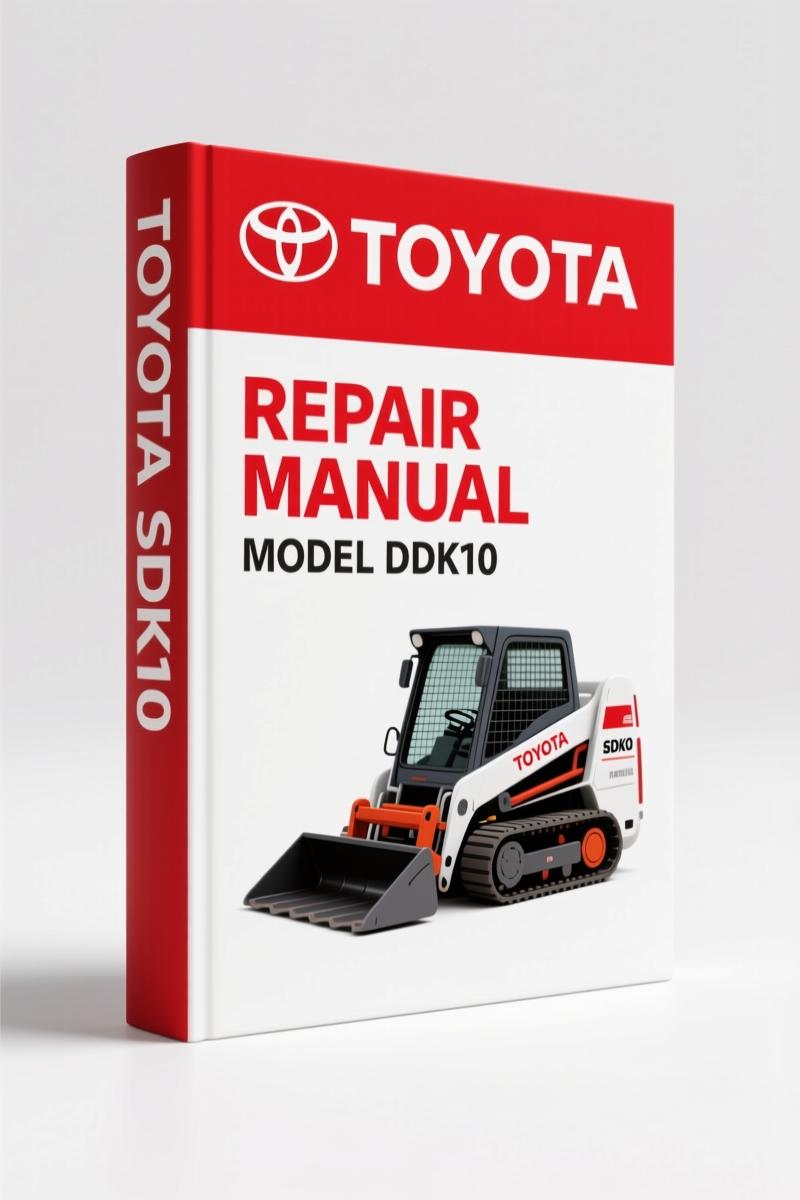
Toyota SDK10 1989 Repair Manual – Factory Specs for Skid Steer Loader
Original price was: $58.50.$45.00Current price is: $45.00.
Factory-certified 238-page repair manual for Toyota SDK10 skid steer loader. Torque specs, engine overhaul, HST diagnostics, suspension, brakes.
Description
Toyota SDK10 1989 Repair Manual
Let me tell you something about these skid steer loaders – the SDK10 is a solid machine, but the second you start guessing on torque values or hydraulic pressures, you’re writing a check your shop can’t cash. I’ve seen guys snap bolts off in the final reduction gear housing because they pulled a number off a forum. That cost them a weekend and a new gear set. The Toyota SDK10 1989 Repair Manual is what you need sitting on the bench while you work. This is the factory document – not some aftermarket rehash with missing pages.
Standard bolt and nut tightening torque is right on page 0-5. You want to know what a precoated bolt needs? That’s on page 0-7. Toyota didn’t leave any guesswork in this manual. The appendix includes an SST list, service standards, and a full wiring diagram – 238 pages of procedures that match what the factory engineers intended. If you’ve ever had a hydrostatic transmission start whining because you got the charge pressure wrong, you know exactly what I mean. That section – Hydrostatic Transmission – covers removal, disassembly, inspection, assembly, and installation of both the HST pump and motor. Charge pressure measurement is detailed in that same chapter. Do not skip it.
Before you even pull a wrench, read the Operational Tips section in General. It covers how to handle high-pressure hose fittings and wire rope suspension angles – safety stuff that keeps you from bleeding out in the shop. I’ve been doing this for 28 years, and I still check the manual when I swap an axle shaft. The front and rear axle shaft removal and installation procedures are in the Axle section. Brakes? Disc brake removal and parking brake adjustment are in Section 6 – and they give you the exact adjustment sequence for the brake link and pedal. You don’t have to guess.
Engine Section: What It Covers (Specs, Removal, Installation)
The Engine section starts with general specs and then goes straight into the engine assembly removal and installation. It includes air bleeding from the fuel system, water draining from the sedimenter, and engine speed adjustment. The accelerator lever adjustment is also covered. If you’re doing an engine overhaul, you need the 1Z engine supplement manual (CE601) for the engine internals, but this manual gives you the chassis-side steps – how to pull the engine, what to watch for on the mounting points, and the torque for the engine mounts (page 0-5 will show you the standard torque for bolts, but check the specific sections for specialty fasteners).
Hydrostatic Transmission (HST) – Troubleshooting and Charge Pressure
This is where most mechanics get burned. The HST has a charge pressure measurement step that requires a gauge and a specific procedure. The manual gives you the relief pressure measurement as well. The HST pump and motor each have a full disassembly and assembly sequence, complete with wear limits for rotating parts. If you’ve got a unit that drifts or won’t move, the troubleshooting table in the HST section will save you hours. The hydraulic circuit diagram and piping diagram are there so you can trace lines without cutting into hoses. Do not rely on memory for the oil filter removal and installation – it’s there, step by step.
Brakes: Disc and Parking Brake Adjustment
The brake section covers the disc brake removal, inspection, assembly, and installation. The parking brake lever removal and installation are separate, and the brake link adjustment is spelled out in a sequence you have to follow exactly. I’ve seen a parking brake left too loose and the skid steer rolled off a trailer. The manual has the adjustment procedure for the parking brake itself, plus the brake pedal adjustment. Page numbers in this section are not listed explicitly in the TOC except for the general section index, but the content is thorough.
Why the 1989 Toyota SDK10 Repair Manual is Not Optional
Buying a used SDK10 and trying to fix it without this manual is like rebuilding a carburetor with a blindfold on. You’ll get close, but something will be off – a torque that’s too low, a clearance that’s too tight, a wiring mistake that kills the solenoid. This manual was printed in March 1989 by Toyota Motor Corporation. It is the original OEM document. The frame serial number decode is in the General section. The recommended lubricants and capacities list is on page 0-10 – including the correct oil for the HST, the final reduction gear, and the hydraulic system. Use the wrong fluid and you’ll be pulling the pump again in 50 hours.
Torque Specs and Fluid Capacities – Get Them Right
The General section has the standard bolt and nut tightening torque table, high-pressure hose fitting torque, and even safe loads for wire rope suspension angles. The periodic replacement parts and lubricants schedule is on page 0-12. If you are doing any kind of preventive maintenance, you need those intervals. The appendix includes an SST (special service tool) list – so you know what tool Toyota intended for each job. Don’t try to use a garden-variety puller where the factory calls for a specific SST. You’ll mar the shaft.
I can’t emphasize this enough: aftermarket manuals mess up torque specs. They copy numbers from other machines. This manual has the exact values for the SDK10. If you’re working on the suspension (the axle shafts and steering lever are part of the suspension system), the steering section includes spring holder disassembly and inspection, plus steering neutral adjustment. That adjustment is critical for even tire wear and proper handling. The troubleshooting section for steering neutral adjustment will tell you why your machine pulls left even though everything looks tight.
Look, you can either buy this manual and do the job once, or you can mess around and then pay for parts twice. I’ve got a shop full of broken “professionals” who thought they knew better. Don’t be that guy. Access the Factory Manual now and keep it on your tablet or print the sections you need. The .pdf is from the original Toyota file, 238 pages, no missing pages, no blurry scans. If you need a supplement for the 2L-T and 3L engines, check out Toyota 2L-T, 3L 1990 Repair Manual – Factory OEM Supplement. For the Tercel, Toyota Tercel 1996 Repair Manual – 1202 Page Factory Spec PDF is a different beast but also factory spec. And the old B-series diesels: Toyota B, 3B, 2B 1980 Repair Manual – Factory OEM Specs is a must if you have those engines. For more on Toyota’s approach to equipment documentation, see the Automotive Industry Overview. Also check the same page for LINK_ID_EXT_0: Automotive Industry Overview (the anchor text is the same).
- Does this manual cover the emissions system?
- No. This is a repair manual for the skid steer loader, not the on-road vehicle emissions. It focuses on engine mechanical, HST, brakes, hydraulics, etc. The engine section covers the 1Z, but not the combustion-related emission controls.
- Is the wiring diagram included?
- Yes, the Appendix contains a full wiring diagram. It is the factory diagram for the SDK10.
- What kind of torque specs are in this manual?
- Standard bolt and nut tightening torque, precoated bolt torque, and high-pressure hose fitting torque are listed in the General section on pages 0-5 to 0-7. Additional torque values appear in each component section (e.g., HST pump assembly, axle shafts).
- Can I use this manual for a different Toyota skid steer model?
- No. This manual is specifically for the SDK10. The steering, HST, and axle configurations are unique to that model. Using it for an SDK9 or SDK11 will lead to incorrect specs.
So stop wondering and get the actual paper – or digital – copy. This is the same manual Toyota techs used in 1989. It’s not a reprint or a copy; it’s the OEM file. Access the Factory Manual and keep your skid steer running like it should.
Additional information
| Brand | Toyota |
|---|---|
| Language | English |
2 reviews for Toyota SDK10 1989 Repair Manual – Factory Specs for Skid Steer Loader
You may also like…
-
Sale!

Toyota 6FGCU33, 6FGCU45 1997 Service Manual – Factory Forklift Repair
Original price was: $94.25.$65.00Current price is: $65.00. -
Sale!

Toyota 5FBE10, 5FBE13, 5FBE15, 5FBE18, 5FBE20 Service Manual – 463 Pages
Original price was: $102.05.$65.00Current price is: $65.00. -
Sale!
Toyota 5FBE10, 5FBE15, 5FBE18, 5FBE20 Service Manual – 463 Pages
Original price was: $102.05.$65.00Current price is: $65.00. -
Sale!

Toyota 7FGU35 7FGU80 2005 Service Manual – 136 Pages Official Factory Data
Original price was: $82.55.$65.00Current price is: $65.00.
Related products
-
Sale!

International 1000-3000 Series Operators Manual – 132 Pages of OEM Specs
Original price was: $14.40.$10.99Current price is: $10.99. -
Sale!
1995 Operators Manual – International 1000-4000 Series | OEM Documentation
Original price was: $12.49.$9.99Current price is: $9.99. -
Sale!
1996 Operators Manual – International 1000-4000 Series (246 pages)
Original price was: $15.28.$9.99Current price is: $9.99. -
Sale!

Technical Manual – International 6.0L Power Stroke FICM Diagnostics
Original price was: $29.80.$20.00Current price is: $20.00.
John S. –
This is just what I needed. Immediate link after checkout. Every wiring layout is provided for Toyota SDK10. I will recommend this shop to others.
Thomas B. –
Great factory service manual. The text is searchable and easy to navigate. A must-have for any Toyota SDK10 mechanic doing repairs. Worth every penny.