
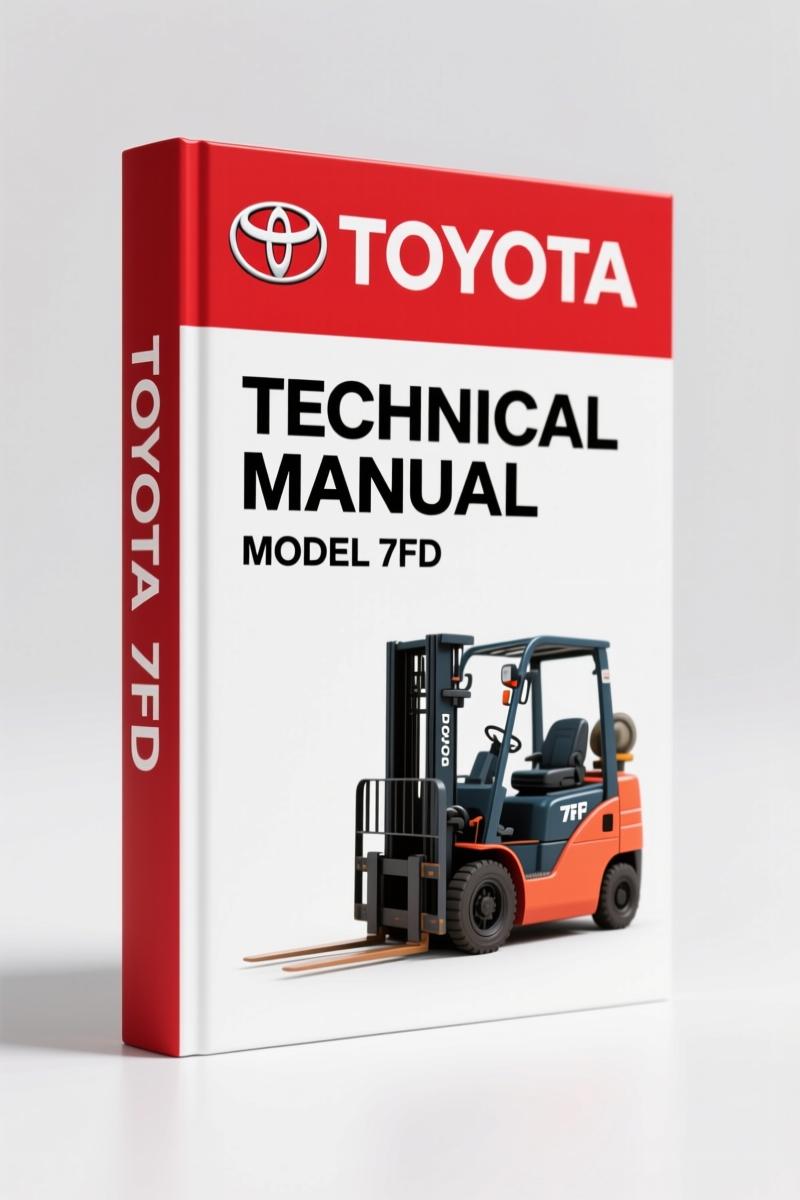
Toyota 7Fd 2006 Service Manual – Factory Spec for OPS and Valve Systems
Original price was: $37.80.$30.00Current price is: $30.00.
OEM 145-page service manual for Toyota 7Fd (2006): OPS, SAS, valve diagnostics, torque specs, and periodic maintenance schedules.
Description
Toyota 7Fd 2006 Service Manual – Factory Specs That Keep Your Forklift Safe
If you work on Toyota 7Fd forklifts, you already know the OPS system is what keeps the operator alive. Guessing on the seat switch wiring or the control valve torque gets people hurt. I have chased electrical gremlins on these trucks for years, and the only reliable source is the factory binder. This Toyota 7Fd 2006 Service Manual is the supplement that covers the OPS system from model year 2006 onward, plus all the critical sections: BODY, OIL CONTROL VALVE, MINI LEVER, SAS, and periodic maintenance. 145 pages of test procedures, block diagrams, and tightening sequences—not a reprint from some third party that leaves out the safety warnings.
OPS System Diagnostics: Why the Factory Manual Matters
The OPS system uses a seat switch, controller, and a buzzer to disable travel and hydraulics if the operator leaves the seat. The manual includes the exact control block diagram on page 0-3, showing every relay and the interaction with the SAS controller. When the controller detects a malfunction, the OPS lamp blinks at a specific rate—you need the OEM troubleshooting table to know which blink pattern means a bad seat switch versus a failed controller. I have seen aftermarket charts mix up the codes. Stick with the factory print.
The manual also covers the return-to-neutral warning function. If the seat switch is turned on with the forward/reverse lever still engaged, the buzzer sounds short intervals. That is a safety-critical feature you do not see in generic forklift guides. You get the manufacturer’s exact description for diagnosing the delay timer and the relay logic.
Does This Manual Cover the Oil Control Valve?
Yes, section 3 is dedicated to the oil control valve. You get the disassembly steps, the spring free length specs, and the all-important O-ring sizes. The manual shows the port numbering and the test pressures for the valve spool. If you have ever had a mast drift down after replacing a valve, it is usually because the torque on the valve body bolts was wrong. The spec is printed here. Do not use a chart from a 1990s manual on a 2006 model—the valve design changed.
3 Reasons to Stick with OEM Documentation
First, the torque values. Section 0 of this manual lists the inspection intervals and tightening specs for the seat mount bolts, the seatbelt anchor bolts, and the OPS controller bracket. Those numbers come from Toyota’s engineering, not from guessing. Second, the wiring diagrams are specific to the 2006 harness with the OPS controller and the SAS interface. Third, the periodic maintenance chart (page 0-2) tells you exactly when to inspect the seat switch, the OPS function, and the hydraulic lines—every 250 hours, every 500 hours, every 1000 hours. That schedule is the difference between a forklift that runs for twenty years and one that drops a load on the shop floor.
If you need the older versions for earlier truck builds, check out the Toyota 7Fd Minispakar Supplement Index (from 2003) or the Toyota SCP10, NCP1, NLP10 2001 Service Manual – Factory OEM for passenger car comparisons. For the CVT-specific DTC charts on related powertrains, the Toyota K311 Service Manual – Factory OEM CVT Specs & DTC Charts is a solid resource.
Understand the Wiring Before You Touch It
The control block diagram in section 0-3 shows the battery, key switch, forward/backward tilt switches, the OPS controller, seat switch, OPS lamp relay, and the SAS controller. Each wire is labeled with the factory color code. I have worked on forklifts where someone swapped a tilt switch wire because a generic diagram showed the wrong pinout. That causes the OPS to activate while the operator is seated—a serious hazard. The manual also explains the plug-in analyzer port for checking signals without backprobing connectors. That is a timesaver, but only if you have the correct pin numbers from the factory pages.
Periodic Maintenance: Follow the Factory Schedule
The inspection table on page 0-2 covers safety devices, seat belt function, seat switch operation, and OPS function at intervals of 250, 500, 1000, and 2000 hours. The manual specifies whether each check is an inspection, measurement, tightening, cleaning, or lubrication. For example, the seat switch function must be inspected every 250 hours—not just when the operator complains. I have pulled many trucks out of service because the switch brushes wore out and the OPS failed to disengage. A simple visual check prevents that.
For broader context on why OEM documentation is the industry standard, read this Automotive Industry Overview. It backs up what I see every day: factory manuals eliminate the guesswork.
- Is this manual in English?
- Yes, the supplement text is primarily English with a Swedish title page. All procedures and torque specs are clear.
- Does it include torque specs for the oil control valve?
- The manual does not list a separate torque table for the valve body bolts, but it references tightening sequences in the disassembly section. If you need an exact lb-ft value for the valve mounting bolts, you will have to cross-check with the main service manual for the 7Fd. The supplement focuses on the OPS system and the modifications specific to 2006 models, so some general engine torque specs are not repeated here. However, the valve-related procedures (section 3) include the necessary tightening patterns for the O-rings and the lock plate. For complete coverage of the entire forklift, pair this supplement with the base manual.
This is the manual that should be in your toolbox if you touch a Toyota 7Fd from 2006 or later. The OPS system has saved lives, but only if the repairs are done to factory spec. Access the Factory Manual and keep your shop safe.
Additional information
| Brand | Toyota |
|---|---|
| Language | English |
2 reviews for Toyota 7Fd 2006 Service Manual – Factory Spec for OPS and Valve Systems
You may also like…
-
Sale!

Toyota 6FGCU33, 6FGCU45 1997 Service Manual – Factory Forklift Repair
Original price was: $94.25.$65.00Current price is: $65.00. -
Sale!

Toyota 5FBE10, 5FBE15, 5FBE18, 5FBE20 Service Manual – 463 Pages
Original price was: $102.05.$65.00Current price is: $65.00. -
Sale!

Toyota 7FGU35 7FGU80 2005 Service Manual – 136 Pages Official Factory Data
Original price was: $82.55.$65.00Current price is: $65.00. -
Sale!
Toyota 5FBE10, 5FBE13, 5FBE15, 5FBE18, 5FBE20 Service Manual – 463 Pages
Original price was: $102.05.$65.00Current price is: $65.00.
Related products
-
Sale!
2004 Acura TSX Wiring Diagram – 73-Page Factory Electrical Schematics
Original price was: $15.88.$9.99Current price is: $9.99. -
Sale!

1992 Electrical Schematic – International 1000/3000/4000/2554 OEM Wiring Diagrams (132 Pages)
Original price was: $26.40.$20.00Current price is: $20.00. -
Sale!

2005 Parts Catalog – International NGD 3.0 L Engine (77 pages)
Original price was: $44.70.$30.00Current price is: $30.00. -
Sale!
1993 Operators Manual – International Bus 1000-3000 OEM Specs
Original price was: $12.30.$7.99Current price is: $7.99.
gearhead88 –
Five stars! Immediate link after checkout process. Every spec sheet is included for Toyota 7Fd. Saved my weekend project! Thank you.
William H. –
Excellent factory service manual. The file is very clear. It guided me to repair my Toyota 7Fd engine. I will definitely buy again.