
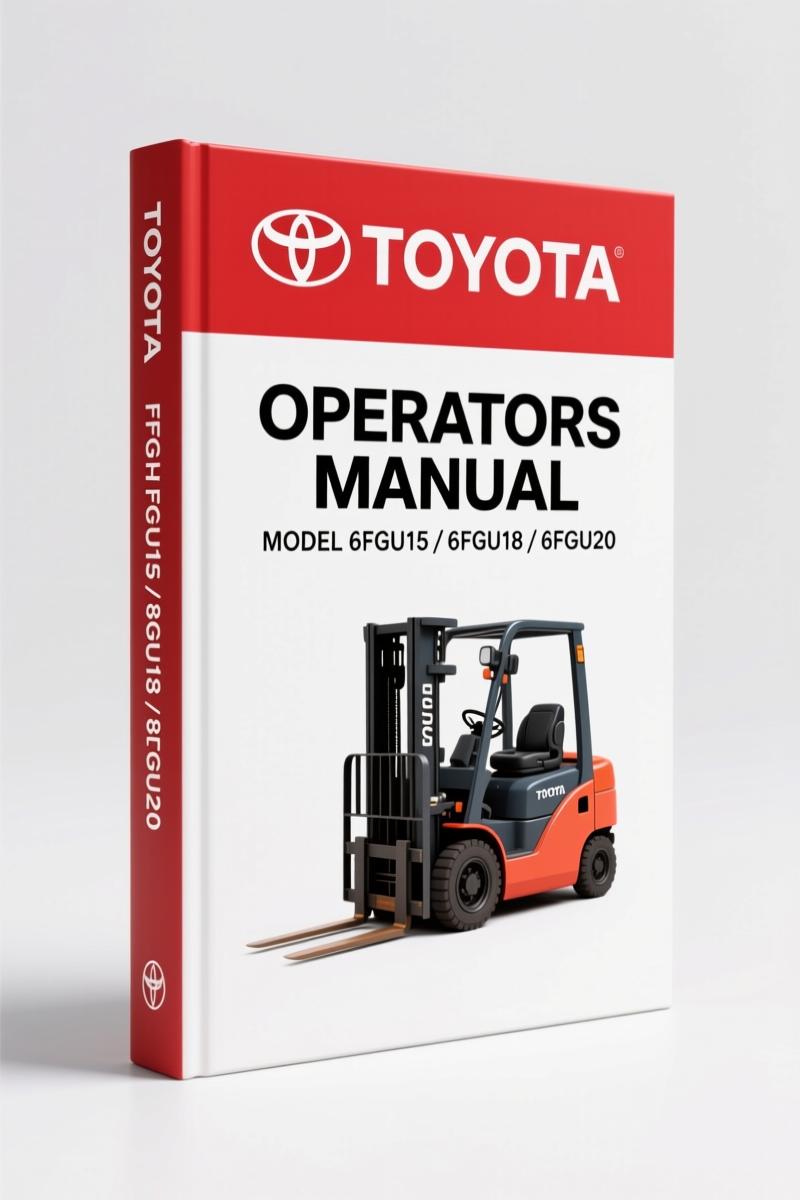
Toyota 6FGU15-6FGU30 Operators Manual – Factory Specs for Technicians
Original price was: $15.68.$9.99Current price is: $9.99.
84-page OEM Toyota operator manual for 6FGU15-6FGU30 forklifts. Pre-operation checks, safety, maintenance schedules, and fluid specs.
Description
Toyota 6FGU15, 6FGU18, 6FGU20, 6FGU25, 6FGU30 Operators Manual – The one you keep in the seat back pocket
I’ve seen too many forklift operators skip the pre-op walk-around because they think they know the machine. Then they find a leaking wheel cylinder mid-shift or a cracked restraint belt that should have been caught before the first fork hit a pallet. That kind of shortcut costs you time, parts, and maybe a citation if OSHA walks through the door. This Toyota 6FGU15, 6FGU18, 6FGU20, 6FGU25, 6FGU30 Operators Manual is the document Toyota wants in the pocket behind the seat – 84 pages of straight factory procedure, no aftermarket interpretation.
Safety Information Section – OSHA/ANSI Rules You Can’t Skip
Page 7 opens with training requirements and the specific OSHA/ANSI safety rules that apply to these trucks. The manual doesn’t assume you’ve operated a lift before. It walks through operational hazards and how to avoid them – tip-over risks, load center shifts, pedestrian traffic. If you’re a shop owner, this is the document you hand to every new operator before they touch the controls. The employer responsibility breakdown on page 1 covers environment, training, work rules, and workplace design. That alone can keep you out of a fine if inspectors ask for your training records.
Know Your Truck: Decals, Controls, and the Data Plate
Section III runs from page 17 to page 36. It covers the ANSI designation for each model – 6FGU15, 6FGU18, 6FGU20, 6FGU25, 6FGU30 – and spells out intended uses and expected work environments. You get the location and meaning of every warning decal on the truck. The data plate section tells you how to read capacities and match them to your load. Controls, switches, instruments, and operator restraints are diagrammed with factory callouts. If you’ve ever had a rental operator ask which lever does what, this section gives you the definitive answer.
Daily Operation Procedures – Inspection Before First Ignition
Daily inspection checklist starts on page 37. Pre-operation checks for gas, LP, and diesel starting sequences – all covered separately because the fuel system procedures are not interchangeable. Brake test, lifting and lowering controls, direction controls. The manual walks through lifting loads, traveling on inclines, stacking, and using attachments. Parking procedure includes the tag-out step. Unexpected emergencies section tells you what to do if the truck tips, if a load shifts, or if you need to evacuate. This is not a repair manual; it’s an operator manual that keeps the truck running reliably through proper daily use.
Operator Maintenance – What You Can Do Without a Mechanic
Fueling procedures for gas, LP, and diesel – each has its own safety steps. Tires and wheels: pressure checks, visual inspection for cuts or bulges. Antifreeze level and type. Fuses and battery care. Parking brake adjustment procedure with clear steps. Tag-out protocol for when you park the truck for maintenance. Page 49 through 56 covers all of it. Most of these tasks take five minutes and prevent a breakdown mid-shift. The manual doesn’t assume you have a full toolbox – it tells you the tools you need and the torque feel, not just a number.
Emergency Procedures and Planned Maintenance Schedules
Dead battery and jump starting – page 57. Lifting, transporting, towing, and jacking the truck – page 58 to 62. These procedures are written for operators and mechanics who need to get the truck back to the shop safely without damaging components. The planned maintenance section starting on page 63 covers training, parts sourcing, weekly maintenance, storage procedures, maintenance schedules, and replacement schedules. Service data and lubrication chart at the back of the manual give you fluid capacities, lubricant grades, and intervals. If you’re running a fleet of these trucks, the replacement schedule table is worth the price alone – it keeps every unit on the same preventive maintenance plan.
Why the Factory Operators Manual Beats Aftermarket Copies
I’ve watched guys buy a $20 aftermarket CD that claims to cover every Toyota lift ever made. Then they find the wiring diagram is from a 1990 model and the torque spec for the mast mounting bolts is wrong. This OEM manual – the Operators Manual – came from Toyota’s engineering group. The safety warnings match current ANSI/OSHA requirements. The decal locations are photographed from actual production trucks. If you need to reference the load capacity chart, it’s on the data plate section, not buried in a generic appendix. Related manuals like the Toyota 7FBEF Series Operators Manual”/> and the TOYOTA FBESF10/12/15 Operator’s Manual”/> follow the same format. For larger trucks, the TOYOTA 7FG35 Operator’s Manual”/> covers similar daily operation content. All of them are OEM prints, not scanned copies with missing pages.
If you want background on how these lift trucks fit into the broader Automotive Industry Overview”>material handling industry, or if you’re cross-training operators who also work on Manual Transmission”>manual transmission vehicles, this manual gives you the specific operation and safety procedures Toyota expects. No generic language, no skip-the-manual shortcuts.
Frequently Asked Questions
- Does this manual cover the 6FGU30 diesel engine start procedure?
- Yes. Section IV, Daily Operation, includes separate starting procedures for gasoline, LP, and diesel. The diesel cold-start and fuel priming steps are on page 39.
- Can I use this manual for a 6FGU18 with an attachment like a side-shift?
- The manual covers attachments in the daily operation section and lists load capacity adjustments on the data plate. It won’t give you installation instructions, but it tells you how to operate safely with attachments.
- Is the lubrication chart in this manual specific to the 6FGU25?
- It covers all five models. The chart lists lubricant grades and service intervals for each component – transmission, drive axle, mast chains, steering knuckles. Page 78 is the lubrication chart.
- How is this different from a generic inspection checklist?
- This manual was written by Toyota for these specific model numbers. Generic checklists miss decal locations, don’t reference the correct fuel type, and often ignore the OSHA/ANSI training requirements that the employer is legally responsible for.
Don’t let a used truck come to your shop without its factory documentation. Access the Factory Manual and put a copy in the seat pocket. Your operators – and your OSHA compliance officer – will thank you.
Additional information
| Brand | Toyota |
|---|---|
| Language | English |
3 reviews for Toyota 6FGU15-6FGU30 Operators Manual – Factory Specs for Technicians
You may also like…
-
Sale!

Toyota 5FBE10, 5FBE15, 5FBE18, 5FBE20 Service Manual – 463 Pages
Original price was: $102.05.$65.00Current price is: $65.00. -
Sale!

Toyota 7FGU35 7FGU80 2005 Service Manual – 136 Pages Official Factory Data
Original price was: $82.55.$65.00Current price is: $65.00. -
Sale!

Toyota 6FGCU33, 6FGCU45 1997 Service Manual – Factory Forklift Repair
Original price was: $94.25.$65.00Current price is: $65.00. -
Sale!
Toyota 5FBE10, 5FBE13, 5FBE15, 5FBE18, 5FBE20 Service Manual – 463 Pages
Original price was: $102.05.$65.00Current price is: $65.00.
Related products
-
Sale!
2004 Acura TSX Wiring Diagram – 73-Page Factory Electrical Schematics
Original price was: $15.88.$9.99Current price is: $9.99. -
Sale!

International 1000-3000 Series Operators Manual – 132 Pages of OEM Specs
Original price was: $14.40.$10.99Current price is: $10.99. -
Sale!

1989 Service Manual – International 2000-8000 Electrical Systems
Original price was: $72.00.$50.00Current price is: $50.00. -
Sale!
1992 Electrical Schematic – International 1000/3000/4000/2554 OEM Wiring Diagrams (132 Pages)
Original price was: $26.40.$20.00Current price is: $20.00.
David K. –
This is exactly what I required. It is easily zoomable on my iPad without losing quality. Contains precise bolt torque specs for Toyota. Saves me a lot of money.
Thomas B. –
This is exactly what I needed. It is very easy to read on my iPad without losing quality. It assisted me to rebuild my Toyota 6FGU156FGU30 engine. I will definitely buy again.
Robert M. –
I am very pleased with this transaction. Immediate link after payment. A must-have for any Toyota 6FGU156FGU30 owner doing repairs. Saves me a lot of dollars.