
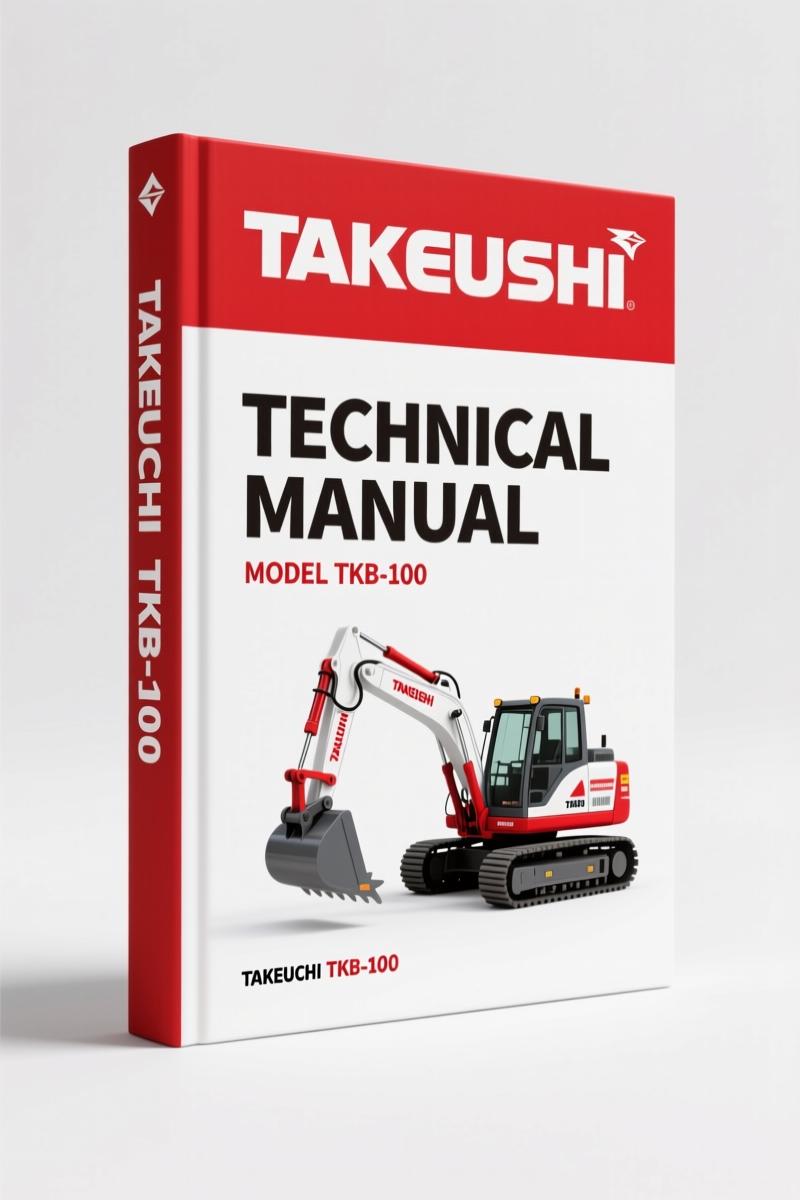
Takeuchi TKB-100 Technical Manual – 20 Page Factory Specs
Original price was: $33.75.$25.00Current price is: $25.00.
OEM factory technical manual for Takeuchi TKB-100 hydraulic breaker: 20 pages covering specs, maintenance, chisel exchange, and troubleshooting.
Description
If you own a Takeuchi TKB-100 Technical Manual and you’ve ever had a breaker stop mid-job because you guessed on the accumulator pressure or reused a bolt that needed replacing, you already know the frustration. That’s why this 20-page OEM document belongs on your bench, not buried in a drawer. I’ve seen too many breakers trashed by shop manuals that skip steps – this one doesn’t. It’s the factory print, not a aftermarket rehash.
Specification and First Examination (Page 4)
The manual kicks off with the Parts List and Section Drawing on page 2 – a clear exploded view so you can name every seal and bushing. Then page 4 lays out the full Specification sheet: operating weight, hydraulic flow range, impact rate, working pressure. You need that data before you hook anything up. The Instruction Manual section starting on page 4 walks you through the first examination and preliminary checkouts. Don’t skip this. I’ve had techs call me because they bolted a breaker on a machine that didn’t even have the right relief valve setting. Page 4 catches that.
Exchange of Chisel: Tools and Torque
Chisel replacement is a common job, but get the retaining pins wrong and you’ll have a flying tool. Section 4 (page 7) covers removing and installing the chisel. It tells you exactly what tools you need – I’d add a brass drift and a torque wrench that reads in ft-lbs. The manual doesn’t list torque values in the table of contents, but the bolt specs on page 9 under Maintenance and Inspection are your safety net. Use a torque wrench on those accumulator bolts. No guessing.
Accumulator Gas Pressure Check (Page 11)
Page 11 is where you find the accumulator gas pressure procedure. This is the single most skipped step on breaker maintenance. Nitrogen pre-charge is critical – too high and the diaphragm tears, too low and you lose blow energy. The manual gives the correct pressure range for the TKB-100. Check it with a nitrogen gauge, not a tire gauge. I’ve seen that mistake burn through a $400 accumulator in a week. This page also covers grease points and hydraulic oil level checks. Stick to the factory intervals.
Troubleshooting Without Guessing (Page 13)
The Troubleshooting section on page 13 is what separates a pro from a parts changer. It lists symptoms – low blow force, erratic cycling, oil overheating – and gives the probable causes in order of likelihood. No fluff, no flowery language. Follow the tree: start with simple stuff like line restrictions before you pull the breaker apart. I’ve watched guys replace a main valve because they didn’t bother checking the return filter. That’s wasted time and money.
Why OEM Documentation Beats Aftermarket Copies
This is the original Takeuchi factory manual, not a third-party reproduction. The difference shows in the pipe fitting chart on page 17 – exact thread sizes, port locations, and torque specs for hydraulic hoses. Aftermarket manuals often reuse generic diagrams that don’t match your model year. With this PDF, what you see is what the factory published. The section drawing on page 2 is clean enough to read part numbers without a magnifying glass. For related machines, check out the Takeuchi TW80 Technical Manual – OEM Factory Service Specs or the Takeuchi TKB-70 Technical Manual – OEM Factory Specs for Breaker Repair. If you need a compact excavator manual, the Takeuchi TB145 TB150 Technical Manual covers those too.
Who Needs This Manual?
Home garage enthusiasts who run a TKB-100 on their mini-excavator need this. So do rental yard mechanics who see a dozen different breakers. The manual is 20 pages – you can read it in an hour and keep it on your phone for reference. The step-by-step procedures for installation and removal of the breaker (page 8) are critical if you’re swapping between machines. Don’t assume all excavator brackets are the same. The cautions on page 8 will save you a cracked housing. For a wider overview of hydraulic systems, you can read about Manual Transmission theory – the same principles of hydraulic pressure apply. Also check out Manual Transmission for understanding how fluid power transfers.
Frequently Asked Questions
- Does this manual include wiring diagrams?
- No. The TKB-100 is a hydraulic breaker – there is no electrical system beyond a solenoid valve if equipped. The manual covers hydraulic schematics and pipe fitting charts.
- What about torque specs for the breaker mounting bolts?
- Section 6-2 on page 9 lists bolt inspection procedures but does not give numeric torque values. You need to match the bolt grade and size to the excavator arm’s specification. For the accumulator cover bolts, use the values in the accumulator assembly section on page 16 of the manual – those are factory numbers. If your manual doesn’t have them, call Takeuchi with your serial number.
If you’re tired of chasing ghosts on your TKB-100, get the real data. Access the Factory Manual and keep it within arm’s reach of your toolbox. One check of page 11 before you start a job could save you a weekend of downtime.
Additional information
| Brand | Takeuchi |
|---|---|
| Language | English |
4 reviews for Takeuchi TKB-100 Technical Manual – 20 Page Factory Specs
You may also like…
-
Sale!
Takeuchi TB-1200, TB-1400 1984 Service Manual – Factory Specs
Original price was: $91.65.$65.00Current price is: $65.00. -
Sale!
Takeuchi TW50 2007 Service Manual – OEM Factory Repair Procedures
Original price was: $96.20.$65.00Current price is: $65.00. -
Sale!
Takeuchi TB180FR Parts Catalog – 359-Page OEM Exploded-View Index
Original price was: $100.10.$65.00Current price is: $65.00. -
Sale!
Takeuchi TW60 2007 Service Manual – 246 Pages
Original price was: $87.75.$65.00Current price is: $65.00.
Related products
-
Sale!

2006 Service Manual – International DT 466E, 530E Diesel Engine
Original price was: $67.50.$50.00Current price is: $50.00. -
Sale!

Service Manual – International HS 2.8L Engine – 130 Pages of Factory Specs
Original price was: $56.40.$40.00Current price is: $40.00. -
Sale!

2011 Parts Catalog – International Truck OE Parts Documentation (1786 Pages)
Original price was: $34.50.$25.00Current price is: $25.00. -
Sale!

1991 Electrical Schematic – 112-Page OEM Wiring Diagram for International 1000-3000 Series
Original price was: $22.75.$17.50Current price is: $17.50.
gearhead88 –
I am very pleased with this transaction. The file is very clear. Every wiring layout is included for Takeuchi TKB100. Highly recommended for mechanics.
Robert M. –
This is just what I needed. The file is very clear. Every wiring layout is provided for Takeuchi TKB100. Worth every penny.
diy_master –
This is exactly what I needed. It is easily zoomable on my tablet without blur. Every wiring layout is included for Takeuchi TKB100. Saved my weekend project! Thank you.
James L. –
Outstanding! Immediate link after payment. Contains detailed schematics for Takeuchi. Saved my weekend project! Thanks.