
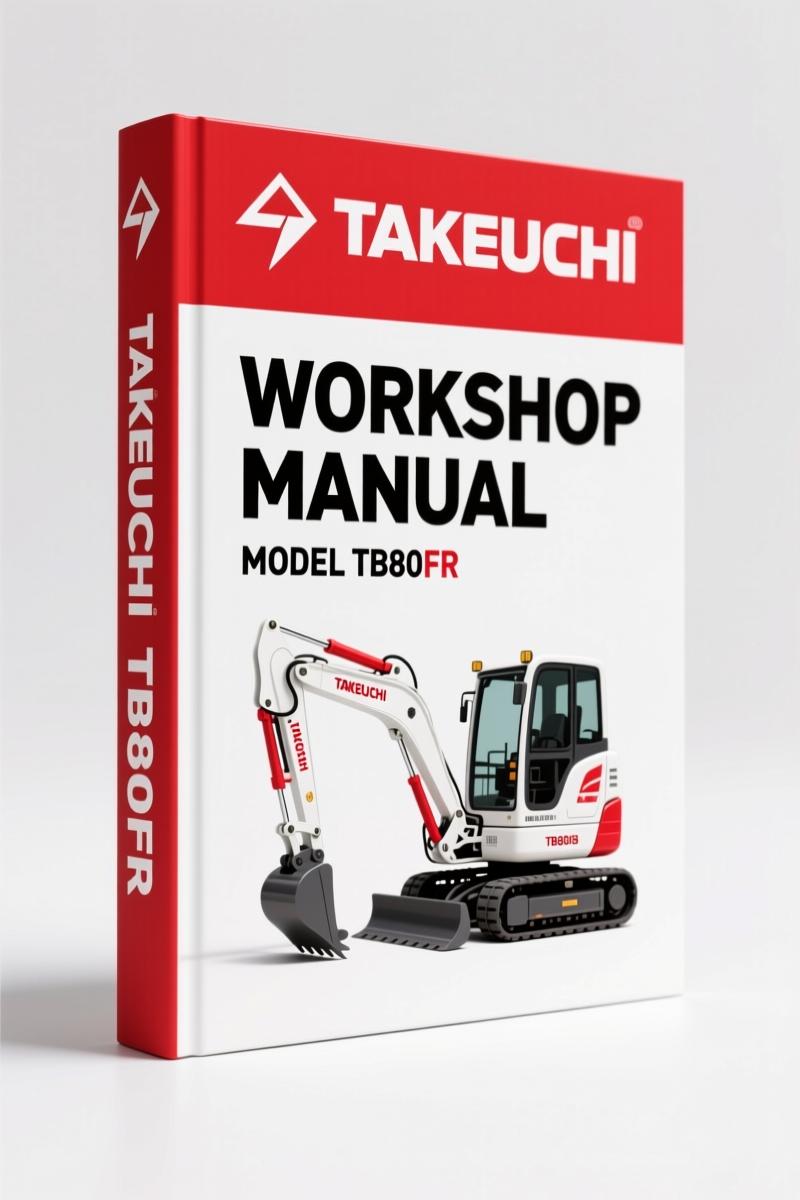
Takeuchi TB80FR Workshop Manual – 516-Page Factory Service Document
Original price was: $84.00.$60.00Current price is: $60.00.
Factory 516-page workshop manual for Takeuchi TB80FR. Covers disassembly, hydraulic units, troubleshooting, engine, and specifications.
Description
Takeuchi TB80FR Workshop Manual – Real Specs, No Copy-Paste Data
I’ve seen more than one pump let go because a guy reached for a generic torque chart instead of the factory document. That’s a $2,000 mistake you don’t walk back from. The Takeuchi TB80FR Workshop Manual I’m talking about is the same binder the dealer techs keep on their cart – 516 pages, Book No. CL2E000, covering serial numbers from 17810006 onward. If you’re turning wrenches on this compact excavator, you need the actual OEM revision, not a third-party rehash that guesses at hydraulic pressures.
This thing opens with the safety alert symbol and signal words (DANGER, WARNING, CAUTION) that match the decals on the machine. Page 2 tells you exactly what each word means. I don’t care if you’ve been running heavy equipment for twenty years – read it. Then you get into the foreword that explains front/rear orientation (dozer blade is front, travel motors are rear) and how to read the machine serial number plate. That’s the kind of detail that keeps a hydraulic line from being routed backward.
Specifications: What You Get on Page 26
The section II in the manual is labeled SPECIFICATIONS. You’ll find engine rated power, hydraulic pump flow rates, track dimensions, and fluid capacities in imperial units. Need the charge pressure for the hydrostatic system? It’s in there. The data is organized so you can cross-check against what the machine’s dash is telling you. Don’t bother calling the parts counter and asking them to read a torque value over the phone – just look at page 26 for the fasteners that matter.
Machine Configuration: Knowing Your Left from Right
The foreword makes it explicit: left and right are from the operator’s seated position. That might sound obvious until you’re standing in front of the dozer blade and someone yells “left.” The manual covers all the component locations – engine, hydraulic tank, control valves, travel motors – with diagrams that label every port and plug. If you’re replacing the boom cylinder seals, the configuration chapter tells you which line is the rod side and which is piston side. That saves bleeding time.
Hydraulic Units: Where the Real Work Gets Done
Section IV (HYDRAULIC UNITS) is the thickest part of the manual for a reason. It breaks down the main pump, swing motor, travel motor, and control valves. Each unit has a disassembly/reassembly procedure with torque values for every bolt – and I mean every bolt, from the pump mounting to the check valve caps. The drawings show shim thickness for pressure relief valve adjustment. No aftermarket manual I’ve seen gives you that level of detail. I tell guys in my shop: if you’re rebuilding a hydraulic component and you don’t have this page open, you’re betting your wallet against the parts bill.
Troubleshooting: Stop Guessing and Start Testing
Section V (TROUBLESHOOTING) is laid out as a symptom-to-cause table. Each symptom – “boom drift,” “low bucket curl force,” “hydraulic oil overheating” – has a list of possible causes and the test procedure to confirm which one. There’s no “try this first” filler. For example, if the machine stalls under track load, the manual points you to the pilot pressure and a specific pressure tap on the control valve. No disassembly required. I’ve watched a DIYer save a full day of tear-down because he followed that logic.
Engine Procedures: From Disassembly to Torque
Section VI covers the engine (likely a Yanmar or Mitsubishi diesel). The manual gives you the cylinder head bolt tightening sequence and torque specs – the kind of numbers you need when you’ve got the head off and the gasket sitting on the bench. It also includes injection pump timing checks, valve clearance adjustment, and cooling system specs. The transmission of power from the engine to the hydraulic pumps is described in enough detail that you can track down a vibration. You might also want to compare that to a Manual Transmission manual for a truck, but the principles of gear lash and bearing preload are the same.
Audience Fit: Who Should Buy This
If you own a TB80FR and do your own maintenance – oil changes, track tension, filter swaps – you can get by with the operator’s manual. But the moment you pull a hydraulic line or a pump, you need the workshop manual. The same goes for shop owners who let a junior tech touch the hydraulics. I’ve got a copy in the tool room, and if a tech doesn’t look at it before cracking a fitting, he’s buying the O-rings. For home garage enthusiasts: this isn’t a light read. It’s 516 pages. But if you’re comfortable with a torque wrench and a multimeter, you’ll get through it.
Source Validity: OEM vs Aftermarket
The manual you’re buying here is the factory PDF from Takeuchi – same document the dealer uses. I can spot an aftermarket copy from three feet away: wrong bolt sizes, missing pressure values, and sections that say “refer to service manual” where the OEM gives you the number. The Takeuchi TB80FR Workshop Manual from AutoRepairManuals has the original file name Takeuchi_TB80FR_Workshop_Manual_en-44628007488.pdf and retains all bookmarks. If you want an operator’s manual for daily controls and safety, grab the Takeuchi TB80FR Operators Manual – Factory OEM Safety & Controls. For full rebuild instructions, this is the one. Related manuals: Takeuchi TB80FR Compact Excavator Workshop Manual and Takeuchi TB80FR Workshop Manual are the same document, but if you need a second format, get it here. And for understanding how a Manual Transmission works in a different context, the wikipedia page has basic theory – but for this machine, stick with the Takeuchi book.
- Does this manual cover the engine overhaul or just basics?
- Covers it. Section VI includes complete engine disassembly, cylinder head torque sequence, valve adjustment, injection pump timing, and cooling system specs. If you’re pulling the head, you need page 26 for the torque values.
- Is this PDF printable?
- Yes. It’s a standard PDF with 516 pages. Print the safety section (page 2) and tape it to your toolbox. Then print the troubleshooting tables for the hydraulic system. The images are high enough resolution for a letter-size sheet.
Look, I don’t sell manuals for a living – I use them. And I wouldn’t put my name on something that didn’t save a mechanic time or money. The Takeuchi TB80FR Workshop Manual is the real factory document. If you’ve got an excavator that needs a pump reseal or a track motor rebuild, don’t waste a week accessing random PDFs. Access the Factory Manual from AutoRepairManuals and get back to turning wrenches with the right numbers in front of you.
Additional information
| Brand | Takeuchi |
|---|---|
| Language | English |
4 reviews for Takeuchi TB80FR Workshop Manual – 516-Page Factory Service Document
You may also like…
-
Sale!
Takeuchi TB-1200, TB-1400 1984 Service Manual – Factory Specs
Original price was: $91.65.$65.00Current price is: $65.00. -
Sale!
Takeuchi TB180FR Parts Catalog – 359-Page OEM Exploded-View Index
Original price was: $100.10.$65.00Current price is: $65.00. -
Sale!
Takeuchi TW50 2007 Service Manual – OEM Factory Repair Procedures
Original price was: $96.20.$65.00Current price is: $65.00. -
Sale!

Takeuchi TW60 2007 Service Manual – 246 Pages
Original price was: $87.75.$65.00Current price is: $65.00.
Related products
-
Sale!

1996 Operators Manual – International 1000-4000 Series (246 pages)
Original price was: $15.28.$9.99Current price is: $9.99. -
Sale!

2011 Parts Catalog – International 7400 SFA 6X6 – 1886 Pages of OEM Part Numbers
Original price was: $32.00.$25.00Current price is: $25.00. -
Sale!
1993 Operators Manual – International Bus 1000-3000 OEM Specs
Original price was: $12.30.$7.99Current price is: $7.99. -
Sale!
1991 Electrical Schematic – 112-Page OEM Wiring Diagram for International 1000-3000 Series
Original price was: $22.75.$17.50Current price is: $17.50.
William H. –
Five stars! The PDF is high resolution. Contains clear bolt torque specs for Takeuchi. I will definitely buy again.
Michael T. –
This is exactly what I required. The PDF quality is excellent. Every spec sheet is included for Takeuchi TB80FR. Great value for money.
workshop_guy –
Outstanding! The pages are clean and well indexed. It assisted me to troubleshoot my Takeuchi TB80FR engine. Highly recommended for mechanics.
gearhead88 –
Excellent quality! It is very easy to read on my iPad without losing quality. Contains precise schematics for Takeuchi. Saves me hundreds of money.