
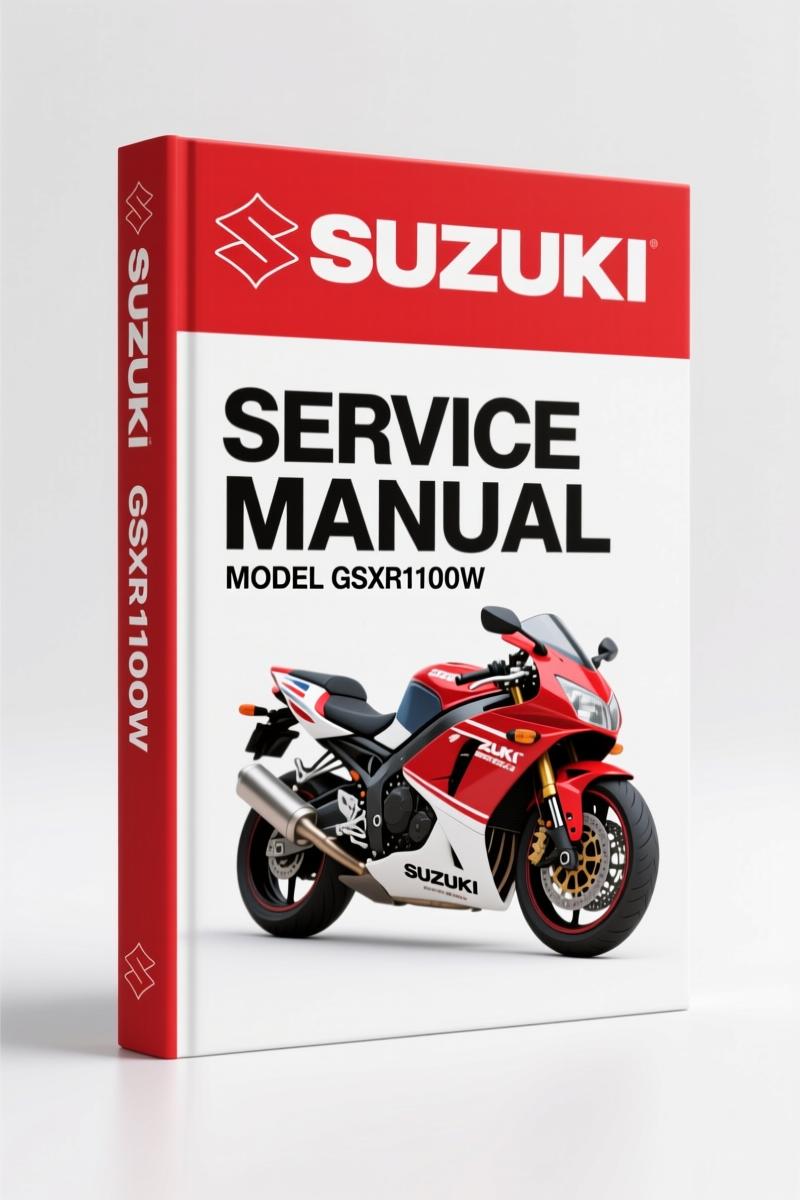
Suzuki GSXR1100W 1992 Service Manual – 380 Pages of Factory Repair Data
Original price was: $48.30.$35.00Current price is: $35.00.
Factory-original service manual for the 1992 Suzuki GSXR1100W. 380 pages of OEM specifications, torque values, wiring diagrams, and emission control data.
Description
If you’ve ever tried to put a GSXR1100W back together using a third-party manual and ended up with a leaky head gasket because the torque sequence was wrong, you already know why this factory manual matters. I’ve seen it too many times in my shop – a guy brings in a bike that won’t hold compression because he trusted a pirated PDF that skipped the tightening order. That’s not a fix, that’s a redo. This Suzuki GSXR1100W 1992 Service Manual is the real deal: 380 pages, printed by Suzuki Motor Corporation in November ’92, and it has the exact specs the assembly line used.
Suzuki GSXR1100W 1992 Service Manual: Engine Disassembly and Inspection
The Engine section (GROUP 3) covers the full rebuild – cylinder head removal, cam chain tensioner setup, and piston ring gap specs. Page 3-26 lists the cylinder head bolt torque in a specific sequence you don’t deviate from. I’ve watched a kid snap a bolt because he thought ‘tight is tight’ – this manual tells you it’s 25 Nm (18.4 ft-lb) on the first pass, then a 90-degree turn. That’s not guesswork, that’s factory. You also get the oil pump clearance check and valve adjustment shim table. If you’re doing a top-end job, you need this open on the bench, not a tablet with a smudged screen.
Fuel and Lubrication System: Factory Specs on Page 4-1
Fuel and Lubrication System (GROUP 4) gives you the carburetor settings, float level heights, and the exact idle mixture screw turns. The manual also calls out the engine oil viscosity for your climate – 10W-40 for most of North America, but 20W-50 if you’re in Texas like me and it’s August. Brake fluid spec is DOT 4, and front fork oil is Suzuki recommended 10W. These aren’t suggestions; they’re the minimum requirement to keep the bike from leaking or fading. The bleeding procedure for the brake system is step-by-step with the correct order – left caliper then right if you want a firm lever. Skip that and you’ll be bleeding again on Saturday.
Does the Cooling Section Cover Anti-Freeze Ratios?
Yes, and it’s specific. GROUP 5 – Cooling System – includes the coolant capacity (2.6 L total) and the mix ratio for ethylene glycol: 50% anti-freeze, 50% distilled water. The book warns you against using alcohol-based coolant, which some cheap brands still sell. The water pump seal replacement procedure is on page 5-12, and it shows the torque for the impeller bolt (10 Nm). If you’re chasing an overheating issue, the thermostat opening temperature is 80-84°C (176-183°F). You won’t find that in a generic manual. The radiator cap pressure spec is 107.9 kPa (15.6 psi). That matters when you’re pressure-testing a system.
380 Pages of OEM Data
Three hundred eighty factory pages. That’s not a weekend read – it’s a reference you’ll tab and dog-ear. The Electrical System (GROUP 6) has the full wiring diagram with color codes and connector pinouts. The charging system test procedure tells you the regulator/rectifier output: 14.0-15.0 V at 5000 rpm. The starter motor disassembly includes the brush wear limit (7.5 mm). The Chassis section (GROUP 7) has the swingarm pivot torque (80 Nm) and the steering head bearing preload. Every number is traceable to Suzuki’s engineering. I trust this more than a forum post where some guy says ‘I used blue Loctite on everything’. No – this manual tells you when to use threadlock and what type.
Brake Fluid and Chassis: Follow the Factory Steps
The Brake system – part of GROUP 7 – covers caliper rebuild, master cylinder piston sizes, and the proper bleeding sequence. The brake disc thickness limit is 4.5 mm front and rear, with a runout maximum of 0.30 mm. Measure with a dial indicator, not your eyeball. The rear brake pedal free play adjustment is 20-30 mm at the pad. The manual also includes the full front fork service: oil capacity per leg (463 mL), air gap (110 mm), and the spring free length (355 mm). If you’re respringing for a heavier rider, you need the preload setting. All in this book.
Look, you can buy a reprint from some online seller that copied page 47 wrong, or you can get the original Suzuki publication. This is the same manual that dealers used when these bikes were on the showroom floor. I’ve had my copy for years, and I still use it for the occasional GSXR1100 that rolls into my bay. The emissions section (GROUP 9) is required for street-legal compliance in the US – it tells you the EPA vacuum line routing and the charcoal canister purge specs. Don’t skip that if you’re restoring a bike to sell.
- Q: Does this manual include torque specs for the cylinder head?
- Yes, page 3-26 lists all cylinder head bolt torque values and sequence.
- Q: Can I use this for a 1993 GSXR1100WP?
- The manual is primarily for the 1992 GSXR1100W but includes supplement chapters for 1993 WP (chapter 10), 1994 WR (chapter 11), and 1995 WS / 1996 WT (chapters 11-12). Each supplement has specific updates for that model year – wiring changes, carb jetting, and chassis revisions. You can use the main 1992 sections for the core engine and chassis work, but always reference the supplement for any part that differs. For example, the 1993 WP got a different ignition rotor and pickup coil – that’s in chapter 10. Without those pages, you’d be using the wrong timing spec. This manual is the only source that compiles all those year-specific details in one place. If you have a 1993, buy this manual and keep the WP supplement open during any electrical or ignition work. I’ve seen too many guys swap in a 1992 CDI and wonder why it runs rough – it’s the wrong part. This manual prevents that.
If you’re serious about keeping your GSXR1100W on the road, you need the factory book. Don’t trust a scanner copy that’s missing page 45. I’ve linked a few related manuals below if you’ve got a stable of Suzukis: Suzuki VLR1800 2008 Service Manual – OEM Factory Repair Guide, Suzuki Grand Vitara 2005 Service Manual – OEM Factory Specs, Suzuki Grand Vitara 2005 Service Manual – OEM Factory Repair Guide. For general industry context on why OEM documents matter, check out Automotive Industry Overview and Automotive Industry Overview.
Stop wasting time on vague instructions. Access the Factory Manual and get the torque right the first time.
Additional information
| Brand | Suzuki |
|---|---|
| Language | English |
2 reviews for Suzuki GSXR1100W 1992 Service Manual – 380 Pages of Factory Repair Data
You may also like…
-
Sale!
Suzuki GC415 2004 Service Manual – 770 Pages Factory Specs
Original price was: $58.95.$45.00Current price is: $45.00. -
Sale!
Suzuki SWIFT 1988 Service Manual – Factory Repair Docs for 1300 GTi
Original price was: $67.05.$45.00Current price is: $45.00. -
Sale!
Suzuki Hatch Service Manual – 151 Pages Factory Repair Data
Original price was: $54.80.$40.00Current price is: $40.00. -
Sale!
Suzuki GSX-R600 Service Manual – 2001-2002 Factory Repair Data
Original price was: $51.60.$40.00Current price is: $40.00.
Related products
-
Sale!

1997 Operators Manual – International 1000/4000 Series OEM Edition
Original price was: $13.49.$9.99Current price is: $9.99. -
Sale!

Technical Manual – International DT 530 & HT 530 (118 Pages)
Original price was: $37.00.$25.00Current price is: $25.00. -
Sale!
1993 Operators Manual – International Bus 1000-3000 OEM Specs
Original price was: $12.30.$7.99Current price is: $7.99. -
Sale!

1991 Operators Manual – International Truck OEM Specs (108 Pages)
Original price was: $13.63.$10.99Current price is: $10.99.
Richard G. –
Great factory service manual. The scan is high-quality and easy to navigate. Contains clear wiring diagrams for Suzuki. Saves me so much time.
Thomas B. –
Great buy! The text is searchable and well indexed. A must-have for any Suzuki GSXR1100W mechanic doing repairs. Highly recommended for mechanics.