
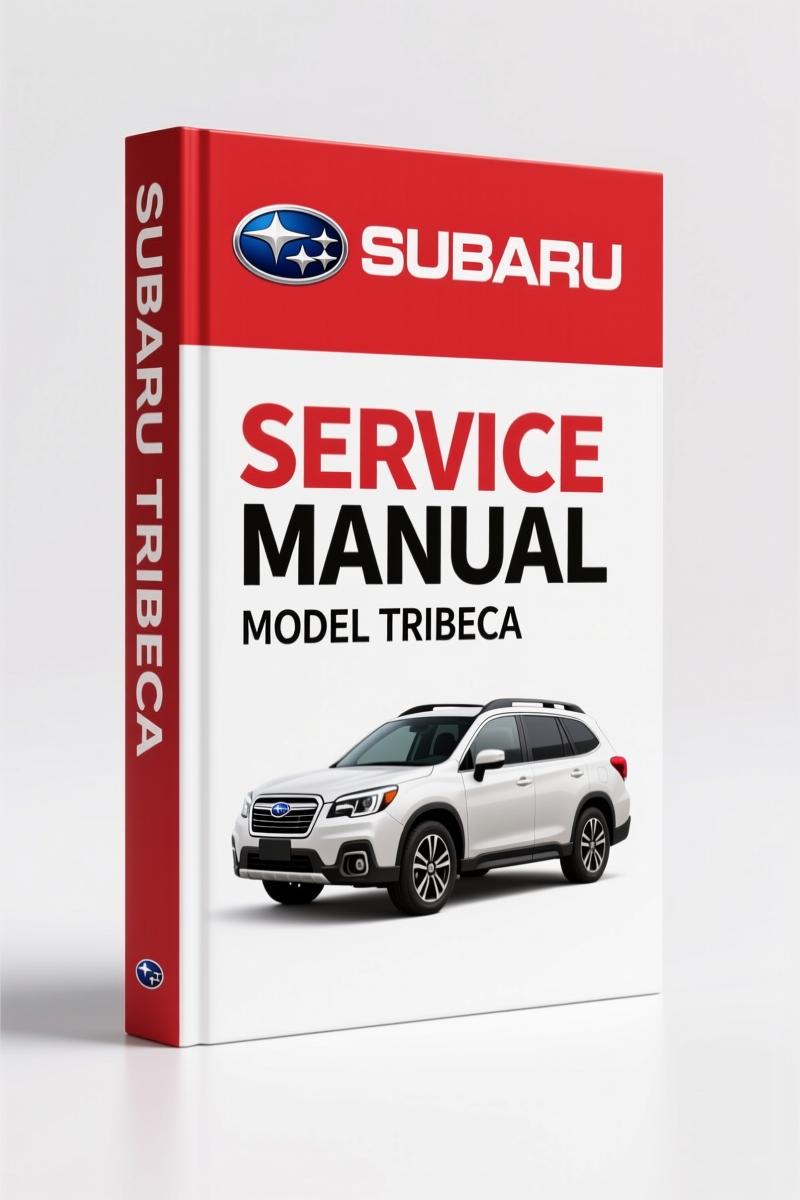
Subaru Tribeca 2007 Service Manual – 2694 Pages of Factory Specs
Original price was: $55.20.$40.00Current price is: $40.00.
Factory-certified 2007 Subaru Tribeca Service Manual: 2694 pages covering engine, transmission, electrical, and PDI procedures in metric units.
Description
Subaru Tribeca 2007 Service Manual – Factory OEM Shop Specifications
If you are working on a 2007 Subaru Tribeca without the factory Service Manual, you are guessing. Guessing costs time, parts, and sometimes a tow truck. I have seen too many DIY mechanics and even some shop guys try to get by with a third-party summary or a forum post, only to strip a bolt because the torque spec was wrong, or miss a hidden diagnostic step because the aftermarket schematic skipped a page. This 2007 Subaru Tribeca Service Manual is the one Fuji Heavy Industries wrote for its own technicians. 2694 pages of procedure that start with the pre-delivery inspection and go through every system on the vehicle – Engine, Transmission, Electrical, steering, suspension, brakes, HVAC, body, and more. You need this book on your bench, not a PDF from a site that recompiled it from three different sources.
2694 Pages of Factory Engineering
Let me be blunt: I do not care how many YouTube videos you have watched. You cannot duplicate what Subaru puts in print. The manual opens with a Foreword, then the HOW TO USE THIS MANUALS section that explains the structure, contents, component breakdowns, specifications, inspection criteria, maintenance intervals, diagnosis procedures, and SI units. It is not a suggestion. It is the engineering department telling you exactly how to measure, test, and torque. Section SPECIFICATIONS SPC covers every dimension, engine output, electrical load, transmission ratios, steering geometry, suspension settings, brake specs, tire sizes, fluid capacities, and vehicle weights. If you need the exact clearance for a valve adjustment or the correct transmission fluid capacity, you get it from the same source that built the car.
Every shop that works on these often should own a physical copy. That is 2694 pages of paper that does not have a battery to die and does not link to a dead server. I have seen the difference between a tech who reads the factory manual and one who wings it. The factory-trained guy finishes jobs in half the time and never brings me a comeback. This is that difference.
Engine, Transmission, and Electrical: What You Get
Open the SPECIFICATIONS chapter and you find the exact data for the Engine – bore, stroke, compression ratio, firing order, idle speed, oil pressure. The Transmission section lists gear ratios, shift pressures, and torque converter stall speeds. The Electrical section gives you the complete wiring diagram reference and component locations. You want the alternator output? Look under the electrical spec. Need the ATF capacity? It is right there in the capacity table. This manual does not hide information in a footnote that contradicts the main procedure. It is all consistent because it was written by one engineering team. When you are diagnosing a no-start condition or a transmission slip, the factory wiring and diagnostic flowcharts get you to the root cause, not a dead end.
Pre-Delivery Inspection – Why It Matters to Your Repair
The PRE-DELIVERY INSPECTION PI section is not just for dealership lot attendants. It is a systematic check of every fluid, fastener, light, switch, and system before the car leaves the factory floor. For a shop rebuilding a Tribeca, that same list is a perfect baseline to verify that everything is correct after a major repair. The PDI procedure goes through 50 items: appearance, tire pressure, fuse installation, door locks, child safety locks, rear gate operation, fuel lid release, battery condition, brake fluid level, engine oil, AT front differential oil, coolant, washer fluid, hood latch, keyless entry, alarm, seats, seat belts, wheel alignment, test mode connector, immobilizer, starting condition, exhaust leaks, indicator lights, clock, audio, navigation, rear entertainment, lighting, wiper deicer, illumination control, washer and wiper operation, power windows, sunroof, door mirrors, brake test, parking brake, AT shift control, heater, A/C, cruise control, ATF level, power steering fluid, fluid leak check, water leak test, and a final appearance check. That is 50 checkpoints. If you skip step 23 (immobilizer system) and later find you cannot code a new key, you will wish you had the manual open to that page.
Source Validity: OEM vs Aftermarket
Aftermarket manuals – Haynes, Chilton, or the cheap PDFs – are often based on generic templates with measurements rounded to the nearest foot-pound. They do not include the factory updates or the specific tool numbers. This manual is original Subaru documentation. It tells you to use genuine parts and gives the exact part numbers. The PRECAUTION PC section warns you about VDC system interactions, brake fluid contamination, radiator fan hazards, airbag deployment risks, static electricity damage to ECUs, and proper use of the lift and jack. Those warnings are not in aftermarket books. The NOTE NT section even covers fasteners noticies, battery handling, service parts, protecting the vehicle, tie-downs, towing, hood damper stay, general scan tool protocol, AWD circuit measures, speedometer test, brake test, and on-car wheel balancing. If you have ever had an airbag fire a module while you were working on the steering column, you will understand why those safety instructions matter. You can read more about automotive service standards in this Automotive Industry Overview, but for the Subaru, you need the factory book.
Look at the IDENTIFICATION ID section – it explains how to decode the VIN, model number label, engine code, transmission code, rear differential, and options. Aftermarket manuals rarely give you the exact option code list. This one does. Automotive Industry Overview
3 Steps to Using This Manual on Your Workbench
First, find the section that matches your job. If you are replacing the transmission, turn to the TRANSMISSION subsection under SPECIFICATIONS. Second, read the precaution notes for that system – especially the fluid warnings and airbag disable procedures. Third, gather the tools listed in the procedure. The manual does not list every tool by number, but it does call out special ones like the scan tool and the window adhesive applicator. Do not skip step 29 (accessory power socket check) in the PDI – it could save you a blown fuse later. Work through the procedure from start to finish, using the torque values printed in the specification table. I have seen too many guys fail because they swapped a component without checking the pre-delivery condition first. That is what this manual is built for – doing the job right the first time without second-guessing.
Frequently Asked Questions
- Does this manual cover the 2007 Subaru Tribeca with the 3.0L H6 engine?
- Yes. The specification chapter includes the exact engine data for the 3.0L H6 – displacement, compression ratio, idle speed, and oil pressure. The transmission specifications cover both the 5-speed automatic and the all-wheel-drive system.
- Are the wiring diagrams included in this 2694-page manual?
- The manual contains electrical component specifications and connector views, but the full wiring diagrams are typically in a separate wiring diagram supplement. This service manual gives you the diagnostic logic and pin-out references you need to use those diagrams.
- Can I use this manual for a 2008 Tribeca?
- Check the Subaru Tribeca 2008 Service Manual – Factory OEM Specs for 2008 model year. The 2007 manual is specific to the 2007 model (VIN prefix WX*****). Some changes in wiring and calibration may apply.
- Why do you say aftermarket manuals are unreliable?
- Aftermath of 20 years in the trade: I have seen aftermarket manuals round torque values by 10%, omit safety warnings like the airbag module disposal procedure, and skip the immobilizer system reset steps. This OEM manual is the only source Subaru technicians use. If you want to do it like the factory, use the factory manual.
Bottom line: you do not have to guess about the 2007 Subaru Tribeca when the complete OEM engineering record is available. Open the SPECIFICATIONS section, check the torque for your job, follow the PDI checklist after any major repair, and close the job with confidence that every bolt is at the right tension. Access the Factory Manual now and put it on your workbench where it belongs. Also consider the Subaru Tribeca 2009 Service Manual – Factory OEM Shop Guide or the Subaru Tribeca 2008 Service Manual – OEM 2874 Pages if you work on other model years.
Additional information
| Brand | Subaru |
|---|---|
| Language | English |
3 reviews for Subaru Tribeca 2007 Service Manual – 2694 Pages of Factory Specs
You may also like…
-
Sale!

Subaru IMPREZA 2003 Service Manual – 3024 Pages of Factory Specs
Original price was: $61.20.$45.00Current price is: $45.00. -
Sale!

Subaru Forester 2002 Service Manual – 2073 Pages of Factory Specs
Original price was: $67.05.$45.00Current price is: $45.00. -
Sale!
Subaru IMPREZA 1998 Service Manual – 1906 Pages Factory Specs
Original price was: $58.05.$45.00Current price is: $45.00. -
Sale!
Subaru Forester 1999 Service Manual – 1972 Pages of Factory Diagnostic Data
Original price was: $67.05.$45.00Current price is: $45.00.
Related products
-
Sale!

2011 Parts Catalog – International Truck OE Parts Documentation (1786 Pages)
Original price was: $34.50.$25.00Current price is: $25.00. -
Sale!

1995 Operators Manual – International 1000-4000 Series | OEM Documentation
Original price was: $12.49.$9.99Current price is: $9.99. -
Sale!
1989 Service Manual – International 1000-4000, 7000, 8000 Instruments
Original price was: $58.80.$40.00Current price is: $40.00. -
Sale!
2004 Acura TSX Wiring Diagram – 73-Page Factory Electrical Schematics
Original price was: $15.88.$9.99Current price is: $9.99.
workshop_guy –
This is exactly what I required. The PDF is high resolution. It guided me to fix my Subaru Tribeca transmission. I will definitely buy again.
diy_master –
Superb resource! The file is high resolution. Contains detailed schematics for Subaru. I will recommend this shop to others.
John S. –
Excellent factory service manual. It is easily zoomable on my laptop without losing quality. Every torque spec is included for Subaru Tribeca. Saves me so much time.