
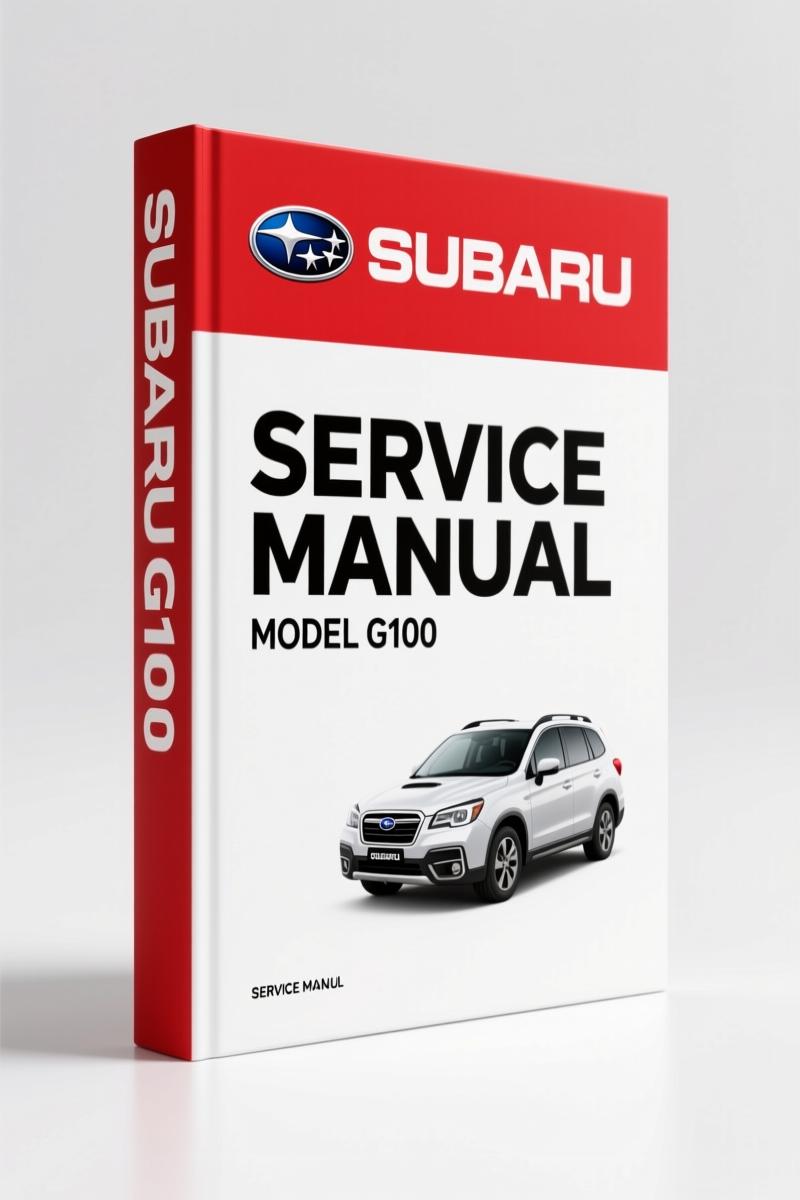
Subaru G100 Service Manual – 2268 Pages of Factory Specs
Original price was: $34.75.$25.00Current price is: $25.00.
2268-page factory service manual for Subaru G100 covering engine, transmission, diagnostics, and wiring. Official OEM specs, not a reprint.
Description
Subaru G100 Service Manual – 2268 Pages of Factory Specs
You are holding a 2268-page binder of Subaru factory engineering. This is the Subaru G100 Service Manual – the same document that sat on the tech’s bench at the dealership. It covers the 2000 Legacy, but don’t let the model name fool you: the G100 chassis code is used across multiple Legacy variants. If you are tearing into an engine swap, chasing a misfire, or replacing a head gasket on a 2.5L, this is the only source you should trust for torque values and sequence. Aftermarket CDs and Haynes manuals get you close enough to break something. This gets you spot-on.
Page 1 opens with the exact precautions that Subaru requires before any service: wear goggles, use genuine bolts coated with bitumen, and replace gaskets and O-rings every time. These are not optional. I have seen a shop skip the rear differential filler plug torque and send a customer off with a slow leak. That does not happen when you reference the factory page. The manual also specifies to use genuine Subaru bolts – not generic hardware store stuff – for suspension and drivetrain.
Engine and Transmission Section Coverage
Dive into the Repair Section and you will find every system broken down by procedure. The Engine section includes the Emission Control System and Vacuum Fitting, On-Car Services, Engine Lubrication System, Engine Cooling System, Fuel Injection System, Fuel System, and Exhaust System. Each subsection lists the required tools – including the special Subaru tools – and the exact torque sequence for parts like the intake manifold and timing belt tensioner. The Transmission and Differential section covers both manual and automatic transmissions, plus the AWD system. Need to rebuild a 4-speed automatic? The manual walks you through clutch pack clearance checks and line pressure tests. Factory data for the transfer clutch duty solenoid is in there – something aftermarket manuals leave out.
Diagnostics Section: On-Board Diagnostics II System
The Diagnostics Section is separate from the repair procedures. Subaru dedicated entire chapters to the OBD-II system, engine cooling system diagnostics, automatic transmission diagnostics, brakes, SRS, and body electrical subsystems including cruise control, keyless entry, and security. This is where you find trouble trees for specific DTCs. For example, a P0420 code? The manual walks you through checking the front and rear O2 sensor signals, then moves to catalyst monitor testing. It gives you the acceptable voltage range and the specific drive cycle requirements. No guesswork about whether the car needs to be at operating temperature – it tells you. I have pulled codes on a Legacy that looked like a bad cat, but the wiring diagram showed a chafed ground at the harness – the manual’s diagnostics caught it in 20 minutes.
Follow the Pre-Delivery Inspection Steps
If you bought a used G100 Legacy and want to baseline it, the General Information Section includes a Pre-Delivery Inspection checklist. That list covers fluid levels, belt tension, brake pad thickness, tire pressure, and a dozen other checks. The Periodic Maintenance Services chapter lists intervals for oil changes, spark plugs, timing belt replacement, and coolant flush. The manual also has a Special Tools page – so you know exactly which Subaru tool number you need for things like the camshaft sprocket holder or the flywheel stopper. You can often rent or borrow these, but at least you will not be improvising with a screwdriver and a prayer.
Does This Wiring Section Cover the Body Electrical System?
Yes – the Wiring Diagram Section is the final part of the manual. It includes full schematics for the engine electrical system, body electrical system, and all optional equipment. The diagrams use the same connector view numbers that appear in the control module pin-out tables earlier in the manual. If you are installing an aftermarket stereo or troubleshooting a tail light issue, this section shows wire colors, connector locations, and ground points. The factory wiring is not the same as aftermarket diagrams – Subaru uses specific wire color codes for their harnesses, and the manual lists them. I have seen more than one guy tap into the wrong wire because a generic diagram said “green/white” when the factory uses “green/black” for the same circuit. Verify here.
3 Reasons to Use OEM Documentation Over Aftermarket
First, torque specifications. Aftermarket manuals often round up or down to the nearest ft-lb. Subaru specifies in N·m with a tolerance – the manual tells you the exact range. Second, diagnostic procedure. Aftermarket books give you a summary; the factory manual gives you a step-by-step decision tree with test point voltages. Third, updates. This manual was printed by Fuji Heavy Industries Ltd. in 1999, so it reflects the latest revisions for the 2000 model year. TSBs and updates are incorporated into the main text. Aftermarket publishers frequently miss mid-year changes. If you want to see the difference for yourself, compare this manual with a Automotive Industry Overview document – the level of detail is night and day.
Related manuals you might want: 2005 Subaru LEGACY Service Manual – Factory Specs, 4596 Pages covers later models with more pages, but for the G100 chassis this is the correct one. If you need a specific section for the airbag system, Subaru IMPREZA Service Manual – Airbag System Section (20 Pages) is a supplement. For earlier Legacy models, 2004 Subaru LEGACY Service Manual – OEM Factory Specs shares similar engine and transmission data.
Also refer to Automotive Industry Overview for broader context on vehicle electronics, but for hands-on repair, stick to the factory manual.
- Can I use this manual for a 1999 Legacy Outback?
- Yes, the G100 chassis covers most 1999-2002 Legacy models with the 2.5L and 3.0L engines.
- What is the difference between this factory manual and a Haynes or Chilton?
- A Haynes manual condenses 2268 pages into 300. They omit the diagnostics trees, the wiring diagrams are simplified, and torque specs are often averaged. The factory manual gives you every bolt torque, every connector pinout, and every DTC test procedure. It also includes the special tool numbers so you can order the correct flywheel lock or piston ring compressor. I have used both – the factory manual saves you hours because you do not stop to question whether the value is correct. It is the difference between repairing a car and rebuilding it right.
Buy the Subaru G100 Service Manual here. No reprints, no scanned copies missing pages – this is the original PDF from Subaru’s archive. Every torque value, every wire color, every diagnostic tree is intact. If you work on these cars for a living or plan to keep your Legacy another 100,000 miles, you need this on your tablet or printed out. Access the Factory Manual now and start wrenching with the same data the dealer uses.
Additional information
| Brand | Subaru |
|---|---|
| Language | English |
4 reviews for Subaru G100 Service Manual – 2268 Pages of Factory Specs
You may also like…
-
Sale!

Subaru IMPREZA 1998 Service Manual – 1906 Pages Factory Specs
Original price was: $58.05.$45.00Current price is: $45.00. -
Sale!

Subaru Forester 2002 Service Manual – 2073 Pages of Factory Specs
Original price was: $67.05.$45.00Current price is: $45.00. -
Sale!
Subaru Forester 1999 Service Manual – 1972 Pages of Factory Diagnostic Data
Original price was: $67.05.$45.00Current price is: $45.00. -
Sale!
Subaru IMPREZA 2003 Service Manual – 3024 Pages of Factory Specs
Original price was: $61.20.$45.00Current price is: $45.00.
Related products
-
Sale!

1992 Electrical Schematic – OEM Wiring Diagrams for International 1000-3800
Original price was: $24.48.$18.00Current price is: $18.00. -
Sale!
1995 Operators Manual – International 1000-4000 Series | OEM Documentation
Original price was: $12.49.$9.99Current price is: $9.99. -
Sale!

2006 Service Manual – International DT 466E, 530E Diesel Engine
Original price was: $67.50.$50.00Current price is: $50.00. -
Sale!
International 1000-3000 Series Operators Manual – 132 Pages of OEM Specs
Original price was: $14.40.$10.99Current price is: $10.99.
David K. –
This is just what I needed. The pages are clean and easy to navigate. A must-have for any Subaru G100 owner doing repairs. I will recommend this shop to others.
Richard G. –
I am so happy with this purchase. The PDF quality is excellent. A must-have for any Subaru G100 mechanic doing maintenance. Great value for money.
James L. –
Five stars! The file looks clean. Every spec sheet is included for Subaru G100. Great value for money.
William H. –
This is just what I required. The scan is high-quality and easy to navigate. Contains detailed wiring diagrams for Subaru. Saves me hundreds of dollars.