
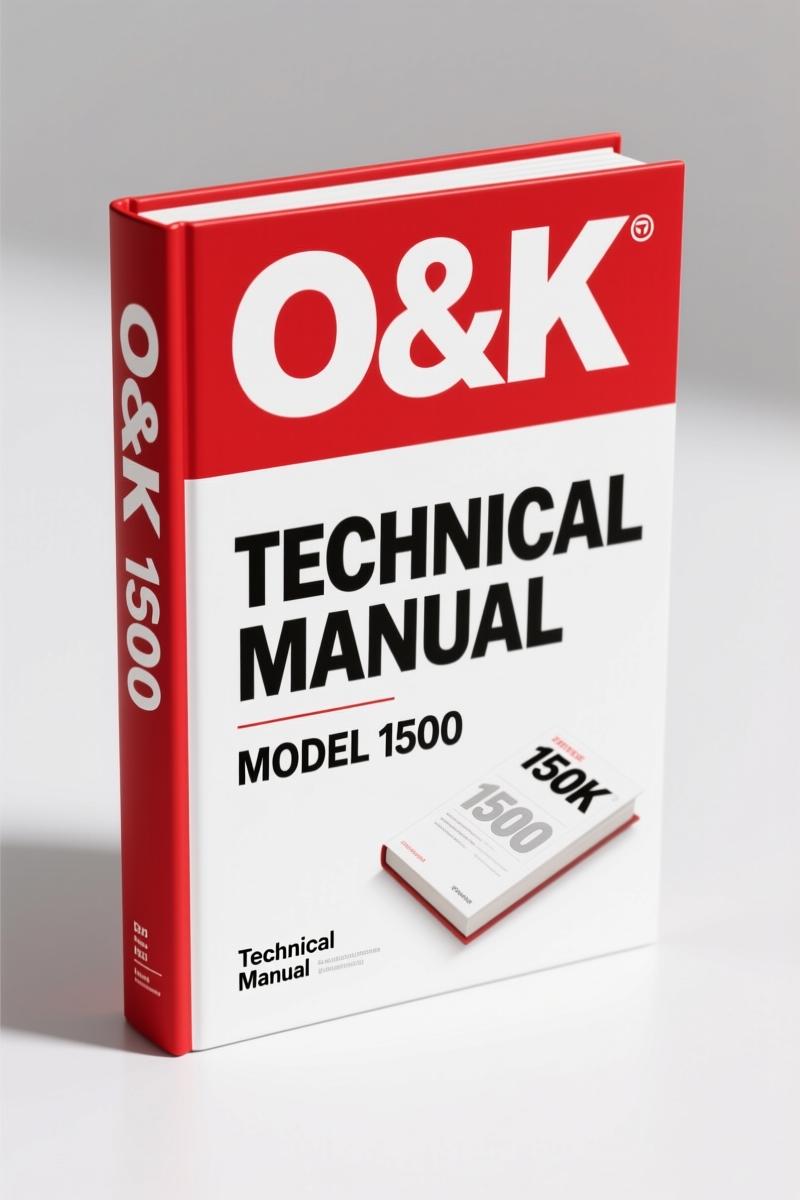
O&K 1500 Technical Manual – 154-Page OEM Specs for Loader Repair
Original price was: $48.00.$40.00Current price is: $40.00.
154-page OEM technical manual for O&K Model 1500 loader. Includes torque chart, electrical system data, capacities, and parts listing.
Description
O&K 1500 Technical Manual – Factory Specs for the Model 1500 Loader
If you’re wrenching on an O&K 1500 loader and you don’t have the factory manual, you’re working blind. I’ve seen guys torque bolts to feel instead of spec and end up with a cracked housing. This 154-page Technical Manual is what the factory gave the dealers in 1975. It’s not a reprint job from some third party. It’s the OEM document that tells you exactly where the charge pressure should be, how to adjust the clutch cut-out switch, and what torque goes on the axle flange bolts. No guesswork.
Battery and Electrical System: Page 26 and Page 12
The manual dedicates page 26 to the battery – mounting, cables, and capacity specs. Page 12 lists the electrical system parameters: system voltage, alternator output, and starter draw. If you’re chasing a no-crank or dim lights, these pages give you the factory baseline. The parts listing on pages 76-77 shows the battery and wiring assembly with part numbers for terminals and harness clips. Aftermarket diagrams don’t have that level of detail for a 1975 machine.
What Does the Safety Section Cover on Page 4?
Page 4 is mandatory reading. It lays out safety precautions specific to the O&K 1500 – operating on slopes, proper chaining, and PPE requirements. The manual was printed in an era when safety wasn’t a lawsuit dodge; it was written for the guy who actually runs the loader. Don’t skip page 4. Period.
3 Critical Sections for Daily Operation
Start-Up Procedure (pages 12-13): The manual spells out the cold-start sequence: check oil, coolant, hydraulic level, transmission fluid. Then prime the fuel system if the engine sits. After start, let the transmission warm until the temperature gauge hits at least 100°F before engaging the bucket. Preparation for Operation (pages 6-7): Walkaround inspection points – tire pressure, hydraulic leaks, loose bolts. Lubrication Charts (pages 28-29): Grease intervals for all pivot points, transmission and axle oil change intervals. These three sections keep a 50-year-old loader running daily.
Check the Torque Chart on Page 148 Before You Tighten Anything
The torque chart on page 148 is a single-page reference that lists fastener torque values for bolts of various grades and sizes. In a machine this size, using the wrong torque can crack a casting or cause a leak that takes hours to find. The chart covers Grade 5 and Grade 8 bolts from 1/4 inch to 1 inch diameter, giving both ft-lbs and in-lbs where appropriate. But the manual doesn’t stop there. Throughout the parts section, specific assemblies call out torque values for their critical fasteners. For instance, the front axle assembly on page 138 includes a note about the hub nut torque. The bucket cylinder page 92 specs the pivot pin retainer bolt torque. This is the kind of obsessive detail that keeps a loader in service for decades.
Instrument Panel: Knowing Your Gauges (Pages 7-11)
Pages 7 through 11 illustrate the instrument panel with callouts for every gauge, warning light, and switch. The manual explains what each reading means during normal operation – transmission temperature range, air pressure minimum, alternator charge rate. If you see a gauge move outside those numbers, the manual tells you where to look next. That kind of diagnostic guidance is gold when you’re troubleshooting in the field.
Who Needs This Manual and Why
If you own a small construction outfit and have an O&K 1500 in the fleet, this manual pays for itself the first time you avoid a misdiagnosis. DIY mechanics restoring an old loader will appreciate the parts listing with exploded views – you can order the right bearing or seal without guessing. The manual uses imperial units (inches, ft-lbs, psi) throughout, which matches the hardware on North American machines. Safety warnings are woven into the procedures, so you’re less likely to skip a critical step.
Source Authenticity: OEM vs Aftermarket
This is the actual factory manual from Eaton Construction Equipment Division, printed in October 1975 with Revision 1. The OCR excerpt confirms the original part number 2022705. Aftermarket manuals often omit the torque chart or compress the lubrication schedules into a generic table. With this document, you get the exact specifications that the dealer techs used. The parts list uses abbreviations like A.R. (As Required) and N.S.S. (Not Serviced Separately) – factory shorthand that keeps the ordering process clean. For related component data, check the O&K 1500 Parts Catalog to cross-reference part numbers.
Frequently Asked Questions
- Does this manual cover the GM, HD, and HG engine variants?
- Yes. The parts listing includes separate sections for GM, HD, and HG air cleaners, accelerator linkage, and compressor piping.
- What pages contain the torque specifications?
- Torque Chart is on page 148. The manual also includes torque callouts within assembly illustrations – for axle bolts, refer to pages 138-139.
- Can I use this manual for a 1500 loader built after 1975?
- This manual covers the Model 1500 as of October 1975 printing with Revision 1. O&K did update components over the years. If your machine serial number falls outside the range covered by this revision, you may need a later supplement or parts catalog. That said, many mechanical systems remained unchanged for years. Compare the illustrations with your machine. The axle, transmission clutch groups, and hydraulic control valve assemblies are documented thoroughly. For complete certainty, check your serial number against the manual’s introduction. If it matches, you’re good. If not, consider also getting the O&K 1500 1982 Parts Catalog – Factory Specs & Part Numbers for later revisions.
- What is included in the ‘Capacities, Pressures, Electrical System’ section on page 12?
- Page 12 lists fluid capacities for fuel, coolant, hydraulic system, transmission, and axles. It also gives system pressures for the hydraulic circuit and air compressor, plus electrical system voltage and alternator output specs – essential for initial fill and troubleshooting.
Understanding the driveline helps when you’re diagnosing shift issues. The forward/reverse clutch groups rely on proper hydraulic pressure. A basic knowledge of how a Manual Transmission works can speed up diagnosis of the O&K’s planetary system. For additional reading, see Manual Transmission theory on Wikipedia.
You’re not going to find a better source for factory data on the O&K 1500. This is the document that the factory techs used. If you need to rebuild the bucket cylinder, adjust the clutch cut-out, or trace the wiring, this is your roadmap. Access the Factory Manual and keep it on the tool box.
- O&K 1500 Parts Catalog
- O&K 1500 1975 Parts Catalog – OEM Factory Parts Manual
- O&K 1500 1982 Parts Catalog – Factory Specs & Part Numbers
Additional information
| Brand | O&K |
|---|---|
| Language | English |
4 reviews for O&K 1500 Technical Manual – 154-Page OEM Specs for Loader Repair
You may also like…
-
Sale!
O&K 2000Z 1986 Parts Catalog – OEM Parts Identification
Original price was: $92.95.$65.00Current price is: $65.00. -
Sale!
O&K RH 3, RH 9 1974 Technical Manual – Factory Specs
Original price was: $79.95.$65.00Current price is: $65.00. -
Sale!
O&K 1900Z 1988 Parts Catalog – 336 Pages OEM Parts Manual
Original price was: $96.00.$75.00Current price is: $75.00. -
Sale!
O&K 3500Z 1988 Parts Catalog – OEM Parts Identification
Original price was: $87.75.$65.00Current price is: $65.00.
Related products
-
Sale!
Acura NSX 1991 Service Manual – 1420 Pages OEM
Original price was: $102.05.$65.00Current price is: $65.00. -
Sale!

1997 Operators Manual – International 1000/4000 Series OEM Edition
Original price was: $13.49.$9.99Current price is: $9.99. -
Sale!

Technical Manual – International DT 530 & HT 530 (118 Pages)
Original price was: $37.00.$25.00Current price is: $25.00. -
Sale!
1989 Service Manual – International 1000-4000, 7000, 8000 Instruments
Original price was: $58.80.$40.00Current price is: $40.00.
John S. –
I am very pleased with this manual. Quick access after checkout process. It helped me to fix my O&K 1500 engine. Saves me a lot of time.
Richard G. –
Highly recommended! Quick access after checkout process. Contains clear schematics for O&K. Worth every penny.
Michael T. –
Perfect OEM spec sheet. Immediate link after checkout process. It assisted me to rebuild my O&K 1500 electrical system. I will recommend this shop to others.
pro_mechanic –
Excellent quality! Instant access after checkout process. It helped me to repair my O&K 1500 transmission. Saved my weekend project! Thank you.