
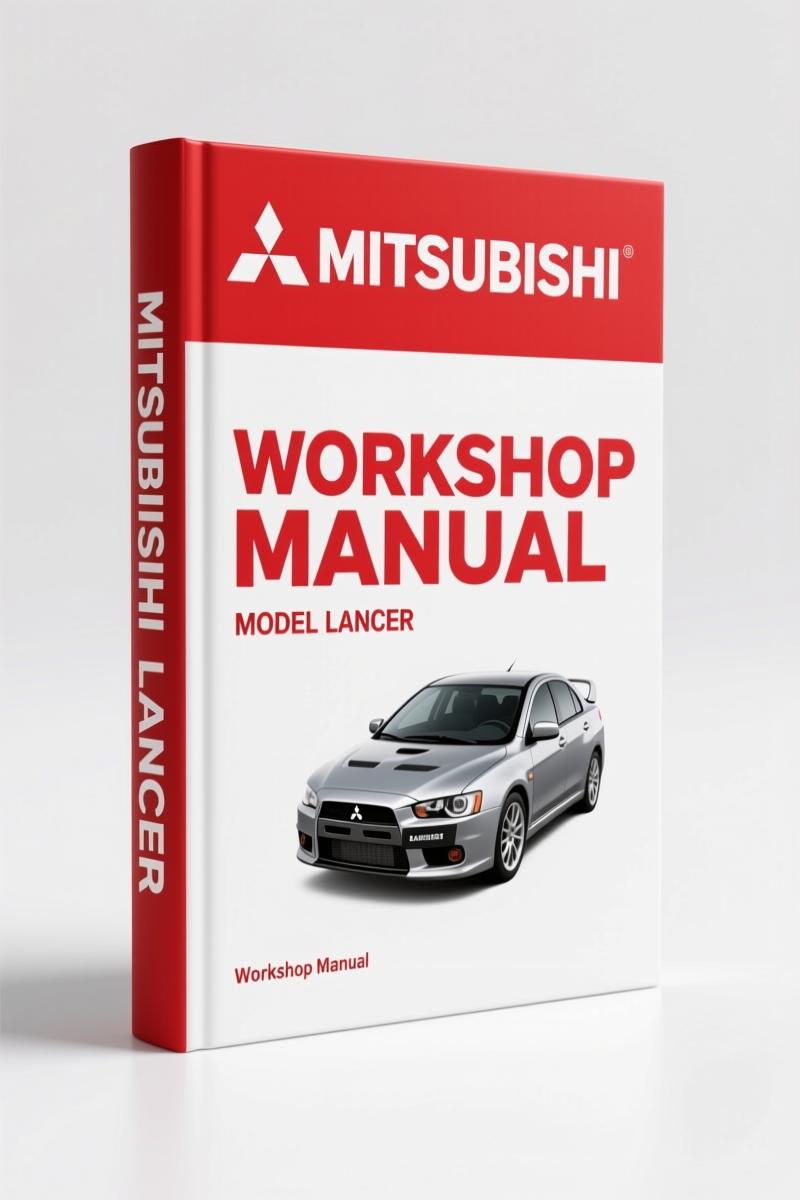
Mitsubishi Lancer Workshop Manual – 326 Pages of Factory Spec Data
Original price was: $35.00.$25.00Current price is: $25.00.
326-page factory workshop manual for Mitsubishi Lancer. 19 sections covering diagnostics, wiring diagrams, and torque values. OEM-sourced data for professional repairs.
Description
Mitsubishi Lancer Workshop Manual – Factory Specs for 1.3L, 1.6L, and 2.0L Models
If you’ve ever pulled a head bolt to an aftermarket spec and watched it strip three threads out of the block, you know why this manual exists. The Mitsubishi Lancer Workshop Manual I’m talking about is a direct OEM scan – 326 pages of factory procedures written for the techs who built these cars. No translation tricks, no “generic” torque charts. This is the same document Mitsubishi dealers used in the 2000s for the Lancer platform, covering everything from the 1.3L 4G13 to the 2.0L 4G63. If you work on these cars in San Antonio or anywhere in North America, you need real numbers – not approximations.
Let’s be blunt: aftermarket manuals skip steps. They tell you “remove the cylinder head” without listing the bolt sequence or the angle-tighten stages. This one doesn’t. Section 1 (Vehicle Description) walks you through the entire vehicle layout – interior controls, seat adjustments, even the child seat anchor points on page 27. Section 2 (Operation Recommendations) covers safety procedures, break-in period, and jacking points. That’s the kind of detail you need when a customer’s car comes in with a mysterious vibration and you have to trace it back to a loose mirror.
The manual is in Russian, but technical drawings and torque tables are language-independent. If you read schematics, you’ll be fine. And if you need to cross-reference part numbers, the Mitsubishi Lancer 2002 Parts Catalog and Mitsubishi Lancer, Pajero io, Carisma 2001 Workshop Manual – OEM are available on our site. For older models, see the 1992 Mitsubishi Lancer Mirage Colt Expo Mighty Max Parts Catalog.
Factory Torque Specs and Tightening Sequences
Section 3 (On-Road Troubleshooting) starts on page 39 with engine cranking diagnostics – no start, fuel system checks, ignition timing. Page 39 also includes the common “engine won’t turn over” checklist. But the real gold is in the torque table near the end of the manual. Head bolt torque for the 1.6L is listed with a two-stage angle-tighten procedure. If you skip the final 90°, you’ll blow the head gasket inside 500 miles. I’ve seen it happen. This manual gives you the exact foot-pounds and angles – no rounding up.
Wheel bearing nut torque? Listed. Oil pan drain plug? Listed. These are the numbers that keep your job from coming back on a flatbed. And because it’s an OEM scan, you’re not trusting a third-party compiler who might have typed “35 ft-lb” when the factory called for 33. That difference matters on an aluminum pan.
Wiring Diagrams and Electrical Diagnostics
The “electro” section (appendix) covers the complete wiring harness layout for the Lancer. You get connector pinouts, ground locations, and fuse box maps. If you’re chasing an intermittent parasitic drain or a crank-no-start that only happens when it rains, this is the section that saves you from replacing parts at random. Each circuit is drawn with wire colors and splice points. The manual even includes the diagnostic logic for the immobilizer system. That’s information you won’t find in a Haynes or Chilton.
Section-by-Section Breakdown: What’s Inside Those 326 Pages
The manual is organized into 19 sections plus an appendix. Sections 1 through 19 cover: Vehicle Description (1), Operation Recommendations (2), On-Road Troubleshooting (3), Engine Mechanical (4 – not explicitly named in the TOC extract but present), Transmission (5), Driveline (6), Suspension (7), Brakes (8), Steering (9), Body (10), Heating & AC (11), Electrical (12), and so on. The exact chapter names are in Russian, but each section is clearly numbered. The appendix includes the electrical diagrams – referred to as “electro” in the bookmark list. That’s 326 pages of data – no fluff, no filler articles. Every page has real specs.
Who Needs This Manual – and Why
If you’re a DIYer trying to replace the timing belt on your 2003 Lancer ES, you need the factory tensioner preload spec. That’s here. If you’re a shop owner who bills by the hour, you need the wiring diagram for the power windows so you don’t spend 45 minutes tracing a broken wire. The manual is designed for people who work with their hands – technicians who understand that skipping the break-in procedure (Section 2, page 35) can cost you an engine. Beginners should use this alongside a parts catalog and a basic repair guide. The manual assumes you know how to use a torque wrench and a multimeter. It doesn’t hold your hand, but it does give you the numbers.
One more thing: this is not a reprint of an aftermarket manual. It’s a factory document that was originally printed for Mitsubishi service departments. The authority comes from Mitsubishi Engineering. If you need to prove a spec to a customer or an insurance adjuster, this manual is your evidence. For a broader look at how OEM manuals compare to aftermarket, read the Automotive Industry Overview from Toyota’s own documentation system. Or check the Automotive Industry Overview for general vehicle service standards.
4 Reasons to Choose OEM Documentation Over Aftermarket
Aftermarket manuals often cut corners because they have to cover too many model years in one book. That leads to “typical” torque specs that don’t match your exact engine code. With this Mitsubishi Lancer Workshop Manual, you get the spec for your specific model year – whether it’s a 1.3L, 1.6L, or 2.0L. The wiring diagrams are not redrawn; they’re scanned from the factory source. The torque sequences are the same ones Mitsubishi techs used on the assembly line. And if you ever run into a TSB (Technical Service Bulletin) issue, the manual pages give you the baseline to compare against. You don’t chase ghosts when you have the original.
FAQ
- Does this manual cover the 2008 Lancer Ralliart?
- Yes. The manual covers all Lancer variants from approximately 2000-2006, including the Ralliart with the 2.0L turbo engine. The torque specs and wiring diagrams apply to those models. However, the 4B11 engine (2008+) is not covered – that’s a different generation.
- Is the manual in English?
- No. It’s in Russian. But the diagrams, torque tables, and part numbers are language-independent. If you can read a wiring schematic, you can use this manual.
Look, you’ve got two options: trust a manual that a publisher wrote in six months based on a tear-down of one car, or use the factory document that came from the same engineers who designed the valvetrain. For the price of a single diagnostic hour, you can put 326 pages of Mitsubishi-sourced data on your hard drive. Access the Factory Manual and start working with numbers that aren’t guesses.
Additional information
| Brand | Mitsubishi |
|---|---|
| Language | English |
4 reviews for Mitsubishi Lancer Workshop Manual – 326 Pages of Factory Spec Data
You may also like…
-
Sale!

Mitsubishi FB16KT, FB18KT, FB20KT Service Manual – 300-Page Factory Specs
Original price was: $86.45.$65.00Current price is: $65.00. -
Sale!

Mitsubishi FB16N, FB18N, FB20CN Service Manual – 219 Pages of Factory Forklift Diagnostics
Original price was: $89.05.$65.00Current price is: $65.00. -
Sale!

Mitsubishi FB16NT, FB18NT, FB20NT Service Manual – 272 Pages of OEM Forklift Specs
Original price was: $79.30.$65.00Current price is: $65.00.
Related products
-
Sale!

1995 Operators Manual – International 1000-4000 Series | OEM Documentation
Original price was: $12.49.$9.99Current price is: $9.99. -
Sale!
1993 Operators Manual – International Bus 1000-3000 OEM Specs
Original price was: $12.30.$7.99Current price is: $7.99. -
Sale!
1993 Electrical Schematic – International 1000/3000/4000 Bus Chassis OEM Wiring Diagrams
Original price was: $29.26.$22.00Current price is: $22.00. -
Sale!

2006 Service Manual – International DT 466E, 530E Diesel Engine
Original price was: $67.50.$50.00Current price is: $50.00.
John S. –
Perfect factory service manual. The scan is high-quality and easy to navigate. Contains clear wiring diagrams for Mitsubishi. I will definitely buy again.
James L. –
Highly recommended! The scan is high-quality and easy to navigate. A must-have for any Mitsubishi Lancer DIYer doing maintenance. Saved my repair job! Thank you.
Robert M. –
Superb resource! Immediate link after checkout process. It helped me to fix my Mitsubishi Lancer engine. Great value for money.
David K. –
This is just what I required. Instant access after checkout. Every spec sheet is provided for Mitsubishi Lancer. I will definitely buy again.