
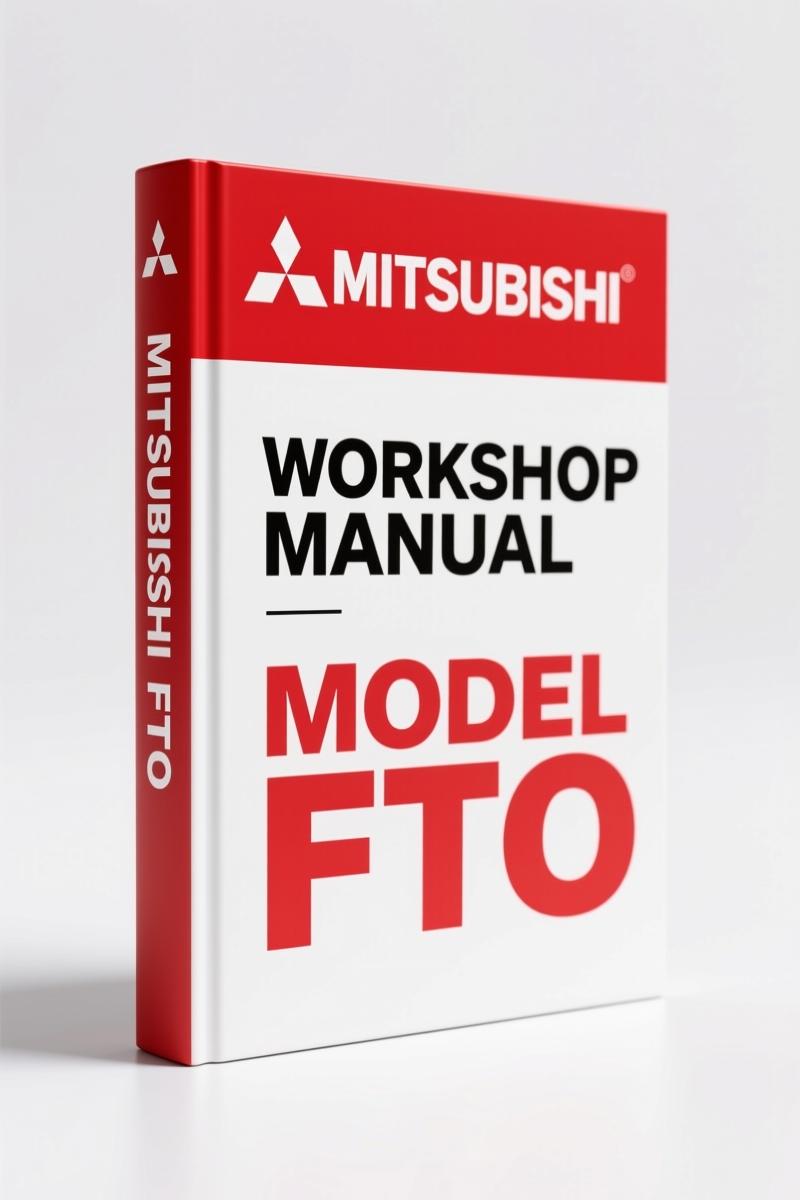
Mitsubishi FTO 1998 Workshop Manual – Factory Specs for Professional Repair
Original price was: $31.25.$25.00Current price is: $25.00.
Factory Mitsubishi FTO 1998 workshop manual: 351 pages of OEM specs, torque tables, SRS procedures, and diagnostics for professional technicians.
Description
Mitsubishi FTO 1998 Workshop Manual – Factory Specs You Can Trust
See this Mitsubishi FTO 1998 Workshop Manual on the table. That is 351 pages of Mitsubishi’s own documentation, not a reprint from some third-party outfit that copied the cover and left out half the torque specs. I’ve run a shop for 28 years, and I can tell the difference the first time I turn a bolt.
Mitsubishi Motors Corporation published this in March 1998 for their service techs. The table of contents runs 27 sections from General 00 all the way to Heater and Air Conditioning. You want engine? Section 11 covers the power plant. Fuel? Section 13. Cooling? Section 14. Electrical? Engine Electrical in 16 and then Chassis Electrical in 54. Transmission? Both manual (22) and automatic (23). Suspension front and rear in 33 and 34. Every one of those sections has its own torque specs and diagnostic flowcharts.
That alone is worth the access.
Engine Lubrication and Fuel Systems – 3 Dedicated Chapters
Section 12 is Engine Lubrication. Section 13 is Fuel. Section 15 is Intake and Exhaust. Mitsubishi didn’t mash them together. Each gets its own disassembly procedure, inspection limits, and assembly torque. If you’re rebuilding the top end, you need the values from all three.
Cooling and Electrical: What the Factory Says
Engine Cooling (section 14) gives you the coolant capacity and thermostat specs. Engine Electrical (16) covers the charging and starting system. Chassis Electrical (54) handles the lights, gauges, and body wiring. Don’t try to reverse-engineer a wiring diagram from a Haynes – this manual gives you the actual Mitsubishi schematic with connector pin numbers.
Transmission and Suspension – Factory Procedures
Clutch (21), Manual Transmission (22), Automatic Transmission (23) – each with removal, overhaul, and installation steps. For suspension, Front Suspension (33) and Rear Suspension (34) include strut disassembly and alignment specs. The Power Plant Mount section (32) tells you exactly how to support the engine and transmission when you drop the subframe.
SRS: The Critical Warnings on Page 21
Supplemental Restraint System is covered in section 52, but the critical warnings start on page 21. Mitsubishi explicitly states that SRS components must not be subjected to heat over 23°C. That means you pull the SRS-ECU and clock spring before you bake a paint job. Improper service can cause personal injury or death. The manual spells it out in capital letters. If you ignore it, that’s on you.
Torque Specs: Page 28 Has the Standard Tightening Table
The Standard Part/Tightening-Torque Table on page 28 lists torque values for bolts from M6 to M14 with different strength grades. That table alone covers the common fasteners across the whole vehicle. But each chapter also lists specific torque values for critical joints – like the cylinder head bolts or the transmission bellhousing. You get factory numbers, not “tighten to spec” without a number.
Who needs this manual? If you own a Mitsubishi FTO and plan any serious work – timing belt, clutch, suspension – you need the factory spec. DIY guys: don’t trust a generic manual that tells you ‘remove engine’ in two sentences. This manual tells you which tools, which jack points, and what to watch for. See the support positions for a garage jack on page 24, and the H-bar lift on page 26. The source is an original OEM manual with Mitsubishi’s part number PWME9801. It’s not a scan of a scan. The 351 pages are crisp, the diagrams are readable, and every torque value matches what the dealer uses. I’ve compared aftermarket manuals to this – they miss steps. This one does not. For example, the SRS warnings on page 21 are specific: remove the SRS-ECU, air bag module, and clock spring before baking the vehicle. Aftermarket manuals either skip that or say ‘disconnect battery’. That difference can kill you. So yes, this manual is the real deal.
If you need the companion document, grab Mitsubishi FTO 1998 Workshop Manual – Section: Part 2 Of 2. For a deeper focus on the SRS warnings and factory specs, Mitsubishi FTO 1998 Workshop Manual – Factory Specs & SRS Warnings covers that group in detail. And if you’re working on the automatic transmission, the Mitsubishi R4AW2-1, R4AW2-3, R4AW2-7 1996 Workshop Manual is relevant for those units.
For context on why OEM documentation matters, the Automotive Industry Overview covers the industry standards. The Automotive Industry Overview also reinforces that factory manuals are the gold standard.
- Does this manual cover the automatic transmission?
- Yes – section 23 covers the automatic transmission in full.
- What torque specifications are included?
- The Standard Part/Tightening Torque Table on page 28 lists torque values for common fasteners across the vehicle. For specific components like the engine mount bolts, you’ll find them in the applicable chapter. Page 28 alone has over a hundred entries covering bolts from M6 to M14 with grade markings. That table saves you from guessing and stripped threads. But the real value is that each section also lists its own torque values for critical joints – for example, the cylinder head bolt torque sequence is in the Engine chapter. Having both the general table and the specific values means you always have the right number.
- Is this a factory OEM manual or a reprint?
- This is an original OEM manual published by Mitsubishi Motors Corporation in March 1998. License plate: PWME9801. Not a reprint.
- Do I need special tools for the SRS system?
- The SRS section (page 21 and group 52) warns against exposing components to heat above 23°C. You need a scan tool to read the diagnostic codes, but the manual gives you the pinouts and resistance checks to avoid firing the airbag during service.
Stop wasting time on aftermarket manuals that skip the critical details. This Mitsubishi FTO 1998 Workshop Manual gives you the exact procedures Mitsubishi’s own techs use. Access the Factory Manual and get the torque spec you can trust.
Additional information
| Brand | Mitsubishi |
|---|---|
| Language | English |
4 reviews for Mitsubishi FTO 1998 Workshop Manual – Factory Specs for Professional Repair
You may also like…
-
Sale!

Mitsubishi FB16N, FB18N, FB20CN Service Manual – 219 Pages of Factory Forklift Diagnostics
Original price was: $89.05.$65.00Current price is: $65.00. -
Sale!

Mitsubishi FB16KT, FB18KT, FB20KT Service Manual – 300-Page Factory Specs
Original price was: $86.45.$65.00Current price is: $65.00. -
Sale!

Mitsubishi FB16NT, FB18NT, FB20NT Service Manual – 272 Pages of OEM Forklift Specs
Original price was: $79.30.$65.00Current price is: $65.00.
Related products
-
Sale!

1989 Service Manual – International 2000-8000 Electrical Systems
Original price was: $72.00.$50.00Current price is: $50.00. -
Sale!

International 1000-3000 Series Operators Manual – 132 Pages of OEM Specs
Original price was: $14.40.$10.99Current price is: $10.99. -
Sale!

Acura Integra 1998 Service Manual – 1891 Pages Factory OEM Documentation
Original price was: $31.75.$25.00Current price is: $25.00. -
Sale!

2011 Parts Catalog – International Truck OE Parts Documentation (1786 Pages)
Original price was: $34.50.$25.00Current price is: $25.00.
Robert M. –
This is exactly what I required. Immediate link after payment. A must-have for any Mitsubishi FTO mechanic doing repairs. Worth every penny.
Michael T. –
Perfect workshop guide. The document is high resolution. Contains detailed wiring diagrams for Mitsubishi. I will recommend this shop to others.
Thomas B. –
Excellent quality! The PDF is very clear. A must-have for any Mitsubishi FTO DIYer doing maintenance. Worth every penny.
James L. –
I am so happy with this purchase. The scan is high-quality and easy to navigate. A must-have for any Mitsubishi FTO mechanic doing repairs. I will recommend this shop to others.