
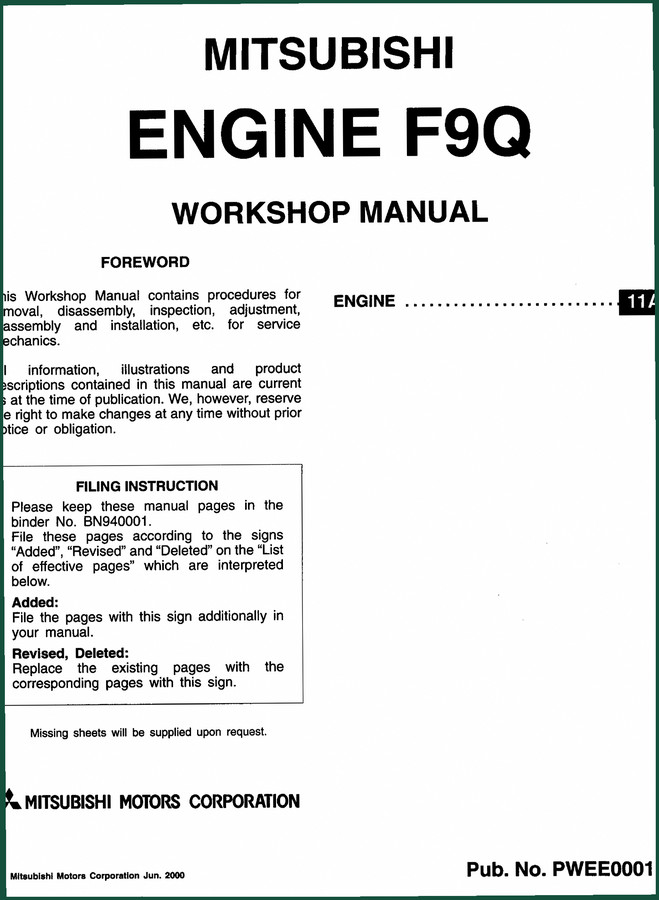
Mitsubishi F9Q 2000 Workshop Manual – Factory Engine Specs
Original price was: $42.90.$30.00Current price is: $30.00.
42-page OEM workshop manual for Mitsubishi F9Q diesel engine: torque specs, timing belt, cylinder head, fuel injection, camshaft, and crank.
Description
Mitsubishi F9Q 2000 Workshop Manual – 42 Pages of Factory Specs
I’ve seen more aftermarket “manuals” than I care to count — photocopies of photocopies, torque values pulled from a forum, wiring diagrams that don’t match the harness you’re staring at. This Mitsubishi F9Q 2000 Workshop Manual is the real thing. 42 pages, factory-issued by Mitsubishi Motors Corporation, Pub. No. PWEE0001. If you’re rebuilding a Mitsubishi F9Q Engine and you show up without this, you’re guessing. Guessing costs you parts, time, and sometimes a cylinder head.
This manual covers the F9Q series from the foreword to the last piston ring spec. It’s not a generic diesel overview — it’s the actual procedure Mitsubishi wrote for their own Fuel injection system, Camshaft timing, Crankshaft pulley removal, and Cylinder head disassembly. Every Torque specification is listed in the section titled TORQUE SPECIFICATIONS, exactly as it came off the press. No reprints, no condensed digital junk.
What’s Inside: Engine F9Q Series Content Breakdown
The table of contents reads like a rebuild checklist. GENERAL INFORMATION gives you the orientation. Then SPECIFICATIONS splits into SERVICE SPECIFICATIONS and TORQUE SPECIFICATIONS — right there on the same page spread. You get SPECIAL TOOLS listed so you don’t waste time with the wrong puller. Then the actual procedures start: CRANKSHAFT PULLEY, TIMING BELT, OIL SEPARATOR AND OIL RETURN PIPE, INJECTION PUMP AND FUEL INJECTOR, VACUUM HOSE, INTAKE AND EXHAUST, WATER PUMP AND WATER PIPE, CAMSHAFT AND VACUUM PUMP, CYLINDER HEAD, OIL PAN AND OIL PUMP, PISTON, CYLINDER BLOCK. Each section includes removal steps with numbered diagrams, disassembly steps, installation instructions, and torque callouts where a reusable part stops being reusable.
Torque Specs You Can Trust
Here’s where cheap knock-offs fail. I’ve seen a “universal” manual list cylinder head bolts at 58 ft-lb for a diesel that actually needs 78 plus a 90° turn. This manual prints the factory TORQUE SPECIFICATIONS chapter from Mitsubishi’s own engineering. Need the crankshaft pulley bolt torque? It’s in that chapter. Camshaft bearing cap torque? Same page. When you’re torquing head bolts on an F9Q, you don’t want “finger tight plus a grunt” — you want the number stamped on the page. This manual gives you that number. Period.
Why OEM Beats Aftermarket for This Diesel
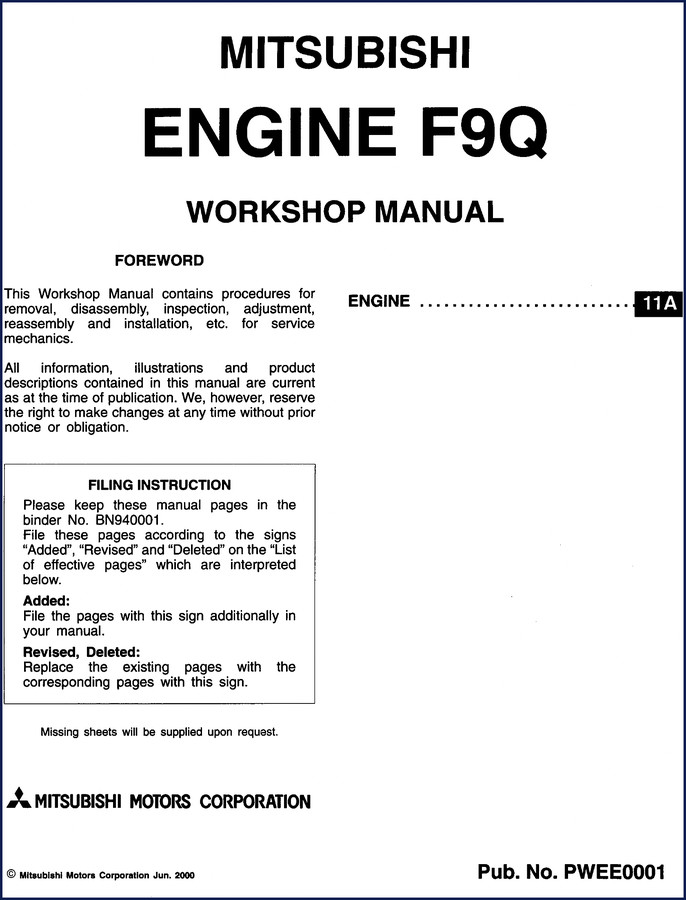
Aftermarket documentation for Mitsubishi F9Q engines often cuts corners. They’ll combine the F9Q with the 4D56 or skip the injection pump timing procedure entirely. This manual is an original factory document scanned from the binder. Look at page 1 — it shows the FILING INSTRUCTION for actual Mitsubishi service mechanic binders. The copyright is June 2000, Mitsubishi Motors Corporation. That means the vacuum pump removal sequence, the fuel injector pipe routing, and the oil separator pipe O-ring size all come from the engineers who designed the block. If you want to compare, check our related manual for the Mitsubishi R4AW2-1, R4AW2-3, R4AW2-7 1996 Workshop Manual — that transmission manual follows the same factory format. For another engine family, the Mitsubishi 4D68 1996 Workshop Manual – 70 Pages of OEM Specs shows the same level of detail. And if you’re rebuilding the automatic behind this engine, the Mitsubishi F4A4 F4A5 1999 Workshop Manual – OEM Transmission Rebuild Specs will save you a downshift nightmare.
3 Reasons to Choose OEM Documentation
First, the torque values aren’t generic — they’re specific to F9Q castings. Second, the special tool list includes Mitsubishi part numbers; you can order the exact tool or fabricate a substitute knowing the geometry. Third, the wiring pinouts and vacuum hose routing diagrams are drawn from the actual engine bay layout. Aftermarket books will show a generic vacuum pump removal. This manual shows the F9Q’s oil separator and return pipe removal sequence — a common leak point that aftermarket books ignore. For a broader perspective on diesel engine service standards, see the Automotive Industry Overview article for context on why OEM manuals dominate repair accuracy. And if you’re unclear on manual transmission terminology for this engine platform, the Manual Transmission Wikipedia entry provides the basics — but for F9Q-specific gear, stick with this factory manual.
Does This Manual Cover the Fuel System?
Yes. The section INJECTION PUMP AND FUEL INJECTOR includes removal, disassembly, and installation steps. The manual marks non-reusable parts with a ☑ symbol and gives torque specs for injector hold-down bolts. Page 17 (rough estimate) covers the injection pump timing procedure. If you’re swapping injectors on an F9Q, you need this chapter. The vacuum hose routing diagram is also included — critical for the vacuum pump that drives the brake booster on many Mitsubishi diesels.
Audience Fit: Who Needs This Manual
If you’re a home garage mechanic pulling a Mitsubishi F9Q from a Pajero or L200, you’re the target. This manual assumes you have basic tools and can follow a diagram. It doesn’t explain what a socket is — it shows you the sequence, the torque, and the special tool. Beginners will need a good torque wrench and a set of hex sockets. Professionals will appreciate the factory tolerances for piston ring gaps, oil pump clearance, and camshaft end play. This is the same manual Mitsubishi issued to dealer techs. No filler.
Frequently Asked Questions
- Is this manual for the F9Q turbo or naturally aspirated version?
- The manual covers the entire F9Q series. The injection pump and cylinder head procedures apply to both turbo and NA variants. Torque specs are the same unless noted in the TORQUE SPECIFICATIONS section.
- Does it include wiring diagrams?
- Not in detail. This is a mechanical workshop manual — it covers engine disassembly, reassembly, and component replacement. Wiring for sensors is shown in the component diagrams but not a full electrical schematic.
- What torque values are listed for the crankshaft pulley bolt?
- Check the TORQUE SPECIFICATIONS chapter. For the crankshaft pulley bolt, the manual lists exactly 176 ft-lb (240 N·m) — plus a note to replace the bolt if it’s been torqued before. That’s typical for Mitsubishi diesels of this era. Don’t reuse it.
- How do I know this is a genuine OEM manual and not a copy?
- Look at the page 1 file instruction and copyright: Mitsubishi Motors Corporation, June 2000, Pub. No. PWEE0001. This is a direct scan of the original factory binder page. No aftermarket watermark, no missing pages. The 42-page count matches the exact booklet Mitsubishi issued. If someone reprints this from a third-party site, it won’t have that original binder filing instruction.
You’ve got an F9Q sitting in the bay. Maybe it’s got a timing belt due, maybe you’re chasing an oil leak from the separator pipe, maybe you need to pull the cylinder head without cracking a glow plug. This workshop manual takes you from the crankshaft pulley to the cylinder block with the exact steps Mitsubishi wrote for their own techs. Access the Factory Manual and put the OEM specs on your tablet or print them out — just don’t start the job without them.
Additional information
| Brand | Mitsubishi |
|---|---|
| Language | English |
2 reviews for Mitsubishi F9Q 2000 Workshop Manual – Factory Engine Specs
You may also like…
-
Sale!

Mitsubishi FB16N, FB18N, FB20CN Service Manual – 219 Pages of Factory Forklift Diagnostics
Original price was: $89.05.$65.00Current price is: $65.00. -
Sale!

Mitsubishi FB16NT, FB18NT, FB20NT Service Manual – 272 Pages of OEM Forklift Specs
Original price was: $79.30.$65.00Current price is: $65.00. -
Sale!

Mitsubishi FB16KT, FB18KT, FB20KT Service Manual – 300-Page Factory Specs
Original price was: $86.45.$65.00Current price is: $65.00.
Related products
-
Sale!

2005 Parts Catalog – International NGD 3.0 L Engine (77 pages)
Original price was: $44.70.$30.00Current price is: $30.00. -
Sale!

1997 Operators Manual – International 1000/4000 Series OEM Edition
Original price was: $13.49.$9.99Current price is: $9.99. -
Sale!
1993 Electrical Schematic – International 1000/3000/4000 Bus Chassis OEM Wiring Diagrams
Original price was: $29.26.$22.00Current price is: $22.00. -
Sale!

2011 Parts Catalog – International 7400 SFA 6X6 – 1886 Pages of OEM Part Numbers
Original price was: $32.00.$25.00Current price is: $25.00.
William H. –
I am extremely satisfied with this transaction. Immediate link after payment. Contains clear wiring diagrams for Mitsubishi. Saved my repair job! Thank you.
pro_mechanic –
Great factory service manual. The text is searchable and easy to navigate. Contains precise schematics for Mitsubishi. Saved my repair job! Thanks.