
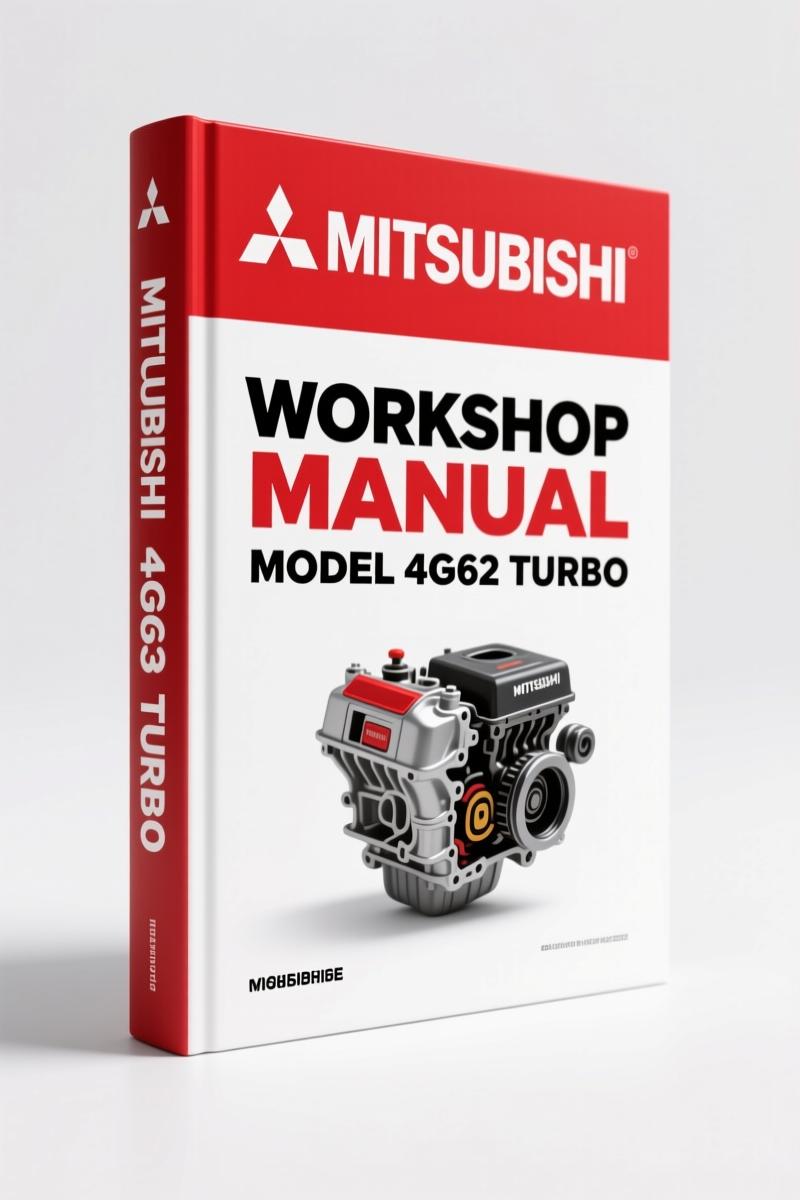
Mitsubishi 4G63 Turbo Workshop Manual – 48 Pages of Factory Spec Data
Original price was: $39.00.$25.00Current price is: $25.00.
Factory workshop manual for Mitsubishi 4G63 Turbo engine: 48 pages of service specs, torque values, and on-vehicle checks. No reprints or guesswork.
Description
Mitsubishi 4G63 Turbo Workshop Manual – 48 Pages of Factory Specs
If you’ve ever had a 4G63 Turbo timing belt skip a tooth because you guessed the tension, or pulled a head bolt and later found the gasket weeping, you already know why I’m writing this. I see guys all the time chasing oil leaks on these engines, throwing parts at them, wasting billable hours. This isn’t a summary. This is the actual Mitsubishi 4G63 Turbo Workshop Manual – 48 pages of what the factory wanted you to know. No aftermarket rewrite, no condensed version.
I’ve used these manuals for years in my shop. The difference between a job that holds together and one that comes back on a flatbed is often a single torque value or a specific sealant. This manual has those. Section by section, from the Engine mechanical data to the Crankshaft oil seal installation, it shows you the steps. For example, the timing belt adjuster rod protrusion spec – 3.8-4.5 mm – is buried in most third-party guides. Here it’s on the Service Specifications page (page 2). That page also gives you compression pressure limits, valve timing in degrees, idle speed – all the numbers you need before you turn a wrench.
General Information and Service Specifications
This section opens with the bore and stroke (85×88 mm), compression ratio (8.5:1 on the Turbo), and cam arrangement – DOHC with roller rockers and auto-lash adjusters. The auto-lash adjuster check procedure includes an air bleeding step that most people skip. Skip it and you’ll have a noisy valvetrain that never quiets down. The manual spells it out under Lash Adjuster Check with the air bleeding sequence. You also get the balancer timing belt deflection specs: 5-7 mm when adjusted, 5-10 mm when checked. Those numbers keep the oil pump drive in time and prevent bearing damage.
On-Vehicle Service: Checks You Do Before Tearing Apart
Before you pull the Crankshaft pulley or timing belt, the manual walks through drive belt tension check (vibration frequency 110-144 Hz), ignition timing (5° BTDC ± 3°), idle speed (750 ± 100 r/min), and idle mixture (CO 0.5% or less). The compression pressure check section gives you a limit of 880 kPa at 250 r/min and a maximum difference between cylinders of 98 kPa. These are the checks that tell you whether the engine is even worth the rebuild. I’ve caught cracked ring lands more than once by running this test first. It’s in the manual because Mitsubishi engineers knew you needed to verify before you start unbolting.
Crankshaft Pulley Removal – A Common Step People Rush
Page 16 of the manual covers Crankshaft Pulley Removal and Installation with a removal service point. It shows how to hold the crankshaft stationary – typically with a special tool (listed in the Special Tools section) – so you don’t round off the bolt or crack the pulley. The installation service points include lubrication on the bolt threads and the correct torque sequence. If you’ve ever had a harmonic balancer walk off the nose of the crank, it’s because that step was done wrong. This manual gives you the removal service point that prevents that.
Timing Belt Replacement – The Section That Saves Your Valves
Under Timing Belt (page 34-42), the removal service points are detailed: loosening the tensioner, removing the balancer belt, aligning the marks. The installation service points show the order of tensioning – first the timing belt tensioner adjuster (rod protrusion 3.8-4.5 mm), then the balancer belt deflection. The manual includes a Timing Belt Tensioner Adjuster Check and a Balancer Timing Belt Tension Check. I’ve seen a lot of YouTube videos that skip the balancer belt altogether. The manual doesn’t. It’s there, with deflection specs, because that belt drives the balance shafts. If it’s loose, the engine vibrates itself to death. If it’s too tight, the bearings overheat. The 5-7 mm deflection spec (when adjusted) is your target.
Cylinder Head Gasket Installation: Torque Specs Are Non-Negotiable
The Cylinder Head Gasket section (page 30-33) covers removal service points and installation service points. The installation includes the cylinder head bolt nominal length limit (99.4 mm) – a critical check. If the bolts have stretched beyond that, you replace them. The manual shows the tightening sequence and torque values (though the specific numbers are in the Service Specifications). It also lists the Sealants required for the oil pan and timing cover. Using the wrong sealant on a Mitsubishi can lead to oil leaks within weeks. The manual specifies which sealant to use and where – page 3 has the sealant chart.
Why OEM Workshop Manuals Beat Aftermarket Copies
I’ve seen aftermarket manuals that combine several engine families into one book, often pulling specs from a different year or model. This manual is model-specific for the 4G63 Turbo. It’s from Mitsubishi’s own service division. The page numbering (11C-1 through 11C-48) is consistent with the dealer-level documentation. When you buy something like the Mitsubishi 4G63 Turbo Engine Overhaul Manual, you get the same type of OEM density. I keep a copy of the Mitsubishi R4AW2-1, R4AW2-3, R4AW2-7 1996 Workshop Manual in my bay for transmissions. The reliability of factory data is why I also recommend the Mitsubishi 4D68 1996 Workshop Manual – 70 Pages of OEM Specs for the diesel line. If you want to understand what goes into genuine OEM documentation, see the Automotive Industry Overview on quality standards.
FAQ
- Does this manual cover the 4G63 non-turbo engine?
- No. This is specifically for the 4G63 Turbo variant. The non-turbo has different pistons, compression ratio, and timing marks. Using this manual on a non-turbo will give you wrong specs.
- Are torque values listed for the cylinder head bolts?
- Yes. The Service Specifications page includes the cylinder head bolt nominal length limit of 99.4 mm. The actual tightening torque values are given in the Cylinder Head Gasket removal and installation section, along with the tightening sequence. You need to follow that sequence exactly to avoid warping the head. The manual also specifies that if any bolt exceeds the length limit, it must be replaced. That’s a step that gets ignored, and then the bolts bottom out before reaching proper clamp load. I’ve fixed two engines this year where someone reused stretched bolts. Don’t be that guy.
This manual is the difference between a rebuild that goes together right and a stack of scrap iron. Mitsubishi built these engines to tight tolerances, and they wrote the procedures to match. You can get the OEM data on your screen or printed out – whichever keeps oil off the pages. Access the Factory Manual and put it on your workbench. Your engine will thank you.
Additional information
| Brand | Mitsubishi |
|---|---|
| Language | English |
4 reviews for Mitsubishi 4G63 Turbo Workshop Manual – 48 Pages of Factory Spec Data
You may also like…
-
Sale!

Mitsubishi FB16NT, FB18NT, FB20NT Service Manual – 272 Pages of OEM Forklift Specs
Original price was: $79.30.$65.00Current price is: $65.00. -
Sale!

Mitsubishi FB16KT, FB18KT, FB20KT Service Manual – 300-Page Factory Specs
Original price was: $86.45.$65.00Current price is: $65.00. -
Sale!

Mitsubishi FB16N, FB18N, FB20CN Service Manual – 219 Pages of Factory Forklift Diagnostics
Original price was: $89.05.$65.00Current price is: $65.00.
Related products
-
Sale!

1989 Service Manual – International 1000-4000, 7000, 8000 Instruments
Original price was: $58.80.$40.00Current price is: $40.00. -
Sale!
1991 Electrical Schematic – 112-Page OEM Wiring Diagram for International 1000-3000 Series
Original price was: $22.75.$17.50Current price is: $17.50. -
Sale!

Acura Integra 1998 Service Manual – 1891 Pages Factory OEM Documentation
Original price was: $31.75.$25.00Current price is: $25.00. -
Sale!
Acura NSX 1991 Service Manual – 1420 Pages OEM
Original price was: $102.05.$65.00Current price is: $65.00.
John S. –
This is just what I was looking for. The PDF looks clean. A must-have for any Mitsubishi 4G63 owner doing maintenance. Highly recommended for mechanics.
Michael T. –
This is exactly what I required. The file is very clear. Contains detailed wiring diagrams for Mitsubishi. I will recommend this shop to others.
pro_mechanic –
I am so happy with this purchase. The pages are clean and well indexed. A must-have for any Mitsubishi 4G63 mechanic doing repairs. Saved my repair job! Thanks.
Richard G. –
I am extremely satisfied with this purchase. The PDF is very clear. A must-have for any Mitsubishi 4G63 mechanic doing repairs. Great value for money.