
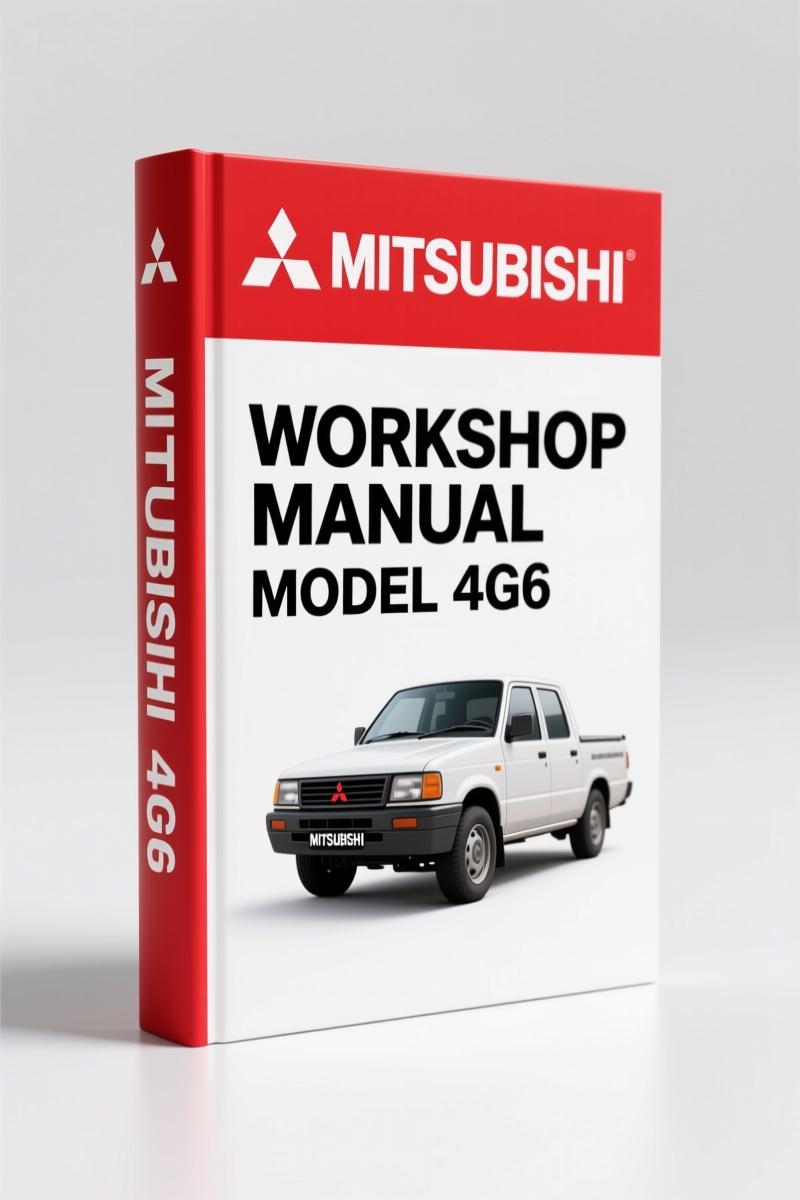
Mitsubishi 4G6 2000 Workshop Manual – Factory Engine Specs
Original price was: $30.60.$20.00Current price is: $20.00.
Factory workshop manual for Mitsubishi 4G6 series (E-W). 124 pages of OEM torque specs, fuel & emission data, and overhaul procedures.
Description
Mitsubishi 4G6 2000 Workshop Manual
You’ve got a Mitsubishi 4G6 2000 Workshop Manual in your hands now, but I’ll bet you’ve already burned an hour searching forums for the right head bolt torque. I’ve been turning wrenches since 1996, and I’ve seen more than one engine come back with a blown head gasket because a guy trusted a photocopied spec from his buddy’s uncle. This 124-page factory document from Mitsubishi itself ends that guessing. The torque specifications section alone is worth the cost—those plastic-region bolts need a specific angle after the initial torque, and aftermarket charts screw that up all the time. Page numbers aren’t my focus here; the data is what counts. You want the real numbers for the 4G6 series, including the GDI fuel system components? They’re in here, word for word from the engineers who built the thing.
Torque Specs and the Plastic Region Bolts
Mitsubishi called out a “New Tightening Method” for bolts tightened in the plastic area. That’s where a bolt is torqued past its elastic limit into the plastic deformation zone—common on head bolts and main bearing caps. The manual lists exact angles and sequences. If you skip the angle or use a generic value, the clamping load drops and the gasket fails. I keep a print of this manual at bay 3 for that reason. The service specifications table covers every fastener you’ll touch: intake manifold, exhaust manifold, rocker arms, camshaft caps, timing belt tensioner. No more wondering if 44 ft-lbs is right for the camshaft bearing cap. It’s in black and white.
What’s Inside the 124 Pages?
You get the full workshop manual layout: removal, disassembly, inspection, adjustment, reassembly, and installation steps. The table of contents lists everything from general information to the crankshaft, flywheel, and drive plate. Specific chapters include: Alternator and Ignition System, Timing Belt, Fuel and Emission Control Parts, Water Pump and Intake Manifold, Cylinder Head and Valves, Pistons and Connecting Rods, and more. Each section has a component parts diagram up front with non-reusable parts marked with an N and torque values applied. The manual also explains the symbols for lubrication and sealants—form-in-place gasket application is covered. That’s the kind of detail that keeps a job from turning into a second trip to the parts store.
GDI Fuel System: Factory Procedures for the Intake Manifold
The 4G6 series includes GDI (Gasoline Direct Injection) variants. The manual has separate sections for the intake manifold (GDI) and fuel part (GDI). That means you get the high-pressure fuel pump removal procedure, injector service specs, and the exact torque for the fuel rail bolts. Don’t trust a generic guide that lumps all Mitsubishi engines together—the fuel system on a GDI is different from a port-injected 4G6. The manual also covers the exhaust manifold (GDI) and water hose routing for the GDI models. If you’re working on a 2000 Mitsubishi with direct injection, this is the only source you should use.
Why OEM Beats Aftermarket Documentation
I’ve had three different aftermarket manuals in my shop, and each one had at least one wrong torque value or a missing step. Mitsubishi’s own workshop manual doesn’t have that problem. It was published June 2000 by Mitsubishi Motors Corporation (Pub. No. PWEE9616-C). The foreword states it contains procedures for removal, disassembly, inspection, adjustment, reassembly, and installation—exactly what the factory technicians use. Aftermarket books rephrase things, crop diagrams, and drop critical notes like “apply sealant to the mating surface” or “replace the bolt.” This manual has those notes in the original Mitsubishi format. For a full industry perspective on why OEM documentation matters, check the Automotive Industry Overview page. The difference between a reliable repair and a comeback job is the difference between this manual and a stack of forum posts.
Timing Belt and Cylinder Head Procedures
Two of the most common jobs on the 4G6 are the timing belt and the cylinder head. The manual walks through both with numbered steps and component diagrams. For the timing belt: special tools are listed (like the belt tensioner adjusting tool), removal sequence, installation with correct tension, and the alignment marks. For the cylinder head: the torque sequence for the head bolts in the plastic region is explicitly given. You also get the valve clearance specs for the rocker arms and camshafts—both GDI and non-GDI versions. This is not a generic timing belt article; it’s Mitsubishi’s own procedure.
FAQ
- Does this manual cover the Mitsubishi 4G6 engine from 1991 to 2000?
- This specific manual covers the 4G6 series engines (E–W) for the year 2000. For earlier models like 1992–1993, look for the separate Mitsubishi Engine 1992-1993 Service Manual or the Mitsubishi Engine 1992-1993 Service Manual – Section: 6G7. There is also a Mitsubishi 4G6 Engine Workshop Manual 1991-1992 available. Always match the manual to your engine’s year to ensure accurate specs.
- What torque values are included for the head bolts?
- The manual includes the tightening method for bolts in the plastic area. The exact numbers are listed in the torque specifications table. I’m not going to quote them here because you need to see the full sequence—partial info leads to mistakes.
- Is the fuel system section detailed enough for a complete GDI pump replacement?
- Yes. The “Fuel Part (GDI)” chapter covers removal, inspection, and installation of the high-pressure fuel pump, injectors, and fuel rail. It also includes the relevant torque specs and sealant requirements. If you follow the steps in order, you won’t have to guess where the O-rings go.
- Can I use this manual for a 4G63 from a 2001 Eclipse?
- This manual is specifically for the 2000 model year 4G6 series. The 4G63 is part of the 4G6 family, but engine management and some hardware changed between years. Check the publication year—if your engine is a 2001, you’ll need the 2001 supplement. The 2000 manual covers the base procedures, but updated specs may differ.
That’s the straight talk. I’ve been a mechanic for 28 years, and I’ve learned that the only way to avoid comebacks is to use original factory data. This Mitsubishi 4G6 2000 Workshop Manual gives you the torque specs, fuel system details, and timing belt steps that Mitsubishi intended. Access the Factory Manual from AutoRepairManuals and keep it on your tablet right next to your torque wrench.
Additional information
| Brand | Mitsubishi |
|---|---|
| Language | English |
3 reviews for Mitsubishi 4G6 2000 Workshop Manual – Factory Engine Specs
You may also like…
-
Sale!

Mitsubishi FB16N, FB18N, FB20CN Service Manual – 219 Pages of Factory Forklift Diagnostics
Original price was: $89.05.$65.00Current price is: $65.00. -
Sale!

Mitsubishi FB16KT, FB18KT, FB20KT Service Manual – 300-Page Factory Specs
Original price was: $86.45.$65.00Current price is: $65.00. -
Sale!

Mitsubishi FB16NT, FB18NT, FB20NT Service Manual – 272 Pages of OEM Forklift Specs
Original price was: $79.30.$65.00Current price is: $65.00.
Related products
-
Sale!

Technical Manual – International 6.0L Power Stroke FICM Diagnostics
Original price was: $29.80.$20.00Current price is: $20.00. -
Sale!

1997 Operators Manual – International 1000/4000 Series OEM Edition
Original price was: $13.49.$9.99Current price is: $9.99. -
Sale!
1993 Electrical Schematic – International 1000/3000/4000 Bus Chassis OEM Wiring Diagrams
Original price was: $29.26.$22.00Current price is: $22.00. -
Sale!

1989 Service Manual – International 2000-8000 Electrical Systems
Original price was: $72.00.$50.00Current price is: $50.00.
Robert M. –
I am extremely satisfied with this transaction. The pages are clean and well indexed. It guided me to fix my Mitsubishi 4G6 engine. Great value for money.
Richard G. –
I am so happy with this transaction. It is easily zoomable on my iPad without losing quality. It guided me to troubleshoot my Mitsubishi 4G6 electrical system. Great value for money.
gearhead88 –
Great buy! It is easily zoomable on my laptop without losing quality. Contains precise schematics for Mitsubishi. I will definitely buy again.