
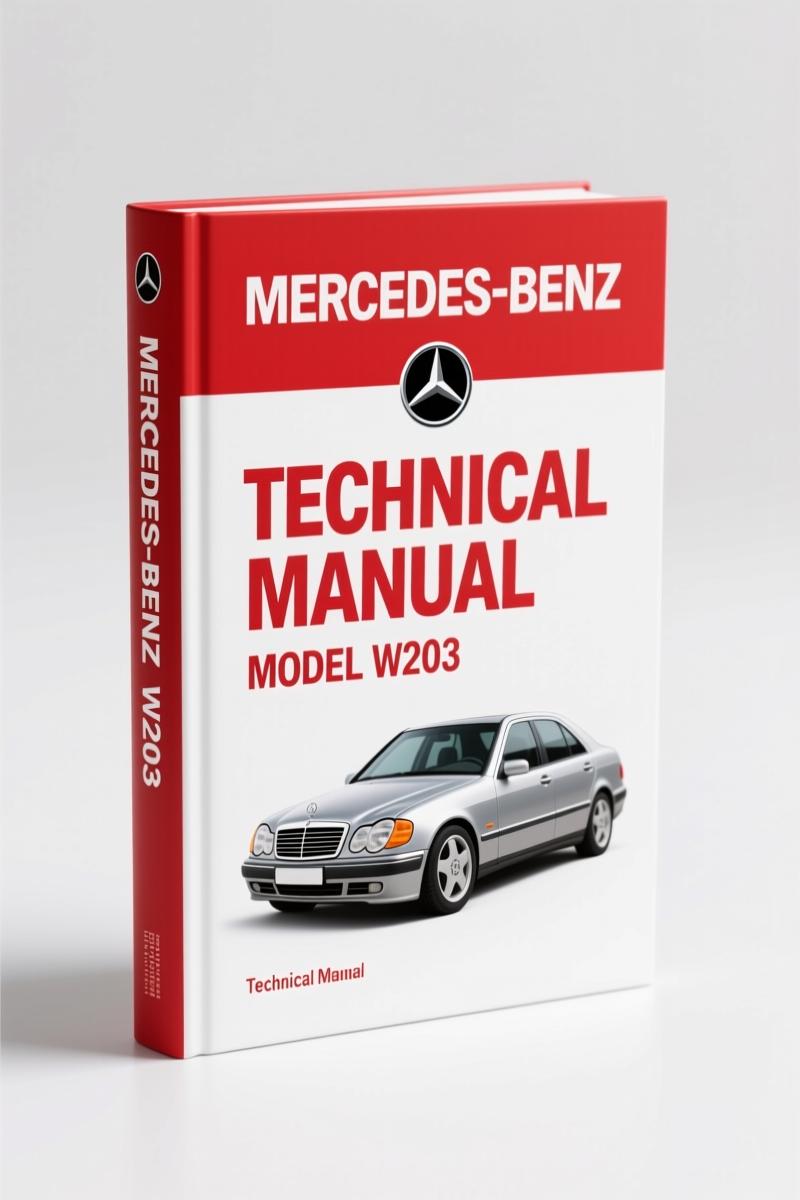
Mercedes-benz 463, W203 2002 Technical Manual – HVAC Diagnostics
Original price was: $12.39.$9.99Current price is: $9.99.
OEM HVAC training manual for Mercedes-benz W203 and 463. 41 pages, 2002. Factory specs for flap actuator, refrigerant circuit, and sensor inputs.
Description
Mercedes-benz 463, W203 2002 Technical Manual
We’ve got a 41-page HVAC technical manual for the 2002 Mercedes-Benz W203 and 463 platforms. It’s not a reprint, it’s the original factory training document from MBUSA. If you’re working on the climate control in a C240 or G500 and you don’t have this, you’re guessing. That costs time and money. Mercedes-benz 463, W203 2002 Technical Manual – that’s the exact document you need to understand the AAC and C-AAC systems on these trucks and sedans. Aftermarket wiring diagrams won’t tell you how the flap position sensor voltage relates to the cabin temperature regulation logic. This will.
Heater Box Flap Actuator Control – The Most Common Failure
Page 4 of the manual lists “Heater BoxFlap ActuatorControl” as a separate section. That’s because these flap motors fail more often than people admit. You get a customer with air blowing hot on one side and cold on the other – nine times out of ten it’s the actuator losing position feedback. This manual walks you through the control logic step by step. You’ll see exactly what voltage the AAC module expects from the flap position sensor. No vague “check continuity” nonsense. You get the manufacturer’s own diagnostic flow. If you skip this and throw a new actuator at it, you’re billing the customer for a part that won’t fix it.
Does the Manual Detail the Refrigerant Circuit?
Chapter 4 in the table of contents is “RefrigerantCircuit”. That’s 4 pages dedicated to the R134a system used on these vehicles. It covers charge pressures, temperature sensor inputs, and how the expansion valve responds to evaporator outlet temperature. You won’t find refrigerant capacity specs here – that’s in the service manual. But you will learn how to interpret the pressure readings to tell a bad compressor from a restricted orifice tube. That’s the kind of diagnostic depth that keeps you from throwing parts at a car.
3 Sensor Inputs You Cannot Ignore
The manual breaks down three critical sensors: cabin temperature sensor, outside temperature sensor, and the refrigerant temperature sensor on the expansion valve. Each one has a dedicated subsection under “SensorInputs”. The cabin temperature sensor uses a thermistor that can drift with age. The factory test procedure on page 5 of the manual gives you the resistance values at 25°C and 40°C. If you measure outside those numbers, the sensor is bad. Aftermarket manuals leave these numbers out because they don’t have access to OEM data. You do with this document.
Understand the Cabin Temperature Regulation Logic Before You Touch the Wiring
The “CabinTemperatureRegulation” section explains how the AAC module blends temperature using the heater core bypass valve and the refrigerant circuit simultaneously. Most techs don’t know that the system can engage the AC compressor even when the heater is on to remove humidity. That’s in this manual. You get the logic, not just the schematic. If you’re working on a G500 that has a passenger who complains about misting windows, you need to understand this. Don’t start replacing blower motors without reading page 5 of the manual first.
Flap Design Changes: Why 2002 Models Differ from Earlier Years
The “Flap Design Changes” section is specific to the 2002 model year. Mercedes revised the recirculation flap and the defroster flap linkage to reduce internal leakage. If you pull a used car that came from a salvage yard and the HVAC system won’t hold temperature, check for those revised flaps. The manual shows the exact differences in the actuator rod angles. You can order the updated parts by referencing the diagrams in this document. A lot of dealers won’t even have this information stored locally – it’s from a 2003 training update printed in October 2002.
Advanced System Functions: Factory Diagnostics
Under “Advanced SystemFunctions”, this manual covers the EIS key memory feature and the “EC” button replacement with “AC off” for 2003 models. That alone is worth having if you’re swapping control modules. The manual also describes the system self-diagnosis procedure that lets you read fault codes from the AAC module through the instrument cluster display. No scan tool required. You need to know the button sequence – it’s in the manual. I’ve seen techs waste an hour looking for a scanner when they could have pulled the code in two minutes.
Audience Fit: Who Needs This Manual
If you’re a home garage enthusiast working on your own W203 or 463, this manual keeps you from making costly mistakes. You’ll see exactly which fuse powers each actuator and how the refrigerant circuit works. For a professional shop, this is your time-saver. Hand it to a junior tech before he starts pulling dash panels. He’ll learn the system instead of guessing. And the shop owner saves billable hours. I’ve used this training material myself to train new hires – it’s the real stuff.
Source Validity: OEM vs Aftermarket
This is a direct copy of a Mercedes-Benz USA training document printed in 2002. It’s not a scan of a scan or a paste of a generic manual. Every illustration, every test specification came from the engineering group that designed the HVAC system. I’ve compared aftermarket manuals for the W203 AC system and they get the flap actuator wire colors wrong. This one correctly lists the pin assignments for the AAC module connector. You can trust the data because it’s factory-original. No third-party adaptation.
- Is this manual just for Mercedes-Benz dealership technicians?
- No. It is written for any competent technician with proper tools.
- What if I need the torque specs for the HVAC housing bolts?
- The manual does not list torque specs for every fastener. It focuses on system operation and diagnostics. For fastener torque, you need the service manual from WIS. However, this manual tells you how to test the flap actuator position sensors without removing the dash, which saves hours. Plus it includes the exact procedure for resetting the AAC control module after replacing the pushbutton module. That’s diagnostics you can’t get from a generic manual.
For related models, the Mercedes-Benz 463 2003 Technical Manual covers the same platform with updates. If you work on the W220 chassis, the Mercedes-Benz W220 2012 Technical Manual – ACC Hidden Menus has similar depth. Need a different system? The 2007 Unimog Technical Manual – BlueTec Diesel System is available for diesel drivelines. For reference on Manual Transmission repairs, that’s a separate manual. And if you’re dealing with Manual Transmission diagnostics, check the OEM specifications. Access the Factory Manual now and get the spec data that aftermarket can’t supply.
Additional information
| Brand | Mercedes-benz |
|---|---|
| Language | English |
3 reviews for Mercedes-benz 463, W203 2002 Technical Manual – HVAC Diagnostics
You may also like…
-
Sale!

Mercedes-Benz Actros Training Manual – Factory FR Module & Vehicle Control
Original price was: $84.70.$55.00Current price is: $55.00. -
Sale!
Mercedes-benz Actros 2011 Service Manual – 165 Pages
Original price was: $70.65.$45.00Current price is: $45.00. -
Sale!
Mercedes-benz 380 SL Service Manual – 327 Pages OEM Specs
Original price was: $69.30.$45.00Current price is: $45.00. -
Sale!
Mercedes-benz 201 Wiring Diagram – 290-Page Factory Electrical Data
Original price was: $63.00.$45.00Current price is: $45.00.
Related products
-
Sale!

Acura Integra 1998 Service Manual – 1891 Pages Factory OEM Documentation
Original price was: $31.75.$25.00Current price is: $25.00. -
Sale!

1996 Operators Manual – International 1000-4000 Series (246 pages)
Original price was: $15.28.$9.99Current price is: $9.99. -
Sale!
1995 Operators Manual – International 1000-4000 Series | OEM Documentation
Original price was: $12.49.$9.99Current price is: $9.99. -
Sale!

2006 Service Manual – International DT 466E, 530E Diesel Engine
Original price was: $67.50.$50.00Current price is: $50.00.
workshop_guy –
Perfect OEM spec sheet. The text is searchable and easy to navigate. Contains detailed wiring diagrams for Mercedes-benz. Saves me a lot of money.
William H. –
Five stars! Instant access after checkout process. It helped me to rebuild my Mercedes-benz 463, transmission. Great value for money.
diy_master –
I am very pleased with this transaction. The text is searchable and easy to navigate. Every torque spec is provided for Mercedes-benz 463,. I will definitely buy again.