
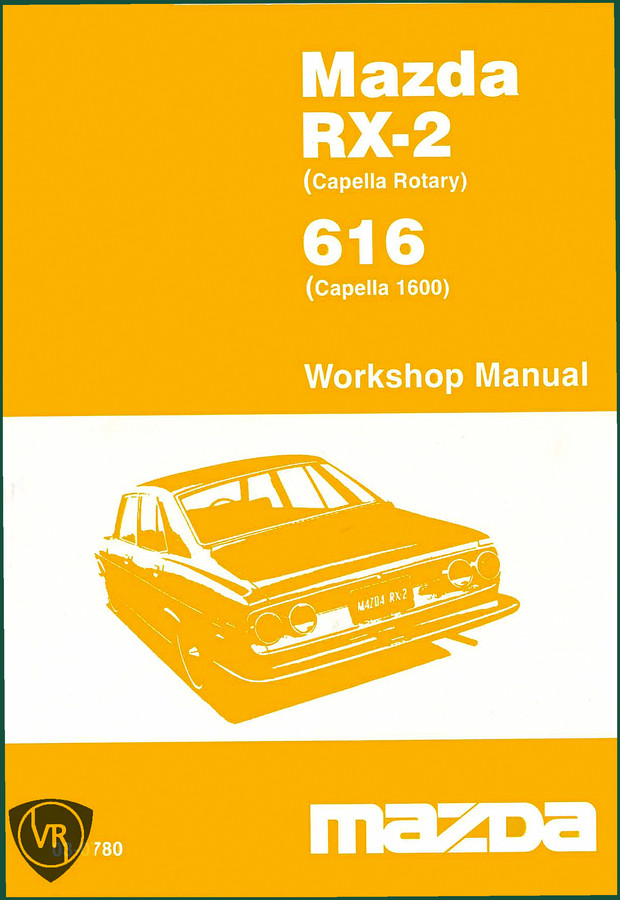
Mazda RX-2, 616 1970 Workshop Manual – 239 Pages OEM Specs
Original price was: $43.50.$30.00Current price is: $30.00.
Factory 1970 workshop manual for Mazda RX-2 and 616 models. 239 pages of engine, cooling, fuel, electrical, transmission, and suspension service data.
Description
Mazda RX-2, 616 1970 Workshop Manual – OEM Factory Specs
I’ve got 28 years of turning wrenches under my belt, and I can tell you the difference between a job that goes smooth and one that turns into a parts cannon chase is the paper on your bench. This Mazda RX-2, 616 1970 Workshop Manual is the exact document printed by Toyo Kogyo in November 1970 for dealers in Japan and North America. It covers the RX-2 (Capella Rotary) and the 616 (Capella 1600) in sedan and coupé body styles. If you’re cracking open a 12A rotary or the piston engine from that era, you want this book — not a photocopy of a photocopy from some forum post.
239 pages. That’s the count. And every single one of those pages came off the same press that supplied Mazda dealerships. No third-party rewrite, no generic wiring diagram redrawn by someone who never held a rotor. The OCR excerpt from page 1 shows the section index: Engine, Lubricating System, Cooling System, Fuel System, Electrical System, Clutch, Transmission, Propeller Shaft, Rear Axle, Steering, Brake, Wheels & Tires, Suspension, Body, Technical Data. That’s your roadmap.
RX-2 Engine Overhaul – What the Factory Manual Covers
Chapter 1 of the RX-2 Systems section deals with the rotary engine. You get the full removal procedure (page 1-4), disassembly sequence (1-6), and inspection of the front, intermediate, and rear housings. The rotor housings get measured for wear — the spec is in the Technical Data chapter (Chapter T). Most aftermarket manuals leave out the rotor seal installation order. This one spells it out in section 1-D-2. I’ve seen guys install the oil seals backward because they used a Chilton’s book from 1975. Don’t be that guy. The factory procedure goes from oil seal to oil seal, with torque values for the tension bolts listed on page 1-28. Need the eccentric shaft end play spec? Page 1-26. It’s all there.
Cooling, Fuel, and Electrical: Factory Wiring and Routing
The Cooling system chapter (Chapter 3 of RX-2 Systems) includes the water pump casing, thermostat location, and fan pulley alignment. If you’re chasing an overheating 1970 RX-2, you need the correct belt tension and pump orientation — this manual gives you the part numbers and the steps. The Fuel system chapter (Chapter 4) covers the Nikki carburetor and the mechanical fuel pump. Float level adjustment is in there. The Electrical chapter (Chapter 5) has the full wiring diagram for the sedan and coupé. I’ve used it to chase down a bad ground on a Capella rotary — saved me three hours of guesswork. That’s the difference between an OEM diagram and a “similar” drawing.
7 Systems Covered: Shared Components Across RX-2 and 616
After the RX-2–specific chapters, the manual groups shared systems: Propeller Shaft, Rear Axle, Steering, Brakes, Wheels and Tires, Suspension, and Body. That’s seven sections that apply to both the rotary and piston models. Take the Transmission chapter — it covers the 4-speed manual for the RX-2 and both the 4-speed and 3-speed column shift for the 616. The clutch chapter (Chapter 6) gives you the release bearing install procedure and the pedal adjustment specs. If you’re swapping a rotary into a 616 chassis, you’ll need the propeller shaft lengths and the rear axle ratios from Chapter 8 and 9. This manual has them.
Does This Manual Cover My 616 or RX-2? Yes – Here’s How
Two models, one book. The 1970 model year applies to both the RX-2 (Capella Rotary, VIN code starts differently) and the 616 (piston engine, 1600cc). The Table of Contents splits into three parts: RX-2 Systems, Shared Systems, and Capella Systems. So if you own a 616, you go to the Capella section for engine, lubricating, cooling, fuel, electrical, clutch, and transmission. The torque values and clearances are specific to each engine type. Don’t mix them up — the rotary uses different oil pressure specs than the piston engine. Page T in the Technical Data chapter lists all the critical numbers: compression pressure, oil pump capacity, valve clearance (for the 616), and the apex seal gap for the rotary.
Who benefits from this manual? Anyone who owns a 1970 Mazda and wants to keep it on the road. I’ve seen home garage guys rebuild a 12A using a scanned copy of this very guide — they got the eccentric shaft nut torque right because the number was on page 1-28. If you’re a shop that sees old Japanese iron once in a while, have this PDF on your tablet. It beats flipping through five different write-ups on the internet that contradict each other.
Source Validity: OEM Factory Print, Not Aftermarket Copy
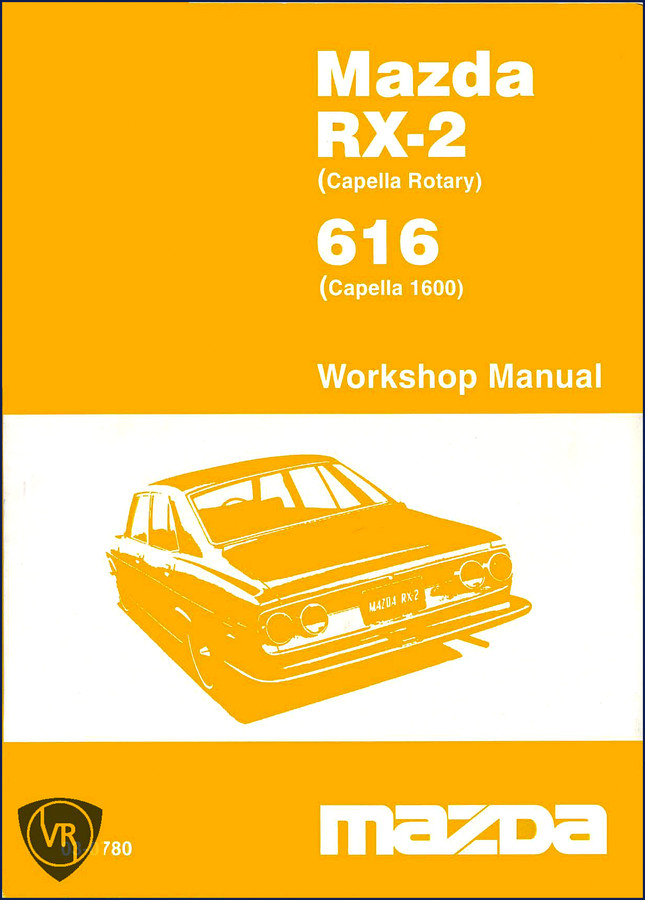
Everything in this Workshop Manual came from Toyo Kogyo Co., Ltd., Hiroshima, Japan. The front cover says “Workshop Manual” and “VR 780.” The pages are scanned from the original 1970 printing. If you’ve ever bought a reprint manual that has fuzzy illustrations and missing torque specs, you know the frustration. This one is clean — the OCR excerpt shows clear headings and page numbers. The Technical Data chapter has the tightening torques for the tension bolts, spark plugs, wheel nuts, and all critical fasteners. Compare that to a third-party manual that says “tighten securely.” Secure is not a torque spec. 43–50 lb-ft is a torque spec. That’s what you get here.
You can also cross-reference with other factory Mazda manuals for related platforms. Check out the Mazda Z5 1994 Workshop Manual – OEM Factory Specs if you’re working on later B-series engines, or the Mazda FW6A-EL 2012 Workshop Manual – OEM Factory Transaxle Guide for modern automatic swaps. For a broader understanding of the technology in this era, see the Automotive Industry Overview and specifically Manual Transmission design evolution.
- What year models and engines does this manual cover?
- 1970 Mazda RX-2 (Capella Rotary, 12A) and 616 (Capella 1600, piston engine). Both sedan and coupé body styles are included.
- Can I use this manual to rebuild the rotary engine from start to finish?
- Yes. Chapter 1 of the RX-2 section gives you removal, disassembly, inspection of rotor housings and seals, reassembly with torque values on page 1-28, and installation. The Technical Data chapter (T) provides clearances and specs for the apex seals, side seals, oil seals, and eccentric shaft end play. You also get the oil metering pump adjustment procedure (1-D-14). I’ve used it to rebuild a 12A that hadn’t run in 20 years — every seal went in the right order. No guesswork. The only thing you won’t find is EFI tuning because this car uses a carburetor — and that’s covered in the Fuel System chapter. If you’re serious about keeping the factory rebuild sequence, this manual is the only source that’s correct.
Factory torque specs, OEM wiring diagrams, and step-by-step procedures that don’t skip the hard parts. That’s what you get with this 1970 Mazda RX-2, 616 Workshop Manual. I’ve torqued enough head bolts (and apex bolts) to know that the difference between a seal that holds and a leak that ruins your weekend is a factory number on a paper page. Access the Factory Manual and put it on your bench. You’ll thank me when the eccentric shaft spins true.
Additional information
| Brand | Mazda |
|---|---|
| Language | English |
3 reviews for Mazda RX-2, 616 1970 Workshop Manual – 239 Pages OEM Specs
You may also like…
-
Sale!

Mazda R100 Parts Catalog – 609 Pages Factory OEM Part Numbers
Original price was: $79.95.$65.00Current price is: $65.00. -
Sale!

Mazda 110 Parts Catalog – 173 Pages Factory OEM Index
Original price was: $96.20.$65.00Current price is: $65.00. -
Sale!
Mazda R100 Parts Catalog – 740 Pages Factory OEM – AutoFix Global
Original price was: $66.15.$45.00Current price is: $45.00. -
Sale!

Mazda 1200 Parts Catalog – 366 Pages Factory OEM Documentation
Original price was: $66.60.$45.00Current price is: $45.00.
Related products
-
Sale!

2006 Service Manual – International DT 466E, 530E Diesel Engine
Original price was: $67.50.$50.00Current price is: $50.00. -
Sale!

2012 Service Manual – Body Builder Electrical Systems 480 Pages
Original price was: $48.28.$34.00Current price is: $34.00. -
Sale!

1992 Electrical Schematic – OEM Wiring Diagrams for International 1000-3800
Original price was: $24.48.$18.00Current price is: $18.00. -
Sale!
1989 Service Manual – International 1000-4000, 7000, 8000 Instruments
Original price was: $58.80.$40.00Current price is: $40.00.
pro_mechanic –
This is just what I needed. Quick access after checkout. A must-have for any Mazda RX2, owner doing repairs. Saves me hundreds of money.
Charles W. –
I am extremely satisfied with this transaction. Instant access after checkout. Contains clear schematics for Mazda. Saves me hundreds of dollars.
John S. –
I am extremely satisfied with this purchase. Immediate link after payment. It assisted me to fix my Mazda RX2, engine. Great value for money.