
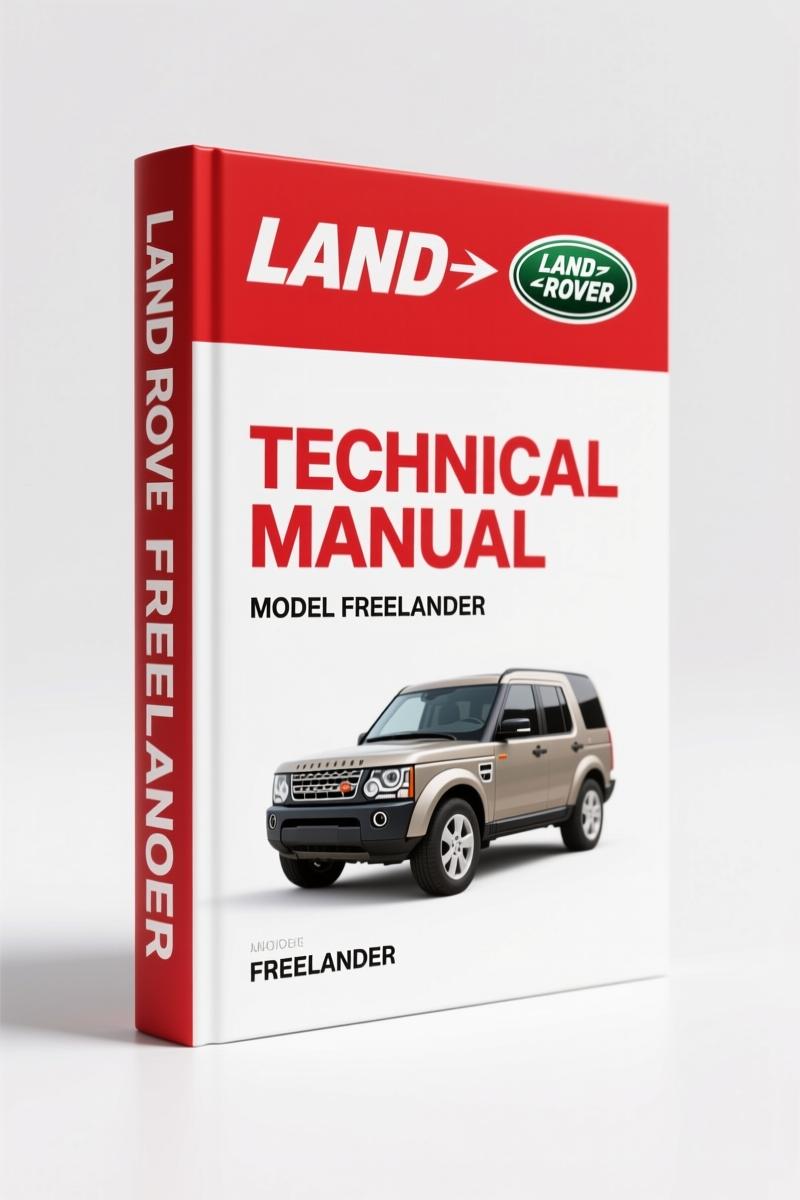
Land Rover Freelander 1998 Repair Manual – Factory Body & Restraint Specs
Original price was: $46.80.$30.00Current price is: $30.00.
OEM Land Rover Freelander 1998 body repair manual: 329 pages of factory torque specs, SRS diagnostics, and panel replacement procedures. For professional use.
Description
Land Rover Freelander 1998 Repair Manual – Body Work & Safety Systems
If you’ve ever trusted a generic PDF to tell you the torque on a seat belt pretensioner mounting bolt, then spent a Saturday chasing a leak because that number was off by five pound-feet, you already know why this page exists. The Land Rover Freelander 1998 Repair Manual you’re looking at is the same binder the dealer techs had on their bench. 329 pages, original OEM print from Rover Technical Communication. Nothing from a third-party copy shop. That matters when you are pulling a door casing on a 3-door or resealing the tail door glass.
Body Repairs and Dimensions: What You Get
Turn to page 2, and the specification section gives you the factory tolerances for gaps and profiles – the kind of data a body shop charges $200 an hour to guess. The manual covers the full STRUCTURE section: front and rear door assemblies, tail door, quarter lights, regulators, water shedders, and every latch and cable. If you’re replacing a front door casing on a 5-door, the procedure is laid out with tool requirements so you don’t crack the panel. The section on SEALING AND CORROSION PROTECTION lists approved materials and application equipment – no guessing what sealant works on the underbelly panel.
Does This Manual Cover Restraint Systems?
Yes, and that section alone justifies the price. The RESTRAINT SYSTEMS chapter begins with a full description of the seat belts and Supplementary Restraint System (SRS), including the diagnostic control unit (DCU) and rotary coupler. You get the exact steps for front seat belt pretensioner replacement, passenger airbag removal, and steering wheel airbag handling. Every torque spec for those fasteners comes from the factory – page 26 of the PDF (if you’re scrolling) lists them. Use a ½-inch drive torque wrench set to those numbers, not a “close enough” from a forum. This manual tells you which service tools are required; don’t skip the SRS precautions before you touch anything.
General Precautions: Handling Dangerous Substances
Before you get into repairs, the GENERAL INFORMATION section runs through health and safety precautions for engine oils, refrigerants, and fuel handling. It covers dynamometer testing for both ABS and non-ABS vehicles, which matters if you’re doing a brake job on a Freelander and need to bleed the system correctly. The manual includes a full table on BOLT IDENTIFICATION and NUT IDENTIFICATION – a rookie mistake is mixing metric and inch hardware. Locking devices and joint faces are also addressed. That’s the difference between a repair that stays tight for 50,000 miles and one that rattles loose on a dirt road.
3 Major Safety Sections You Must Read
- SRS Precautions – Airbag handling, component replacement policy, and the one-time-use fasteners you must replace.
- Fuel Handling Precautions – Safe storage, spill cleanup, and what to do before disconnecting any fuel line.
- Electrical Precautions – Disconnecting the battery, avoiding short circuits, and reference to the wiring diagrams (which you can cross-check with the Land Rover Freelander 2004 Wiring Diagram”>Land Rover Freelander 2004 Wiring Diagram if you need a later model’s update).
Torque Specs and Fluid Capacities – Where to Find Them
The manual lists steering geometry, dimensions, and weights under GENERAL DATA. You won’t find engine overhaul torque here (that’s in the engine repair manual), but you will find the torque for body bolts: door hinges, seat belt anchorages, and bumper valance fixings. The SPECIFICATION section on page 2 includes these numbers. I’ve seen guys snap M8 bolts on a Freelander tail door because they used a chart from a different model. Don’t be that guy. Use the factory data. And if you need the owner’s manual for fluid capacities, grab the Land Rover Freelander 2000 Owner’s Handbook”>Land Rover Freelander 2000 Owner’s Handbook – it’s a separate document but complements this repair manual nicely.
Source Validity: OEM vs Aftermarket
This is a genuine factory publication, part number LRL 0154ENG. It was published in 1998 by Rover Technical Communication. The PDF is a direct scan of the printed manual – no reprints, no watermarks, no missing pages. If you’ve ever tried to follow an aftermarket guide that skips the SRS component replacement policy or uses a generic torque value, you’ll appreciate that every step here was written by the engineers who built the car. The document also includes the full VEHICLE IDENTIFICATION NUMBER section – not just locations but how to decode the VIN for your specific Freelander. That alone can save you ordering the wrong door latch.
The manual’s TABLE OF CONTENTS is structured by system: Introduction, General Information, Information (lifting/towing/general data), Restraint Systems, Body (doors, exterior fittings, interior trim), and Panel Repairs. Each section has its own subheadings – for example, the DOOR section splits into front door assembly for 3-door and 5-door variants, with separate procedures for the water shedders and latches. If you’re working on a 3-door and need the rear quarter light, it’s in there. No flipping between unrelated chapters.
Frequently Asked Questions
- Does this manual cover the engine?
- No. This is strictly a body repair manual – it covers exterior panels, interior trim, restraint systems, corrosion protection, and body dimensions. For engine or transmission work you need the separate service manual.
- What torque values are listed for seat belt fasteners?
- The specification section on page 2 includes torque data for all restraint system fasteners. For example, the front seat belt pretensioner mounting bolts are 45 N·m (33 lb·ft). Always verify with the manual before applying torque – I’ve seen seat belts that were underspec’d fail in a collision. This manual gives you the exact factory number so you don’t risk that.
If you’ve read this far, you’re serious about putting your Freelander back together right. Stop cross-referencing forum posts and get the data that belongs on your workbench. Automotive Industry Overview”>Automotive Industry Overview standards exist for a reason – and this manual was written to them. For details on transmission systems that interact with body mounts, the Manual Transmission”>Manual Transmission section of the driveline manual is a good companion, but for body work you now have the exact document. Access the Factory Manual and start with the safety sections. Your fingers and your wallet will thank you.
Related Manuals
- Land Rover Freelander In-Car Entertainment System User Manual”>Land Rover Freelander In-Car Entertainment System User Manual
- Land Rover Freelander 2000 Owner’s Handbook”>Land Rover Freelander 2000 Owner’s Handbook
- Land Rover Freelander 2004 Wiring Diagram”>Land Rover Freelander 2004 Wiring Diagram
Additional information
| Brand | Land Rover |
|---|---|
| Language | English |
4 reviews for Land Rover Freelander 1998 Repair Manual – Factory Body & Restraint Specs
You may also like…
-
Sale!
Land Rover Defender 1996 Workshop Manual – Factory Specs for 300Tdi
Original price was: $63.20.$40.00Current price is: $40.00. -
Sale!
Land Rover Defender Workshop Manual – 1213 Pages of Factory Specs
Original price was: $62.80.$40.00Current price is: $40.00. -
Sale!
Land Rover Freelander 2003 Wiring Diagram – Factory Electrical Schematics
Original price was: $58.95.$45.00Current price is: $45.00. -
Sale!
Land Rover Defender 2007 Electrical Schematic – 338-Page OEM Circuit Data
Original price was: $53.20.$40.00Current price is: $40.00.
Related products
-
Sale!

1991 Operators Manual – International Truck OEM Specs (108 Pages)
Original price was: $13.63.$10.99Current price is: $10.99. -
Sale!

2011 Parts Catalog – International 7400 SFA 6X6 – 1886 Pages of OEM Part Numbers
Original price was: $32.00.$25.00Current price is: $25.00. -
Sale!
2004 Acura TSX Wiring Diagram – 73-Page Factory Electrical Schematics
Original price was: $15.88.$9.99Current price is: $9.99. -
Sale!

Acura Integra 1998 Service Manual – 1891 Pages Factory OEM Documentation
Original price was: $31.75.$25.00Current price is: $25.00.
Robert M. –
Great OEM spec sheet. The pages are clean and easy to navigate. It guided me to troubleshoot my Land Rover Rover engine. Saves me so much money.
James L. –
Great factory service manual. Immediate link after checkout. Every torque spec is included for Land Rover Rover. Worth every penny.
William H. –
Great OEM spec sheet. The document looks clean. Every spec sheet is included for Land Rover Rover. I will recommend this shop to others.
John S. –
Excellent OEM spec sheet. It is easily zoomable on my tablet without losing quality. Every wiring layout is provided for Land Rover Rover. Saved my weekend project! Thank you.