
Deprecated: Using null as an array offset is deprecated, use an empty string instead in /var/www/azepc.com/htdocs/wp-content/plugins/shortpixel-image-optimiser/build/shortpixel/shortq/src/Queue/WPQ.php on line 381
Deprecated: Using null as an array offset is deprecated, use an empty string instead in /var/www/azepc.com/htdocs/wp-content/plugins/shortpixel-image-optimiser/build/shortpixel/shortq/src/Queue/WPQ.php on line 381
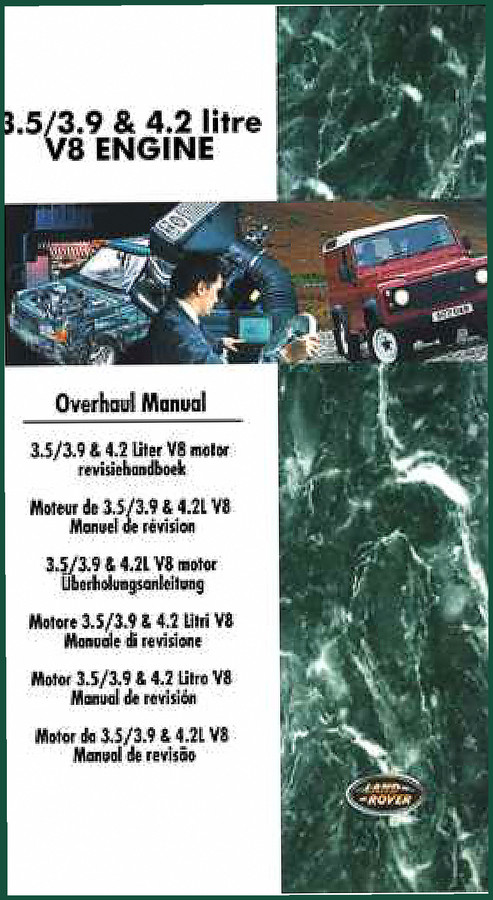
Land-rover 3.5, 3.9, 4.2 1996 Repair Manual – Factory V8 Overhaul
Original price was: $27.68.$22.50Current price is: $22.50.
Factory 1996 Land-rover V8 overhaul manual for 3.5, 3.9, and 4.2 litre engines. 49 pages of torque specs, service tools, and wear limits.
Description

You’ve got a Land-rover 3.5, 3.9, 4.2 1996 Repair Manual in your hands. Not some aftermarket photocopy that guesses at clearances. This is the factory-published Rover Technical Communication manual, part number RCL, 49 pages of what you need to pull a V8 completely apart and put it back together with the right preload on every bearing. If you’ve ever torqued a main cap to a spec you found on a forum and had the engine knock two hundred miles later, you know why this matters. The manual is dated 1996, but it covers the 3.5, 3.9, and 4.2 litre V8 engines with or without the suffix B on the serial number. That’s the same family used in Range Rovers, Defenders, and Discoverys through the mid‑90s.
Engine Overhaul Coverage: 3.5, 3.9, and 4.2 Litre V8
This is an overhaul manual, not a general repair guide. It assumes the engine is on the bench with the gearbox, clutch, inlet manifold, exhaust manifolds, coolant pump, starter motor, alternator, and all ancillaries removed. The procedures follow a strict sequence. You start with the front cover and timing chain, work through the cylinder heads, pistons, rods, crankshaft, and bearings, then back up through assembly with oil seals and gaskets. Each major section begins with a contents page listing sub‑sections. Every operation references official Land‑Rover service tool numbers. If the tool’s use isn’t obvious, there’s an illustration. The manual also includes wear limits, assembly details, and specialist notes like which bearing cap bolts need threadlock. None of that is guesswork.
What Torque Values Does This Manual Provide?
Dimensions quoted in the manual are to design engineering specification with service limits where applicable. That means you get factory torque specs for every fastener that touches oil or compression: main bearing cap bolts, connecting rod nuts, cylinder head studs, timing cover bolts, and the crankshaft pulley nut. For the connecting rod nuts, the spec is given in lb-ft and also in Nm for the Airbus guys. You also get the angular tightening step for the main bearing bolts — that’s the one where a lot of people stop at initial torque and then have a spun bearing. The manual warns that any bolt or stud that has reached its yield point must be replaced. That’s not a suggestion; it’s written as a CAUTION in the text.
7 Major Sub-Sections in the Overhaul Sequence
The manual breaks the overhaul into sub-sections that start on their own page 1. Each sub-section is numbered so when Land‑Rover publishes a revision, you can swap the old pages out. Actual sub-section titles from the manual include ‘Crankshaft and Bearings’, ‘Pistons and Connecting Rods’, ‘Cylinder Heads and Valves’, ‘Timing Gears and Chain’, ‘Oil Pump and Pressure Relief Valve’, ‘Lubrication System’, and ‘Engine Assembly’. For each sub-section, you get a list of required service tools and step‑by‑step instructions. For example, the piston ring fitting procedure tells you to check end gap before installation. The manual says to use a feeler gauge and gives a maximum gap. If the gap exceeds that, you chuck that ring and try a new one.
Check the Bearing Clearances Before You Reassemble
One of the most skipped steps on a backyard rebuild is measuring bearing oil clearance. The manual covers how to use Plastigage or a bore gauge to check main bearing and connecting rod clearances. It gives the standard clearance range and the service limit. If you’re within spec, you’re good. If not, you select a different bearing shell color. The engine can have different bearing grades from the factory. The manual tells you which color goes with which journal size. That kind of data is what keeps an engine from starving an oil gallery on startup. You do not get that from a third‑party manual that recycles generic data.
Factory Specs vs Aftermarket Guesswork: What You Get
This manual is an original OEM print from Rover Group Limited, published in 1996. The text on page 2 says ‘©1996 Rover Group Limited’ — no facsimile, no scanned and OCR’d mess with missing torque values. The manual itself warns you: ‘When replacement parts are required it is essential that only Rover parts are used.’ That’s legal boilerplate, but it also means the specs were written against Rover-made components. If you swap in a non‑standard aftermarket gasket set, you have to verify thickness yourself. The manual doesn’t need to account for that. For a shop like mine, that saves argument time. For a home builder, it means you can trust the numbers.
If you’re planning a Manual Transmission removal first, the manual assumes that part is already done — it references the Repair Manual for removal of ancillaries. But once the engine is bare on the stand, this booklet takes over. Pair it with the Rover L Series Diesel Engine Overhaul Manual’>Rover L Series Diesel Engine Overhaul Manual if you’re working on a diesel swap, or the Rover K-Series Engine Revision Manual (2001)’>Rover K-Series Engine Revision Manual (2001) for the four‑cylinder stuff. And if you’re restoring an old beast, grab the LAND-ROVER 101 Forward Control Repair Operation Manual’>LAND-ROVER 101 Forward Control Repair Operation Manual for the running gear.
Every page of this manual is written with the assumption that you are not a dealership technician but someone who will follow the sequence. They put the warning at the end of the introduction: ‘It is essential that work is inspected and tested after completion and if necessary a road test of the vehicle is carried out particularly where safety related items are concerned.’ That’s actual advice, not a disclaimer. For procedures on Manual Transmission’>Manual Transmission removal, refer to the separate transmission manual — this one sticks to the block.
- Can I use this manual for a 1995 Range Rover 3.9?
- Yes. The manual covers 3.5, 3.9, and 4.2 litre engines with or without suffix B. Check your engine serial number — it applies to all those.
- Does it cover the complete vehicle or just the engine?
- Only the engine overhaul. It assumes everything else is off the engine. You need a separate repair manual for removal/installation of ancillaries, clutch, gearbox, etc.
- What about the LH and RH bank references — which side is which?
- Page 3 explains: with the engine and gearbox assembly removed, the crankshaft pulley end is front. RH and LH banks are viewed from the flywheel end. That’s consistent across all Rover V8 documentation.
- Can I access it immediately after purchase?
- Yes. It’s a digital PDF. Once you order, you get a access link. 49 pages, no waiting for shipping.
Bottom line: if you’re rebuilding a Rover V8 and you want the same information the factory technicians had in 1996, this is it. Access the Factory Manual and print it out. Keep it on the bench next to the Plastigage and torque wrench. You’ll use every page.
Additional information
| Brand | Land-rover |
|---|---|
| Language | English |
3 reviews for Land-rover 3.5, 3.9, 4.2 1996 Repair Manual – Factory V8 Overhaul
You may also like…
-
Sale!
Land-rover 200, 114, 214, 414, 216 2001 Repair Manual – Factory Specs
Original price was: $44.70.$30.00Current price is: $30.00. -
Sale!
Land-rover 214, 414 1997 Service Manual – OEM Factory Specs
Original price was: $33.50.$25.00Current price is: $25.00. -
Sale!
Land-rover 101 Repair Manual – Factory MoD Specs for 1 Tonne 4×4
Original price was: $66.60.$45.00Current price is: $45.00. -
Sale!
Land-rover 25, 45, 220, 420, 620 1999 Repair Manual – Factory Specifications
Original price was: $37.80.$30.00Current price is: $30.00.
Related products
-
Sale!

2006 Service Manual – International DT 466E, 530E Diesel Engine
Original price was: $67.50.$50.00Current price is: $50.00. -
Sale!

1989 Service Manual – International 1000-4000, 7000, 8000 Instruments
Original price was: $58.80.$40.00Current price is: $40.00. -
Sale!

Acura Integra 1998 Service Manual – 1891 Pages Factory OEM Documentation
Original price was: $31.75.$25.00Current price is: $25.00. -
Sale!

1991 Operators Manual – International Truck OEM Specs (108 Pages)
Original price was: $13.63.$10.99Current price is: $10.99.
diy_master –
This is exactly what I was looking for. It is very easy to read on my iPad without losing quality. Every torque spec is provided for Land-rover 3.5,. Highly recommended for mechanics.
John S. –
Excellent workshop guide. It is easily zoomable on my laptop without losing quality. Every torque spec is included for Land-rover 3.5,. I will recommend this shop to others.
William H. –
Excellent workshop guide. It is easily zoomable on my iPad without losing quality. It assisted me to fix my Land-rover 3.5, electrical system. I will definitely buy again.