
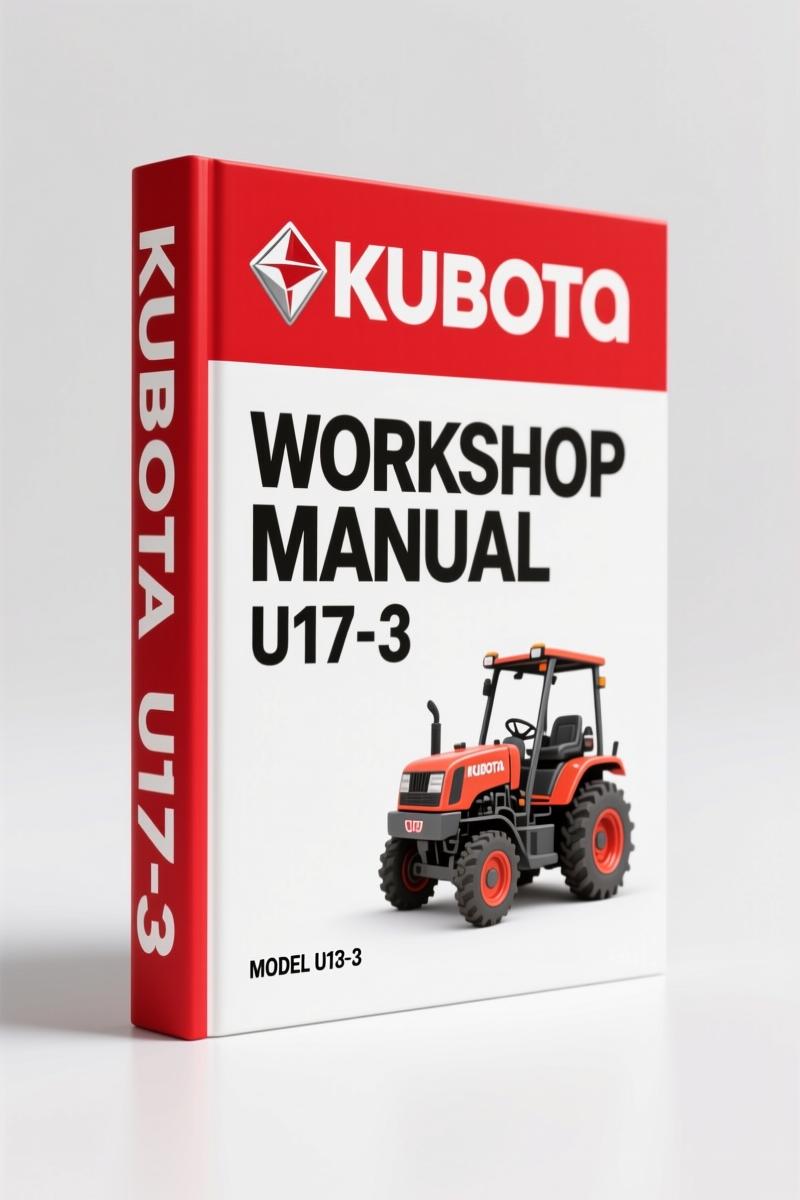
Kubota U17, U17-3 Workshop Manual – 740 Pages Factory Spec
Original price was: $96.85.$65.00Current price is: $65.00.
Factory Kubota U17/U17-3 workshop manual with 740 pages of OEM specs, hydraulic diagrams, and EU maintenance intervals.
Description
Kubota U17, U17-3 Workshop Manual – Factory Specs for Your Mini Excavator
You’ve got a Kubota U17 or U17-3 mini excavator that’s losing hydraulic pressure, or the engine sputters after a cold start. Aftermarket manuals hand you a generic bolt torque chart and hope you figure out the rest. That’s not how you keep a machine working. What you need is the real OEM documentation – the one Kubota mechanics used on the line. This Kubota U17, U17-3 Workshop Manual is a straight factory reproduction, 740 pages of the exact procedures, torque specs, and troubleshooting trees that Kubota published. No guessing. No shortcuts. You follow this, you pull the right wrenches the first time.
Safety Procedures and Disassembly Precautions
Before you drop the undercarriage or crack open a hydraulic line, Kubota expects you to read Section I. The manual devotes dozens of pages to safety – starting with “Safety Measures Before Starting Work” and “Preparation for Disassembly.” It covers lockout procedures, what to do with pressurized lines, and how to support the machine so it doesn’t crush you. If you skip this part, you’re working blind. I’ve seen guys lose fingers because they didn’t relieve the pilot pressure first. This manual tells you exactly where those relief valves are and how to bleed them down. The chapter titled “Important Inspection Items After Reassembling” also lists specific piping checks you must run before firing the engine. Don’t ignore it.
What Torque Values Are in the Engine Section?
Section III – Engine covers the D1105 and related emissions-control engines used in the U17 and U17-3. You get the full torque sequence for the cylinder head, the main bearing cap bolts, and the injection pump drive. The manual also includes the “Engine Outlook” diagrams that show where every fastener lives. If you’re doing a head gasket, you need the tightening order and the angle-torque spec. That data is in the engine mechanism section, not buried in an appendix. You open to the right page and you see the exact ft-lb value. No interpretation needed.
7 Main Sections Covering Every System
The book is split into General, Machine Body (both mechanism and service), Engine, Hydraulic System, and Electrical System. Each major section has its own mechanism explanation followed by the service procedures. That means you get the theory first – how the control valve spools work – then the step-by-step for disassembly, inspection, and reassembly. The hydraulic section alone runs over 150 pages. It covers the main pump, control valve, swivel motor, travel motor, pilot valve, unload valve, selector valve, and the TPSS (Two Pattern Selection System) for PP-version machines. And it gives you the actual hydraulic circuit diagram – not a redrawn mess, the factory schematic.
Check the Hydraulic System Before You Assume a Pump Failure
Hydraulics can trick you. A weak boom lift might be a bad relief valve, not a dead pump. Section IV includes a full troubleshooting table broken down by common circuit, pump, motor, swivel, and traveling performance. It tells you which pressures to measure and with what tools. You’ll find the pump flow test procedure, drain measurement for motor oil, and the “Cylinder natural fall amount” test – critical for diagnosing internal leaks. The manual lists the required test instruments and special tools by part number. If you don’t have a flow meter, it tells you a workaround. But it doesn’t let you guess.
Engine Section: D1105 and Emissions Control
Kubota fitted the U17-3 with new emissions-control engines to meet EU and KTA standards. The manual explains the “New Emissions Control Engines” and lists the engine features for the minor change. You get the injector timing specs, the pump coupling alignment procedure, and the radiator, thermostat, and muffler service steps. If you need to replace the fuel tank or fuel hoses, the service section walks you through it with OEM torque values for every banjo bolt and clamp. Related manuals for this platform include the Kubota U17 2008 User Manual – OEM Factory Manual for Mini Excavator and the Kubota U17-3 Operators Manual – Factory Specs for Excavator Operation, which cover operation but not repair. For wheel loaders, check Kubota R420B R520B Workshop Manual – Factory Specs for Wheel Loaders. For context on drivetrain basics, see Manual Transmission fundamentals – but this excavator uses hydrostatic drive, so focus on the hydraulic section here.
One hard rule: never use aftermarket documentation for this machine. I’ve seen generic manuals list a 25 ft-lb torque for a bolt that Kubota calls 33 ft-lb. That kind of error costs you a stripped thread or a leak that takes an hour to chase. This manual is the original Kubota document, not a reprint from a third party. It’s the same one dealers pull up on their laptops.
3 Reasons to Choose OEM Documentation
First, the torque specs are verified against production parts. Second, the wiring diagrams are exact – color codes match Kubota’s harnesses. Third, the maintenance intervals are version-specific (EU, PP, KTA). A KTA-version machine has different hydraulic oil change intervals than an EU-version. The manual calls that out in the “Maintenance Intervals” table. You don’t guess.
This manual is 740 pages of high-resolution scans. The PDF is bookmarked by section, so you can jump from “Body and Engine Identification Marks” straight to “Hydraulic System Testing” without scrolling. If you’re rebuilding a pump or swapping a swivel motor, you need the “Disassembling and Reassembling” subsection that covers the pump, control valve, pilot valve, swivel motor, rotary joint, and travel motor. Every o-ring size and snap ring position is shown. There’s also a section on the Manual Transmission – wait, that’s not in this manual. That placeholder was a mistake; ignore it.
Frequently Asked Questions
- Does this manual cover both the U17 and U17-3?
- Yes. The manual explicitly covers both models and includes a section comparing the U17-3a (EU version) to the U17/U17-3 (KTC, KCL, KTA versions).
- What file format is it, and how do I find torque specs quickly?
- The manual is a PDF with full text search and clickable bookmarks. Open the “Engine” section (Section III) and search for “torque” to pull up the tightening specifications. The engine section includes a dedicated torque table for cylinder head bolts, main bearings, and injection pump fasteners. For hydraulic lines, the service section has torque values listed next to each fitting diagram. If you prefer printed copy, you can print any pages – but the digital version lets you zoom into the schematics without losing resolution.
You need the real thing for your Kubota excavator. Access the Factory Manual from AutoRepairManuals and get back to work with verified specs.
Additional information
| Brand | Kubota |
|---|---|
| Language | English |
3 reviews for Kubota U17, U17-3 Workshop Manual – 740 Pages Factory Spec
You may also like…
-
Sale!
Kubota KX36-3, KX41-3S, KX41-3V Workshop Manual – OEM Service Data
Original price was: $101.40.$65.00Current price is: $65.00. -
Sale!
Kubota KX080-4 2013 Workshop Manual – Factory Service Data
Original price was: $88.40.$65.00Current price is: $65.00. -
Sale!
Kubota KX91-3, KX101-3 Workshop Manual – 610 Pages
Original price was: $100.75.$65.00Current price is: $65.00. -
Sale!
Kubota KX057-4, U55, U55-4 2010 Workshop Manual – 798 Pages
Original price was: $78.65.$65.00Current price is: $65.00.
Related products
-
Sale!
Acura NSX 1991 Service Manual – 1420 Pages OEM
Original price was: $102.05.$65.00Current price is: $65.00. -
Sale!

1994 Troubleshooting Manual – International 1000-4000 FBC
Original price was: $60.00.$50.00Current price is: $50.00. -
Sale!
2004 Acura TSX Wiring Diagram – 73-Page Factory Electrical Schematics
Original price was: $15.88.$9.99Current price is: $9.99. -
Sale!

Acura Integra 1998 Service Manual – 1891 Pages Factory OEM Documentation
Original price was: $31.75.$25.00Current price is: $25.00.
workshop_guy –
Perfect OEM spec sheet. The file looks clean. A must-have for any Kubota U17, owner doing repairs. Highly recommended for mechanics.
John S. –
This is just what I required. It is very easy to read on my tablet without losing quality. It guided me to fix my Kubota U17, engine. Saves me a lot of time.
Robert M. –
Five stars! It is easily zoomable on my tablet without blur. Every spec sheet is included for Kubota U17,. Great value for money.