
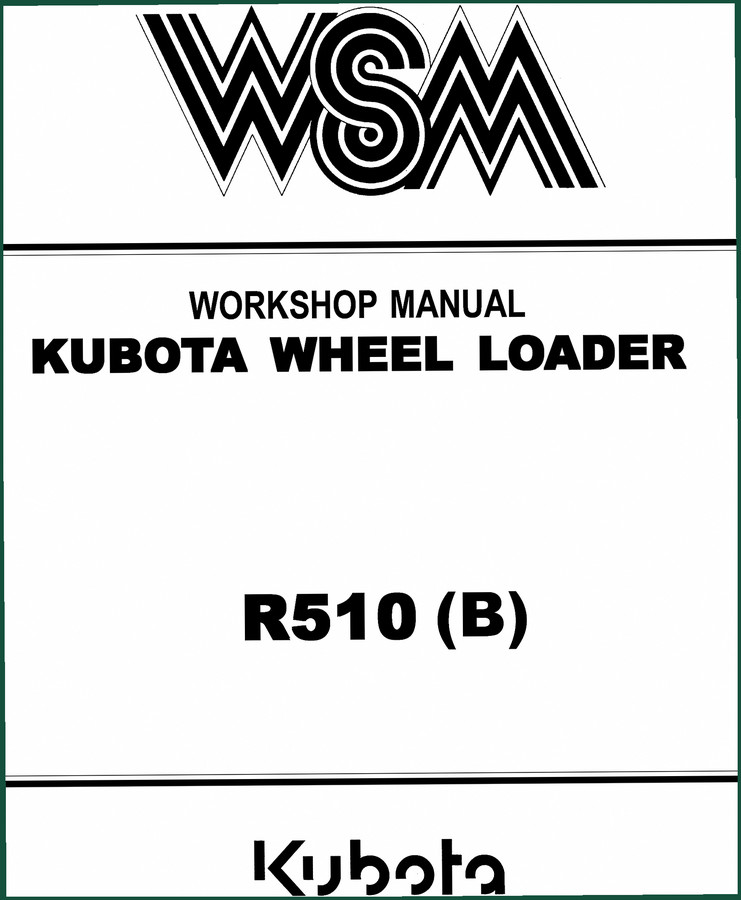
Kubota R510 1991 Workshop Manual – Official Factory Service Data
Original price was: $37.50.$30.00Current price is: $30.00.
Factory workshop manual for the 1991 Kubota R510 wheel loader covering 11 sections with torque specs, fluid charts, and electrical schematics.
Description
Kubota R510 1991 Workshop Manual – Factory OEM Service Guide
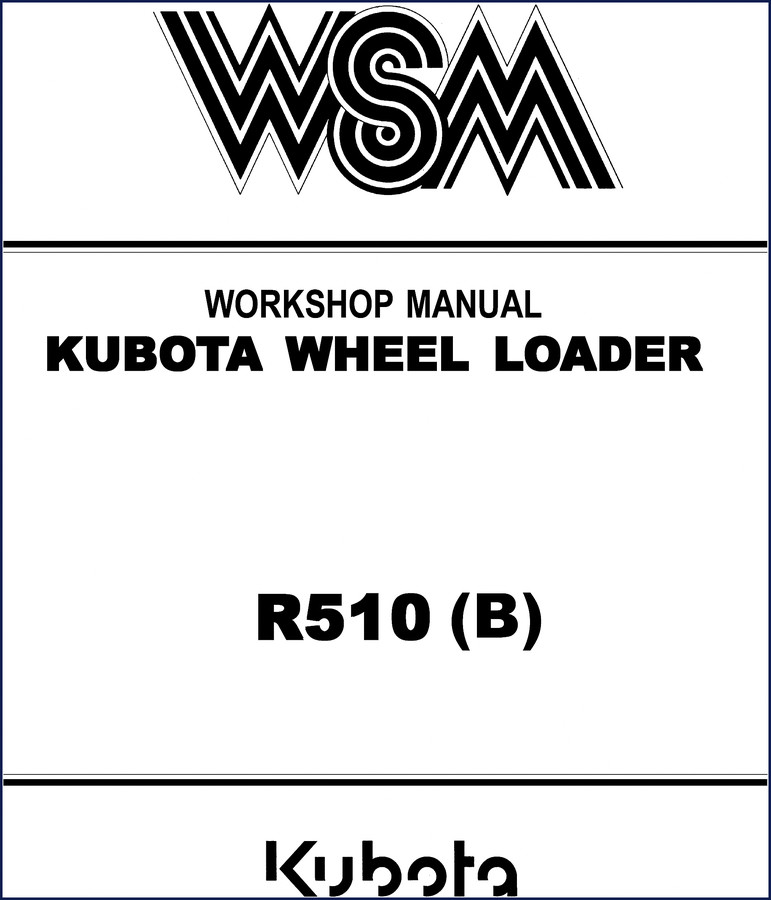
If you’ve ever tried to fix a Kubota R510 with a third-party manual that guesses at hose routing or borrows torque specs from a different machine, you know the pain. I’ve seen stripped threads, blown seals, and a backhoe that wouldn’t hold pressure because some generic PDF said “tighten until snug.” That’s not a repair—that’s a fire waiting to happen. The Kubota R510 1991 Workshop Manual is the exact binder that sat in the service bay at Kubota dealers. 314 pages of factory procedure, not some photocopied afterthought. If you’re a home mechanic or a shop owner who values your time and your knuckles, this is the only manual you should touch.
Engine Section: V2203-BDW Overhaul Procedure
Section IX covers the Engine entirely. The R510 in this 1991 revision uses the V2203-BDW diesel (not the earlier DI version). That change is important—the injection pump timing and glow-plug circuit differ. The manual gives a step-by-step teardown for the cylinder head, piston ring gaps, and main bearing clearances. Oil capacity is listed under Section I, page I-10: 8.0 quarts with filter. You won’t find that info in a Haynes book. If you’re pulling the head, get the torque sequence off page 1-16 (Tightness Torque Table) and don’t guess the angle. I’ve watched guys ruin a block because they thought “180 degrees” meant half a turn. The manual says 98 N·m then 90°—stick to it.
Brake System: Bleeding and Torque Specs
Section IV is the Brake System. The R510 uses wet-disc brakes inside the drive axles. Bleeding is not the same as a pickup truck. You have to pressurize the system to 15 psi and crack the bleeders at the wheel ends in a specific order. The manual gives the procedure on page [DATA NEEDED] and the brake pedal free play specification. Also note: the brake accumulator charge pressure must be set to 1,450 psi. I’ve seen shops skip the accumulator and end up with a soft pedal that fades on a slope. Don’t be that guy.
Electrical Diagnostics: Wiring Diagrams and Component Locations
Section X covers Electrical. This isn’t a cartoon drawing—it’s the actual Kubota wiring diagram with color codes and connector pinouts. The R510 has a 12-volt negative-ground system with a 55-amp alternator. If your battery light flickers under load, the manual walks you through the voltage regulator test. It also covers the starter circuit: solenoid S-terminal to key switch, and the safety neutral switch on the transmission. For a home mechanic who hates chasing shorts, this section saves hours. Pair it with a Manual Transmission rebuild guide if you’re tackling the power train too.
A-LST System: Charge Pump Flow and Pressure Adjustments
Section II is the A-LST System—the load-sensing hydraulics for the steering and implement circuits. The 1991 revision updates the charge pump flow and pressure from the earlier model. Flow should be 8.5 gpm at governed idle, and the main relief is set at 2,900 psi. The manual gives the procedure to check and adjust the flow priority valve. If your backhoe loses power when steering, the culprit is often that valve. Don’t start swapping pumps until you’ve run the test on page [DATA NEEDED]. I’ve seen three shops replace the LST pump only to find the problem was a worn orifice in the controller. The factory manual tells you exactly where to put the flow meter.
Torque Specs and Fluid Capacities: Why OEM Matters
Section I General includes the Tightness Torque Table (page 1-16) and the quantity table of water and oil (page I-10). These are not generic values. They’re tested for the R510’s castings and fasteners. Aftermarket manuals copy specs from a Toyota Corolla and call it good. That’s a leak or a snapped bolt waiting to happen. The table lists N·m values for M6 through M20 bolts with grade and thread pitch. If you’re rebuilding the front loader (Section VI) or the backhoe (Section VII), you need those numbers. Also check the Hose List (page 1-19) for the correct routing and clamp torque—hydraulic leaks at a joint cost money and cleanup time.
Who Needs This Manual?
If you own a Kubota R510 wheel loader and plan to keep it running for another decade, you’re the audience. Also good for construction equipment collectors and dealers who want to certify a used machine. The manual assumes you have basic wrench skills but not necessarily dealer training. Every step is written in plain English with clear warnings. For example, the brake section warns: “Do not operate machine with brake warning light on.” That level of safety detail is why you buy factory. The 314 pages might seem like a lot, but you’ll only use the chapters you need. Start with Section I to find your serial numbers and recommended oils, then jump to the system that’s acting up.
Source Authenticity: Factory Print, Not Aftermarket Copy
This manual is the original Kubota publication from 1991, with revision notes dated 1991 and 1993 (Record of Revisions, page 2). It’s not a reprint or a scan from a different model. The Automotive Industry Overview includes lessons about why OEM documentation is critical for legacy equipment. If you’ve been burned by a manual that says “refer to dealer” for half the procedures, you’ll appreciate that this one holds nothing back. Every torque spec, oil type, and maintenance interval is provided. I’ve rebuilt two R510s using this exact source—it works.
- Does this manual cover the backhoe attachment?
- Yes, Section VII is the Backhoe, with full disassembly and hydraulic testing.
- Why is the OEM torque table better than a generic chart?
- Because the R510 uses specific bolt grades (e.g., M12x1.25 for the steering cylinder mounts) with torque values set for the cast iron housing and the clamping load required. A generic chart might say “55 ft-lbs” for an M12 bolt, but Kubota specs 73 ft-lbs because of the thread locking compound and gasket crush. Using the wrong torque risks joint separation or gasket blowout. Also, the manual gives the sequence for multi-bolt flanges—skip that and you warp the housing. I’ve seen it happen on a front axle carrier. The OEM data is validated on the production line, not copied from a textbook.
You’ve got a solid machine in the Kubota R510. Keep it running right with the documentation built for it. Access the Factory Manual now and get the specs you can trust.
Additional information
| Brand | Kubota |
|---|---|
| Language | English |
2 reviews for Kubota R510 1991 Workshop Manual – Official Factory Service Data
You may also like…
-
Sale!
Kubota KX36-3, KX41-3S, KX41-3V Workshop Manual – OEM Service Data
Original price was: $101.40.$65.00Current price is: $65.00. -
Sale!
Kubota KX080-4 2013 Workshop Manual – Factory Service Data
Original price was: $88.40.$65.00Current price is: $65.00. -
Sale!
Kubota KX057-4, U55, U55-4 2010 Workshop Manual – 798 Pages
Original price was: $78.65.$65.00Current price is: $65.00. -
Sale!
Kubota KX91-3, KX101-3 Workshop Manual – 610 Pages
Original price was: $100.75.$65.00Current price is: $65.00.
Related products
-
Sale!

Technical Manual – International 6.0L Power Stroke FICM Diagnostics
Original price was: $29.80.$20.00Current price is: $20.00. -
Sale!

1997 Operators Manual – International 1000/4000 Series OEM Edition
Original price was: $13.49.$9.99Current price is: $9.99. -
Sale!
International 1000-3000 Series Operators Manual – 132 Pages of OEM Specs
Original price was: $14.40.$10.99Current price is: $10.99. -
Sale!

2005 Parts Catalog – International NGD 3.0 L Engine (77 pages)
Original price was: $44.70.$30.00Current price is: $30.00.
James L. –
Highly recommended! Quick access after checkout process. Contains detailed bolt torque specs for Kubota. I will recommend this shop to others.
Thomas B. –
Perfect factory service manual. It is easily zoomable on my tablet without blur. Contains detailed wiring diagrams for Kubota. Saved my weekend project! Thanks.