
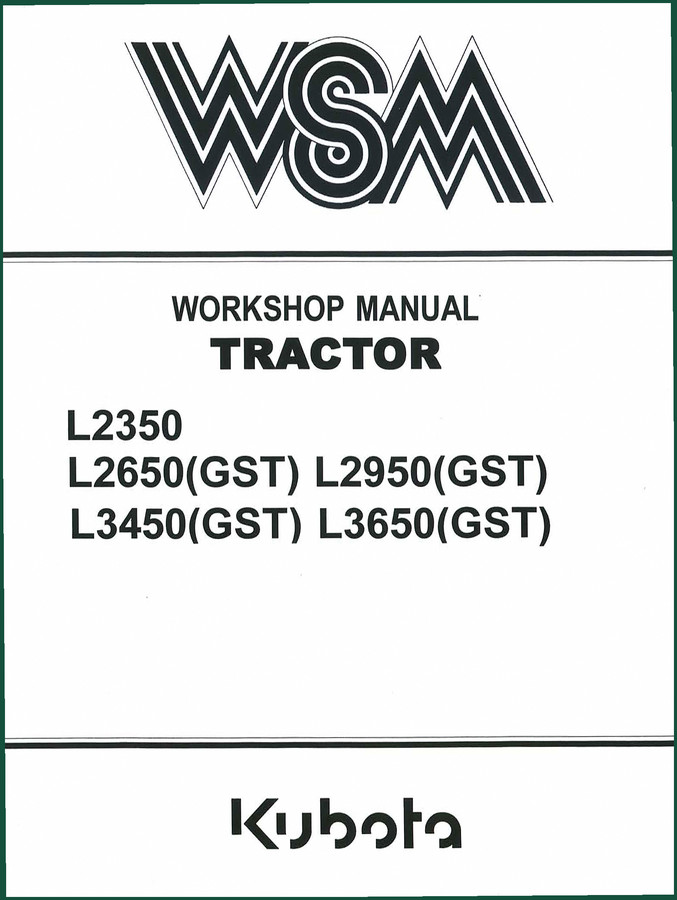
Kubota L2350-L3650 1991 Workshop Manual – OEM Factory Specs
Original price was: $46.55.$35.00Current price is: $35.00.
OEM Kubota Workshop Manual for L2350-L3650 (1991). 612 pages of factory specifications, torque data, and service procedures for professional mechanics.
Description
Kubota L2350, L2650, L2950, L3450, L3650 1991 Workshop Manual
If you’ve ever cracked open an aftermarket manual that told you to “torque to snug” on a head bolt, you already know why I’m writing this. That kind of crap gets a cylinder head warped and a customer screaming on Monday morning. This is the real thing – the Kubota L2350, L2650, L2950, L3450, L3650 1991 Workshop Manual, 612 pages of factory-printed data from Kubota Corporation. Not a reprint. Not a scan that missed every other page. Original OEM documentation that came off the same press as the one in the dealership service bay. If you are turning wrenches on any of these five tractors – including the GST hydrostatic models – you need this book within arm’s reach.
Safety Instructions: Read Page 4 Before You Turn a Bolt
Page 4 of this manual has the safety instructions that Kubota printed for a reason. It tells you to park on firm level ground, set the parking brake, lower the implement, stop the engine, remove the key, and disconnect the battery ground cable before you even put a socket on a fastener. I know you’ve heard it before, but I’ve seen guys skip the battery disconnect and arc-weld a wrench across the starter solenoid. That’s a fire waiting to happen. The manual also warns against working under a machine supported solely by a jack – use safety stands. Two people working together? Coordinate your actions. And if the engine has to run for diagnosis, ventilate the area. Carbon monoxide kills. These aren’t suggestions. They’re the factory’s minimum standard. Ignore them and you own the consequences.
Page 4 is not optional.
612 Pages of Factory Data – Not Abridged Notes
612 pages. That’s how much content Kubota packed into this workshop manual. It’s split into two main parts: Mechanism and Servicing. The Mechanism section (page 2 explains the layout) covers construction and function for each system – engine, transmission, hydraulics, electrical. You read that before you start troubleshooting. The Servicing section then walks through troubleshooting, specification lists, checking and adjusting, disassembling and assembling, and limits. Every factory spec is there: clearances, pressures, torque values. Aftermarket manuals strip out half of that to save paper. This one gives you the full treatment. You want to know the allowable limit for cylinder liner projection? It’s in there. Need the charge pressure for the hydrostatic transmission? Page 2 tells you where to look in the Servicing section – the data is complete and verified.
Mechanism Section – How the Hydraulics and Transmission Work
Before you pull a pump or split the transmission, you need to understand how the system functions. That’s what the Mechanism part teaches. It covers the engine cooling, fuel system, electrical, and the GST transmission. The GST (Glide Shift Transmission) is a hydraulic-mechanical setup that requires specific service procedures. The manual explains the flow of power from the engine through the torque converter, the hydraulic clutches, and the final drive. Without that understanding, you’re guessing at why the tractor won’t move under load. The manual also details the hydraulic system: the gear pump, control valve, and lift cylinder. Knowing the difference between a stuck spool and a blown O-ring comes from reading this section.
Servicing Section – Disassembly, Specs, and Limits
Once you understand the mechanism, the Servicing section gives you the step-by-step. It includes: troubleshooting charts, servicing specifications (clearances, torque values, pressures), checking and adjusting procedures, and the actual disassembly and reassembly steps. For example, adjusting the valve clearance on the L2350 requires a specific sequence – the manual lists the order, the feeler gauge size in inches, and the torque for the rocker arm bolts. Aftermarket manuals only say “adjust valves.” That’s worthless. The GST transmission section includes the clutch pressure test procedure: you need a 0-500 psi gauge, tee into the line at port P1, run the engine at 2400 rpm, and check for 170-210 psi. If it’s below 150 psi, the manual tells you to inspect the regulator valve, the relief valve, and the clutch piston seals. It gives the spring free length for each valve. That level of detail is why you don’t have to call Kubota tech support at $150 an hour. This manual also includes allowable limits – wear limits for parts that you can reuse if within spec. That saves you from replacing perfectly good components.
Does This Manual Cover the GST Models?
Yes. The manual covers both the standard gear-drive L2350 and the GST (Glide Shift) versions of the L2650, L2950, L3450, and L3650. The GST models have a different transmission and hydraulic control system. The manual includes specific sections for the GST – including the shift control linkage adjustment and the clutch pressure tests. If you’re working on a GST tractor, you need the factory data. Aftermarket manuals I’ve seen treat all L-series as identical. They’re not. The GST hydraulic servos are finicky. This manual gives you the exact pressures and adjustments.
Why OEM Kubota Documentation Beats Aftermarket
I’ve been an ASE Master for 28 years. I’ve seen aftermarket manuals that list a torque value that’s 20% off because they copied from a different model year. Kubota printed this in 1991, and every spec was verified against the production line. The manual is from Kubota Corporation, not some third-party aggregator. The safety warnings are factory-level. The wiring diagrams are accurate. The tolerances are correct. You cannot trust a $9.99 PDF that claims to cover five models but only has 150 pages. This manual has 612 pages. That’s the difference between a repair that lasts and a repair that comes back.
For a deeper dive into manual transmission rebuild theory, the Manual Transmission article on Wikipedia covers the fundamentals. Compare that with the specific GST transmission data in this manual. Also, if you’re working on other Kubota equipment, the Kubota R420B R520B Workshop Manual – Factory Specs for Wheel Loaders and Kubota Z402-EB 2000 Workshop Manual – Factory Service Specs are available on site. For gasoline engine variants, check the Kubota WG752-E2 DF752-E2 2003 Workshop Manual – Factory Specs. Another resource for transmission theory is the Manual Transmission page.
- Is this manual only for the L2350 or does it cover all five models?
- Covers L2350, L2650, L2950, L3450, and L3650 including GST variants. All in one 612-page volume.
- What’s the difference between the Mechanism and Servicing sections?
- Mechanism explains how each system works – construction and function. Servicing gives you the actual repair steps: troubleshooting, specs, checking and adjusting, disassembly and assembly, and allowable limits. You need to read Mechanism first or you’ll waste time chasing the wrong issue. For example, if you don’t understand the GST transmission’s hydraulic logic, you might replace a solenoid when the real problem is a worn clutch piston seal. The manual’s Servicing section then tells you the exact clearance and spring free length to check. It also includes safety warnings specific to each repair, like depressurizing the hydraulic system before disconnecting lines. Skipping that step can send hydraulic fluid through your skin at 2000 psi. That’s not hyperbole – it’s in the manual.
Get the real factory data. Access the Factory Manual and keep it on the bench. Your customers (and your insurance company) will thank you.
Additional information
| Brand | Kubota |
|---|---|
| Language | English |
4 reviews for Kubota L2350-L3650 1991 Workshop Manual – OEM Factory Specs
You may also like…
-
Sale!
Kubota KX91-3, KX101-3 Workshop Manual – 610 Pages
Original price was: $100.75.$65.00Current price is: $65.00. -
Sale!
Kubota KX080-4 2013 Workshop Manual – Factory Service Data
Original price was: $88.40.$65.00Current price is: $65.00. -
Sale!
Kubota KX36-3, KX41-3S, KX41-3V Workshop Manual – OEM Service Data
Original price was: $101.40.$65.00Current price is: $65.00. -
Sale!
Kubota KX057-4, U55, U55-4 2010 Workshop Manual – 798 Pages
Original price was: $78.65.$65.00Current price is: $65.00.
Related products
-
Sale!

1991 Electrical Schematic – 112-Page OEM Wiring Diagram for International 1000-3000 Series
Original price was: $22.75.$17.50Current price is: $17.50. -
Sale!
1993 Operators Manual – International Bus 1000-3000 OEM Specs
Original price was: $12.30.$7.99Current price is: $7.99. -
Sale!
Acura NSX 1991 Service Manual – 1420 Pages OEM
Original price was: $102.05.$65.00Current price is: $65.00. -
Sale!

2011 Parts Catalog – International 7400 SFA 6X6 – 1886 Pages of OEM Part Numbers
Original price was: $32.00.$25.00Current price is: $25.00.
gearhead88 –
I am so happy with this manual. It is very easy to read on my phone without losing quality. Every torque spec is provided for Kubota L2350L3650. Saves me a lot of dollars.
David K. –
Highly recommended! It is easily zoomable on my laptop without losing quality. Contains detailed schematics for Kubota. Saved my weekend project! Thank you.
John S. –
Excellent workshop guide. The text is searchable and easy to navigate. A must-have for any Kubota L2350L3650 mechanic doing repairs. I will definitely buy again.
Robert M. –
Perfect OEM spec sheet. It is very easy to read on my tablet without losing quality. It helped me to repair my Kubota L2350L3650 transmission. Saved my weekend project! Thank you.