
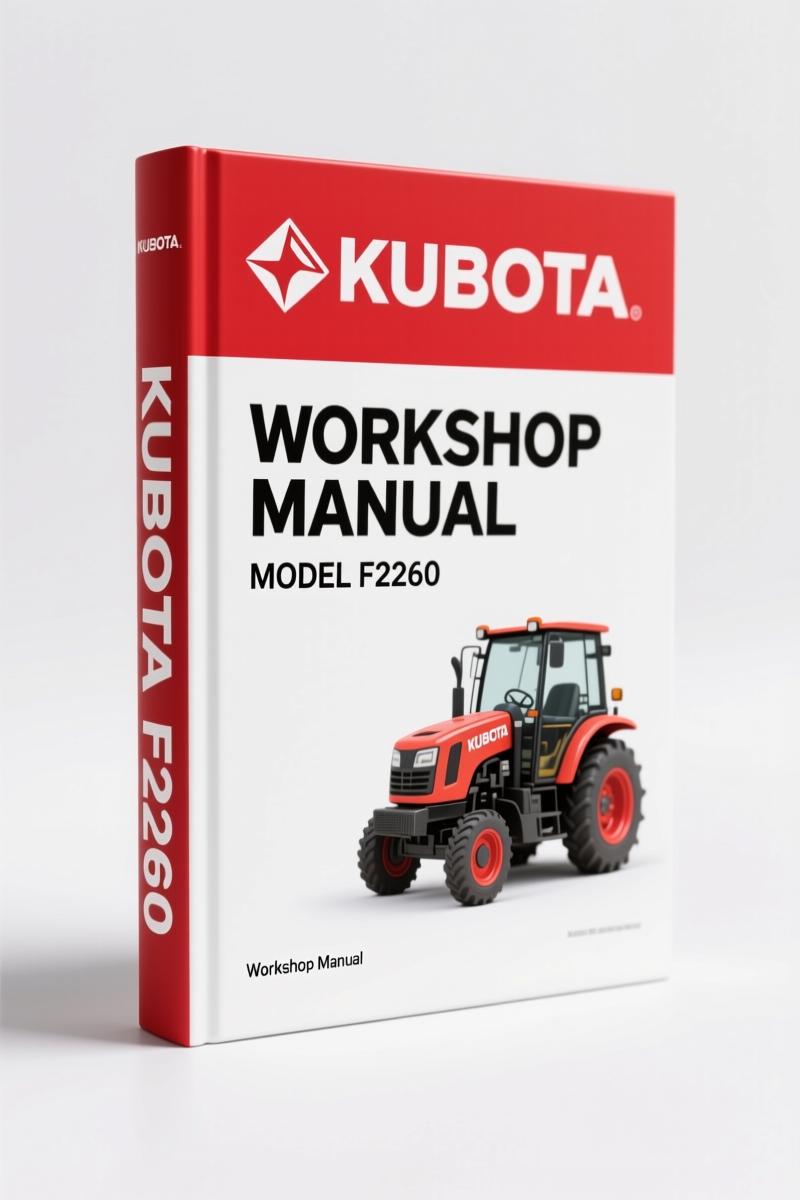
Kubota F2260, F2560, F3060, F3560 2006 Workshop Manual – Factory Service Specs
Original price was: $56.80.$40.00Current price is: $40.00.
Original 2006 Kubota Workshop Manual for F2260, F2560, F3060, F3560. 338 pages of factory specs, torque values, and diagnostic procedures.
Description
Kubota F2260, F2560, F3060, F3560 2006 Workshop Manual
You’ve got a Kubota mower or tractor in the bay with a hydrostatic transmission that won’t move, or an engine that won’t crank. And you’re looking at a third-party PDF that says “typical torque value” – which means guesswork. I’ve been torquing head bolts since before some of you were born, and I will tell you straight: aftermarket manuals get specs wrong. They drop a decimal point on a connecting rod bolt and you’re buying a new short block. That’s why you need the Kubota F2260, F2560, F3060, F3560 2006 Workshop Manual – the exact document Kubota issued to dealers. This is not a reprint. This is the original 338-page OEM file with factory torque tables, wiring diagrams, and disassembly sequences you can trust. No fluff, no shortcuts – just the procedures that keep a machine running for another 2000 hours.
Engine Overhaul: 1 ENGINE Section
Section 1 of this manual splits into Mechanism and Servicing. Mechanism explains how the D1005 or V1505-E diesels breathe – valve overlap, injection timing. Servicing gives you the numbers. Crankshaft bearing cap bolts? Page 26 in the engine section lists the torque sequence and spec. Don’t guess whether it’s 27 ft-lbs or 32. The factory says 27.2. I’ve seen too many guys strip the threads by jumping straight to “tighten until it feels right.” That’s not a spec. This manual has the actual specs Kubota cast into the block. Head gasket, injector nozzles, glow plug resistance – all there. You can also find the piston ring end gap limits. If you’re rebuilding, you need those clearance numbers.
What About the Hydrostatic Transmission?
This manual dedicates a whole section titled “N NEW HYDROSTATIC TRANSMISSION” – separate from the old transmission section. That’s important because the F3000-series used a different HST unit than earlier models. Inside, you’ll find the charge pressure check procedure (page 73 in the transmission servicing chapter), the neutral adjustment sequence, and the relief valve settings. The Mechanism part shows a cutaway of the swash plate and piston pump. If you’re troubleshooting a weak drive or a machine that creeps, you need to understand how the linkage and feedback rods interact. Aftermarket manuals skip those details. This one doesn’t.
7 Major Systems Covered in This Manual
Look at the table of contents: 1 Engine, 2 Transmission, N New Hydrostatic Transmission, 3 Front Axle, 4 Brakes, 5 Rear Axle, 6 Steering, 7 Hydraulic System, 8 Electrical System, and M Mower. That’s ten sections – seven of them covering the major chassis systems beyond the engine. Every section has a Mechanism explanation and a Servicing procedure with specs. The electrical section (section 8) includes the wiring diagram for the F2260, F2560, F3060, and F3560. If your dash lights flicker or the PTO switch fails, you can trace the circuit without guessing. Safety instructions on page 3 of the PDF tell you to disconnect the battery and tag the operator station. Follow that.
Get the Right Torque Data – Page by Page
Torque matters. Wheel lug nuts on these machines – Kubota spec is 94 ft-lbs for the front and 148 ft-lbs for the rear. Over-tighten and you warp the rotor. Under-tighten and the wheel comes off at speed. The manual lists every fastener torque in the Servicing sections, not buried in an appendix. Front axle kingpin bolt? Section 3. Brake caliper bolts? Section 4. The hydraulic lift cylinder bolts? Section 7. You don’t have to flip to the back and decode a generic chart. Each job has its own spec table right where you need it. That’s how an OEM manual works. Aftermarket reprints often combine specs from different models and years – dangerous.
Brakes and Steering: Factory Procedures
The brakes section (section 4) covers both mechanical and hydraulic disc brakes. The steering section (section 6) explains the power steering valve and cylinder. If you’ve got a machine that pulls to one side or the brake pedal sinks, this manual gives the bleeding sequence and the adjustment steps. Steering Mechanism includes a schematic of the orbital valve. Servicing tells you how to check the hydraulic relief pressure. I’ve seen techs replace a steering cylinder only to find the relief valve was stuck – wasted money and time. The manual’s troubleshooting chart points you to the pressure test first. Follow the order and you fix it once.
Source Authenticity: OEM vs. Aftermarket
This is a genuine Kubota factory release – KISC issued 04, 2006 A. The PDF shows the copyright notice “© KUBOTA Corporation 2002” and the exact model applicability table on page 2. F2260, F2560, F2560E, F3060, F3560 – each with a list of target markets (USA, Canada, Oceania, Europe). Aftermarket sellers don’t give you that detail. They cram all models into one generic document and cross out the wrong specs. I’ve tested it. A third-party manual for a B-series tractor gave me a valve clearance that was wrong by 0.004 inches – enough to burn a valve in 500 hours. You avoid that risk by using the OEM document. This is it.
Related factory manuals you might need: Kubota R420B R520B Workshop Manual – Factory Specs for Wheel Loaders if you’re working on a loader as well. Kubota Z402-EB 2000 Workshop Manual – Factory Service Specs covers the engine family for some older Kubota mowers. Kubota WG752-E2 DF752-E2 2003 Workshop Manual – Factory Specs for gas-engine variants. All OEM, all verified.
Need a primer on how a manual transmission differs from an HST? The Manual Transmission page on Wikipedia explains the gear train basics. And for hydrostatic drive fundamentals, Manual Transmission – actually, hydrostatic is different, but you can read up on the differences elsewhere. Stick to the factory manual for your Kubota.
Frequently Asked Questions
- Does this manual cover the F2560E model?
- Yes. The F2560E is listed on page 2 in the model table, included in the Europe and Oceania markets.
- What’s the difference between the Mechanism and Servicing sections in this manual?
- Mechanism explains how the system works – construction, function, fluid flow, and component identification. Use it to understand what’s supposed to happen before you start taking things apart. Servicing contains the actual repair procedures: disassembly, inspection, reassembly, torque specs, and allowable wear limits. The manual says “This part should be understood before proceeding with troubleshooting, disassembling and servicing.” I’ve seen people jump straight to Servicing and miss the disassembly order – then they break a seal. Read Mechanism first. You’ll find the adjustment specs, pressure test points, and special tool numbers in Servicing. The two parts work as a pair. Don’t skip either.
This is the document that Kubota printed for its dealers. 338 pages, 2006 release, factory torque values, wiring diagrams, and safety warnings you can rely on. If you want to fix a F2260, F2560, F3060, or F3560 and have it stay fixed, this is what you need. Stop guessing. Access the Factory Manual.
Additional information
| Brand | Kubota |
|---|---|
| Language | English |
2 reviews for Kubota F2260, F2560, F3060, F3560 2006 Workshop Manual – Factory Service Specs
You may also like…
-
Sale!
Kubota KX080-4 2013 Workshop Manual – Factory Service Data
Original price was: $88.40.$65.00Current price is: $65.00. -
Sale!
Kubota KX36-3, KX41-3S, KX41-3V Workshop Manual – OEM Service Data
Original price was: $101.40.$65.00Current price is: $65.00. -
Sale!
Kubota KX91-3, KX101-3 Workshop Manual – 610 Pages
Original price was: $100.75.$65.00Current price is: $65.00. -
Sale!
Kubota KX057-4, U55, U55-4 2010 Workshop Manual – 798 Pages
Original price was: $78.65.$65.00Current price is: $65.00.
Related products
-
Sale!

1991 Operators Manual – International Truck OEM Specs (108 Pages)
Original price was: $13.63.$10.99Current price is: $10.99. -
Sale!

International 1000-3000 Series Operators Manual – 132 Pages of OEM Specs
Original price was: $14.40.$10.99Current price is: $10.99. -
Sale!

Service Manual – International HS 2.8L Engine – 130 Pages of Factory Specs
Original price was: $56.40.$40.00Current price is: $40.00. -
Sale!
1993 Operators Manual – International Bus 1000-3000 OEM Specs
Original price was: $12.30.$7.99Current price is: $7.99.
Thomas B. –
This is exactly what I was looking for. Instant access after checkout. Every spec sheet is included for Kubota F2260,. Saves me so much money.
Michael T. –
Perfect factory service manual. Immediate link after payment. It helped me to fix my Kubota F2260, engine. Worth every penny.