
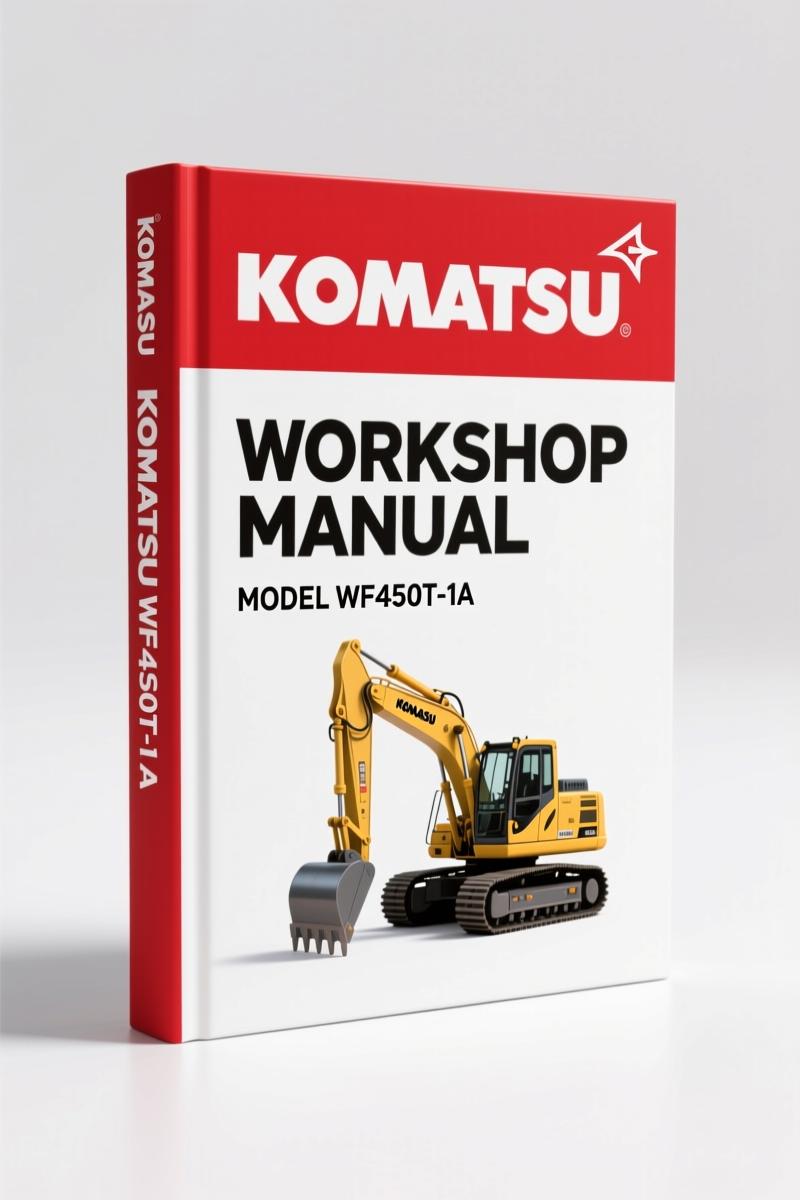
Komatsu WF450T-1A, WA450-1 Workshop Manual – OEM Factory Specs
Original price was: $94.25.$65.00Current price is: $65.00.
294-page OEM workshop manual for Komatsu WF450T-1A and WA450-1. Covers transmission, brake, electrical systems with factory specs.
Description
Komatsu WF450T-1A, WA450-1 Workshop Manual
If you are trying to rebuild a transmission without the factory specs, you are asking for trouble. I have seen it too many times—guys guessing on bolt torque, using aftermarket diagrams that are off by a quarter inch, then wondering why the machine comes back with a leak. That is unacceptable. This 294-page Komatsu WF450T-1A, WA450-1 Workshop Manual comes straight from the OEM. It is the same binder the dealer techs flip open when they get paid by the job. You need the correct data for these machines. The WF450T-1A mounts the S6D125-1 engine, and for engine specifics you need the separate 6D125-1 manual, but for the chassis, transmission, brakes, hydraulics, and electrical system on the WF450T-1A and its close relative the WA450-1, this is the one.
Every section in this manual is built around testing and adjusting before you tear anything apart. Skip that, and you waste hours chasing something that could have been caught with a pressure gauge and a few measurements. The manual includes a list of required tools for testing and troubleshooting—if you do not have them, get them. You cannot eyeball steering valve pressures.
Transmission Control Valve: Factory Disassembly Procedure
The transmission control valve is the brain of the shift pattern. If the valve body is sticking, you get harsh engagements or no movement at all. This manual walks through removal and installation of the transmission control valve, plus the full disassembly and assembly of the torque converter and transmission assembly. The torque converter and transmission section alone covers removal, installation, and internal breakdown. You get the exact steps for pulling the damper, upper drive shaft, and the whole driveline. When you reassemble, those torque specs for the valve body bolts come from the factory—not a third-party reprint that rounded numbers. The hydraulic piping diagrams show the exact routing for the converter and transmission lines. Page 20-1 has the standard judgment table for testing, adjusting, and troubleshooting. Do not start a job without checking that table first.
Testing and Adjusting: What the Manual Covers
Section 20 is the meat of this manual. It details everything: measuring accelerator pedal operating force, engine stall speed, oil pressure of torque converter and transmission, steering wheel play and operating force, steering oil pressure, brake oil pressure, brake disc wear, parking brake performance, dump and lift control lever measurements, hydraulic pressure of work equipment, and adjusting the machine monitor speedometer module. There is a specific procedure for air bleeding from the brake line—skip it and you get a spongy pedal that will not stop a 40-ton loader. The manual also includes a method for operation of the emergency manual spool. If the electrical system dies and the transmission locks up, you need to know that spool location. I have watched a shop burn a Saturday because they did not have the emergency procedure. Do not be that guy.
Troubleshooting the Steering System (S-1 through S-5)
Steering problems on these machines are not always the steering valve. The manual has a full troubleshooting table with specific conditions: S-1 steering wheel does not turn, S-2 steering wheel is sluggish, S-3 unsteady movement or large shock, S-4 machine tends to turn naturally in one direction, S-5 left and right turning radii differ. For each, the manual gives a cause and corrective action. You will also find troubleshooting tables for work equipment: blade does not rise, blade moves slowly, blade cannot be held down, hydraulic drift, and more. These are real-world issues. I have used the S-3 diagnosis myself—turned out to be a worn steering linkage joint, not the valve. The manual saved me three hours of disassembly.
Brake System: Checking Oil Pressure and Wear
Brake oil pressure checks and disc wear measurements are covered in the testing section. For the brake disassembly and assembly, go to section 30. The parking brake pad removal and installation procedure is separate. You need to know the correct brake disc wear limit—the manual spells it out. Aftermarket documentation often omits the wear limits or gives generic numbers. This manual gives factory tolerances. When you bleed the brake line, the manual shows you the order of bleeder screws and the correct pressure. Get it wrong and you introduce air into the system. Page 20 has the specific check for brake oil pressure. I recommend pulling a pressure reading before you crack any lines. It tells you if the master cylinder is shot or the caliper is sticking.
Electrical Wiring Circuit Diagram
The electrical section includes the full electrical wiring circuit diagram, the electronic vehicle monitoring system (EVMS), and the electrical transmission control. For troubleshooting, there is a dedicated subsection for electrical circuit problems and a wiring diagram. The manual also includes connector positions for troubleshooting—critical when you are chasing a no-start or a transmission that does not work normally. The E-8 diagnostic covers “transmission does not work normally.” If you have ever tried to trace a wiring fault without a proper diagram, you know it is a nightmare. This manual gives you the path. Ignore the aftermarket versions that redraw the wiring with missing pins. Stick with the OEM. Related manuals you might need: Komatsu WA450-1 1992 Workshop Manual – 780 Pages OEM Specs for the earlier serial numbers, and Komatsu WA65-5 WA70-5 WA80-5 2005 Workshop Manual if you work on smaller loaders. Also Komatsu WH609-1E0 WH613-1E0 WH713-1E0 WH714H-1E0 WH716-1E0 Workshop Manual for the wheeled excavator variants. For general knowledge on Manual Transmission theory, Wikipedia has a decent overview, but do not use it for Komatsu-specific repairs.
Disassembly and Assembly of the Torque Converter and Transmission
Section 30 covers removal and installation of the torque converter and transmission as a unit. That is a heavy lift—the transmission alone weighs 770 kg. You need the weight table on page 00-2-2 to plan your lifting gear. The disassembly and assembly procedures inside the transmission are detailed with step order and torque values. The manual also covers removal and installation of the front differential, rear axle, drive shaft, final drive, steering gear, brake, main control valve, lift and tilt cylinder, center hinge pin, and work equipment. Each has a structured procedure. If you are doing an engine removal, the manual shows you the steps for the radiator, engine, and then the torque converter separation. Do not skip the installation sequence for the drive shaft—the phasing matters. On page 30-1 you get the radiator removal and installation steps. Use this manual as your shop reference. Manual Transmission external resources are fine for theory, but for actual wrenching, this PDF is your insurance.
I have been in this trade for 28 years. I have seen what happens when a junior tech uses a third-party reprint that omits a torque spec—head bolts snap, transmissions drip, brakes fade. This Komatsu WF450T-1A, WA450-1 Workshop Manual is an OEM factory document. It is 294 pages of verified data. You should not be guessing on a machine that costs hundreds of thousands of dollars. Access the Factory Manual now and keep it in your bay.
- Does this manual cover the engine in detail?
- No. The manual states the WF450T-1A uses the S6D125-1 engine and directs you to the separate 6D125-1 Series Engine Shop Manual. This manual covers everything else: transmission, axles, brakes, hydraulics, steering, and electrical.
- What serial numbers does this manual apply to?
- The WF450T-1A manual is for serial numbers 10001 and up. The WA450-1 section covers machines after serial number 20001. For earlier WA450-1 machines, use the separate WA450-1 manual (780 pages).
- Are the torque specs in this manual from Komatsu or aftermarket?
- OEM. This is a direct reproduction of the Komatsu factory shop manual. All torque values, fluid capacities, and tolerances are as printed by Komatsu—not a third-party rewrite. That is why I trust it on my workbench.
- Does it include wiring diagrams?
- Yes. The manual contains the full electrical wiring circuit diagram, the EVMS system, and the electrical transmission control troubleshooting with connector positions. The troubleshooting section includes E-8 for transmission faults.
Additional information
| Brand | Komatsu |
|---|---|
| Language | English |
4 reviews for Komatsu WF450T-1A, WA450-1 Workshop Manual – OEM Factory Specs
You may also like…
-
Sale!
Komatsu PC600LC-6 Workshop Manual – Factory Service Data for 732-Page Excavator Guide
Original price was: $112.80.$80.00Current price is: $80.00. -
Sale!
Komatsu HD1200 1980 Workshop Manual – Factory Specs & Procedures
Original price was: $91.50.$75.00Current price is: $75.00. -
Sale!
Komatsu D65EX, D65PX, D65WX Workshop Manual – 2820 Pages
Original price was: $108.75.$75.00Current price is: $75.00. -
Sale!
Komatsu PC5500E-6 Workshop Manual – 1378 Pages
Original price was: $150.00.$100.00Current price is: $100.00.
Related products
-
Sale!

1996 Operators Manual – International 1000-4000 Series (246 pages)
Original price was: $15.28.$9.99Current price is: $9.99. -
Sale!
2004 Acura TSX Wiring Diagram – 73-Page Factory Electrical Schematics
Original price was: $15.88.$9.99Current price is: $9.99. -
Sale!

Service Manual – International HS 2.8L Engine – 130 Pages of Factory Specs
Original price was: $56.40.$40.00Current price is: $40.00. -
Sale!
1992 Electrical Schematic – OEM Wiring Diagrams for International 1000-3800
Original price was: $24.48.$18.00Current price is: $18.00.
John S. –
Perfect workshop guide. The PDF is high resolution. It guided me to repair my Komatsu WF450T1A, electrical system. I will recommend this shop to others.
William H. –
Outstanding! The PDF is high resolution. Contains detailed schematics for Komatsu. Saves me a lot of money.
Richard G. –
This is exactly what I was looking for. The pages are clean and well indexed. A must-have for any Komatsu WF450T1A, owner doing maintenance. I will definitely buy again.
James L. –
Great factory service manual. The pages are clean and well indexed. Contains detailed wiring diagrams for Komatsu. Worth every penny.