
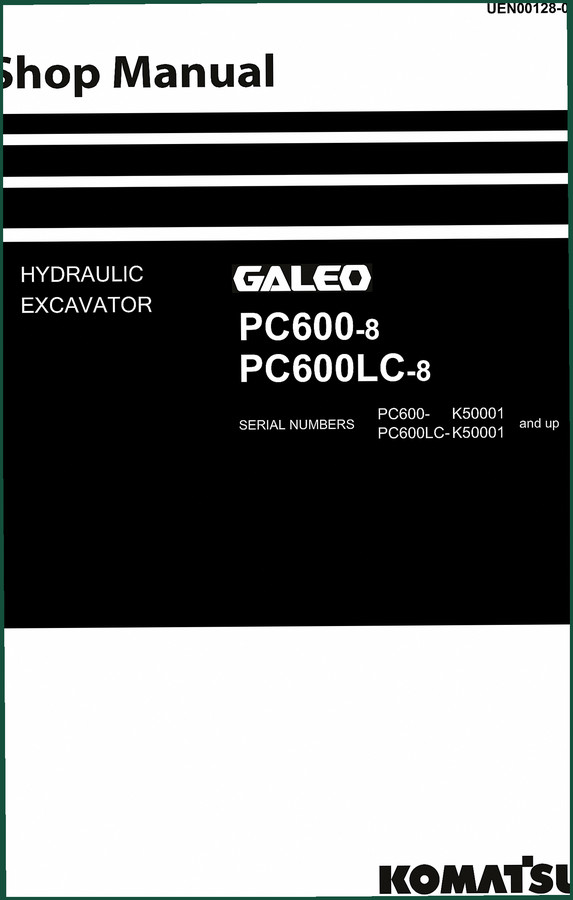
Komatsu PC600-8, PC600LC-8 Workshop Manual – Factory Specs, 986 Pages
Original price was: $42.70.$35.00Current price is: $35.00.
986-page factory workshop manual for Komatsu PC600-8 and PC600LC-8. Covers engine, hydraulics, power train, and troubleshooting with OEM torque spec tables.
Description
Komatsu PC600-8, PC600LC-8 Workshop Manual
I’ve seen too many guys crack a hydraulic manifold because they used a torque spec from a reprint manual that was off by 12 lb-ft. That mistake costs a shop a day of downtime and a four-digit part. The Komatsu PC600-8, PC600LC-8 Workshop Manual I’m talking about is the OEM binder—none of that aftermarket garbage. 986 pages, factory serial number coverage from K50001 up, and the same documentation Komatsu dealers are supposed to use. If you’re wrenching on one of these excavators, you need the standard tightening torque table in section 00, not a screenshot from a forum.
Standard Tightening Torque Table – Why It’s Tabled First
Section 00 opens with a standard torque table for bolts and nuts. Komatsu doesn’t hide that. They know every fastener on a PC600-8 needs a specific value, from the swing motor mounting bolts to the PPC valve cover screws. The manual includes a conversion table right next to it, so you don’t have to guess between Nm and lb-ft. If you skip this page and rip into the engine bay, you’re asking for stripped threads or leaks that show up at hour 10. That torque table is the first thing I dog-ear on a new manual.
36 Pages of Testing and Adjusting – Not for the Impatient
Section 30, Testing and adjusting, runs over thirty pages and covers exactly what the title says: measuring engine speed, boost pressure, valve clearance, blow-by, compression, oil pressure, fuel system leakage, track tension, swing circle bearing clearance, and every hydraulic circuit pressure adjustment. The manual tells you which tools to use, like a tachometer and a pressure gauge set, and gives the acceptable ranges in imperial units. I’ve used the procedure for measuring PPC valve output pressure on a PC600LC-8 that was drifting; found a bad shuttle valve in thirty minutes instead of pulling the whole control valve stack.
Hydraulic System Part 2 – Where Most Shops Screw Up
The hydraulic system is split into two sections in this manual. Part 2 gets into the control valve, swing motor, swing brake, safety valve, reverse prevention valve, center swivel joint, travel motor, parking brake, brake valve, set pressures varying mechanism, valve control, and every PPC valve. If you’re troubleshooting a boom drift on a PC600-8, the manual walks through the boom holding valve and the boom LOWER regeneration valve. That’s not something you find in a generic hydraulic schematic. The factory drawing shows the exact port numbering and pressure tap locations.
Why OEM Beats Aftermarket Every Time
Aftermarket manual reprints often miss the “How to read electric wire code” section (page 73, I think—mine is dog-eared). Komatsu includes that in the foreword. They also explain handling electric equipment and hydraulic components, how to work with push-pull couplers, and the safety notice that tells you when to relieve hydraulic pressure before opening a line. I’ve seen a tech skip that step and get a face full of hydraulic oil at 3,000 psi. Aftermarket manuals don’t include the standard service value tables in section 20 either. That’s where you find the acceptable wear limits for track roller diameter, idler clearance, and final drive backlash. Without those numbers, you’re guessing whether a part is reusable.
What’s Inside the 986 Pages
The manual is broken into sections: 00 index and foreword, 01 specification, 10 structure/function/maintenance standard (engine, power train, undercarriage, hydraulics part 1 and 2, work equipment, cab, electrical), 20 standard value table, 30 testing and adjusting (two parts), 40 troubleshooting by failure code and by system, and 50 disassembly and assembly. The disassembly section covers engine and cooling system in two parts, power train, undercarriage, and frame. Everything is there to rebuild this machine from the ground up. If you need the operation & maintenance manual instead, see the KOMATSU PC600-8 PC600LC-8 Operation & Maintenance Manual”>. The shop manual is strictly for repair and overhaul—no routine care instructions.
I’ve worked with both the PC600-8 and the PC600LC-8. The KOMATSU PC600-8 PC600LC-8 Shop Manual”> covers both variants. The LC model has a longer undercarriage, so the track frame and idler specs differ. The manual lists separate weight tables and standard values for each. Don’t assume they’re interchangeable. Also, if you’re dealing with a hydraulic pump failure, the manual includes testing for the piston pump, servo piston stroke, and fan circuit oil pressure. That kind of precision is why I refuse to use anything but factory documentation.
For anyone who’s rebuilt a manual transmission before, you know torque sequences aren’t optional. The same applies here. Manual Transmission”> rebuilds rely on factory bolt patterns and precise tightening orders. This Komatsu manual treats every assembly with the same discipline. If you’re used to working on passenger cars, the scale is different, but the principle is identical: follow the book or pay for it.
Another external reference on proper bolt tightening: Manual Transmission”> covers the concept of torque-to-yield. Komatsu uses that on some engine fasteners. The workshop manual specifies whether a bolt is reusable or must be replaced.
Frequently Asked Questions
- Does this manual cover the fuel system?
- Yes. Section 30 includes fuel pressure measurement, bleeding air from the fuel circuit, testing leakage from the pressure limiter, and return rate from the injector. Also covers reduced cylinder mode operation and no-injection cranking.
- What torque values are listed?
- The standard tightening torque table in section 00 gives general values for bolts and nuts. But every specific assembly—like the swing motor mounting bolts or the hydraulic cylinder gland—has its own torque spec listed in the relevant section. Do not rely on the general table for critical fasteners.
- Is this manual suitable for a beginner?
- If you have never opened a hydraulic line before, no. This is a factory shop manual written for experienced technicians. It assumes you know how to use a torque wrench, a pressure gauge, and a multimeter. Beginners should get the Operation & Maintenance Manual first.
- Can I use this for the PC600LC-8?
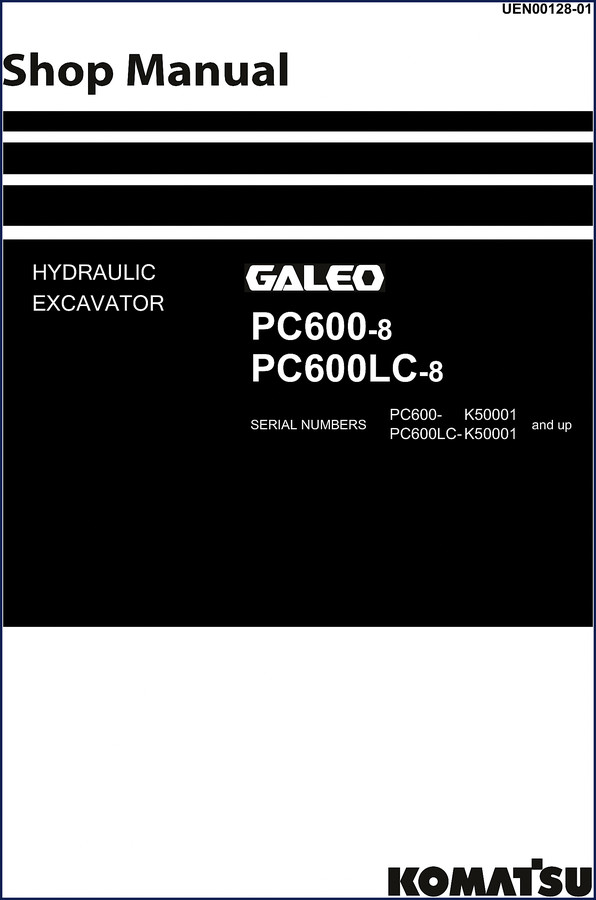
- Yes. The manual covers both PC600-8 and PC600LC-8. Serial numbers are listed: PC600- K50001 and up, PC600LC- K50001 and up. The LC model has different undercarriage specs, and those are included in the track frame and track shoe sections.
I’ve been wrenching since before some of you were born. A manual like this is worth its weight in saved downtime. Don’t waste money on reprints. Get the real thing. Access the Factory Manual.
Additional information
| Brand | Komatsu |
|---|---|
| Language | English |
4 reviews for Komatsu PC600-8, PC600LC-8 Workshop Manual – Factory Specs, 986 Pages
You may also like…
-
Sale!
Komatsu PC600LC-6 Workshop Manual – Factory Service Data for 732-Page Excavator Guide
Original price was: $112.80.$80.00Current price is: $80.00. -
Sale!
Komatsu PC5500E-6 Workshop Manual – 1378 Pages
Original price was: $150.00.$100.00Current price is: $100.00. -
Sale!
Komatsu D65EX, D65PX, D65WX Workshop Manual – 2820 Pages
Original price was: $108.75.$75.00Current price is: $75.00. -
Sale!
Komatsu HD1200 1980 Workshop Manual – Factory Specs & Procedures
Original price was: $91.50.$75.00Current price is: $75.00.
Related products
-
Sale!

1994 Troubleshooting Manual – International 1000-4000 FBC
Original price was: $60.00.$50.00Current price is: $50.00. -
Sale!
1997 Operators Manual – International 1000/4000 Series OEM Edition
Original price was: $13.49.$9.99Current price is: $9.99. -
Sale!

1989 Service Manual – International 2000-8000 Electrical Systems
Original price was: $72.00.$50.00Current price is: $50.00. -
Sale!

1991 Operators Manual – International Truck OEM Specs (108 Pages)
Original price was: $13.63.$10.99Current price is: $10.99.
diy_master –
I am very pleased with this manual. Instant access after checkout process. Contains clear schematics for Komatsu. Highly recommended for mechanics.
Robert M. –
Great workshop guide. The file looks clean. It helped me to fix my Komatsu PC6008, electrical system. Saves me a lot of money.
Richard G. –
I am extremely satisfied with this manual. Quick access after checkout. Contains detailed wiring diagrams for Komatsu. Saves me hundreds of time.
gearhead88 –
Outstanding! It is easily zoomable on my tablet without blur. A must-have for any Komatsu PC6008, mechanic doing repairs. Saves me so much money.