
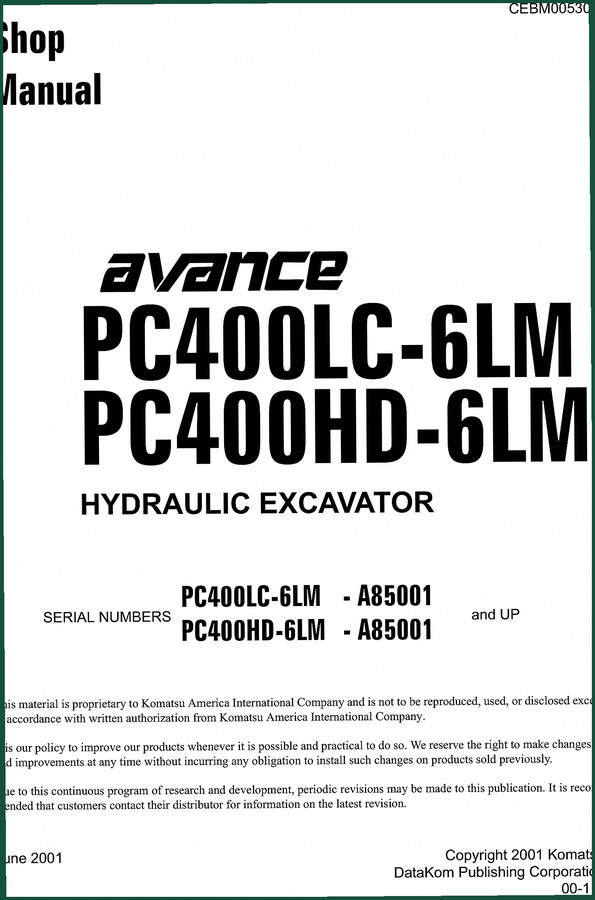
Komatsu PC400LC-6LM, PC400HD-6LM 2001 Service Manual – 868 Pages
Original price was: $43.75.$35.00Current price is: $35.00.
Factory service manual for PC400LC-6LM and PC400HD-6LM excavators – 868 pages of torque specs, hydraulic circuit diagrams, and disassembly procedures.
Description
Komatsu PC400LC-6LM, PC400HD-6LM 2001 Service Manual – Factory OEM Specs for Hydraulic Excavators
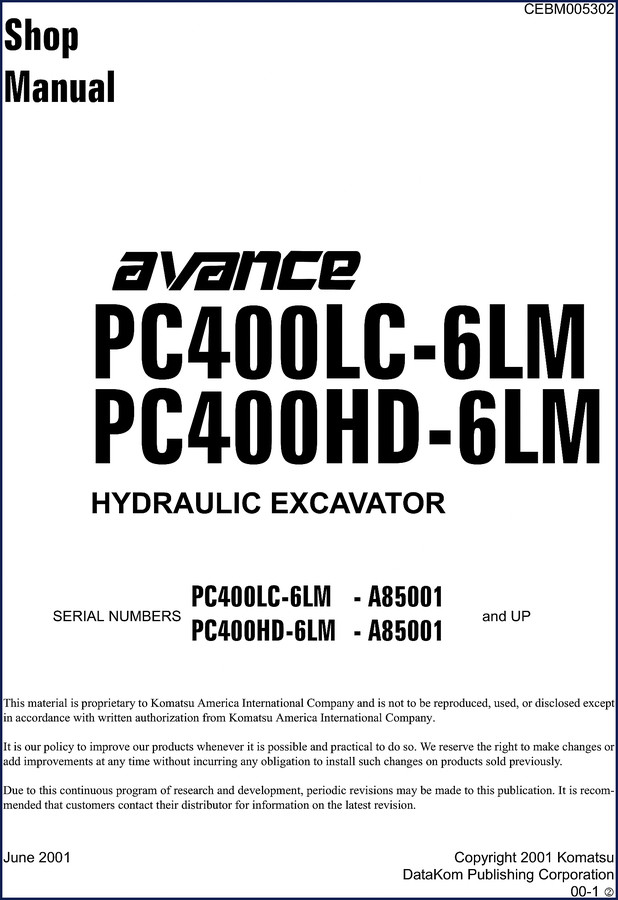
You have a Komatsu PC400LC-6LM or PC400HD-6LM sitting in the bay with a hydraulic leak, a wonky swing motor, or a track frame that needs rebuild. The aftermarket PDFs you obtained from random forums gave you torque values that didn’t match, and you wasted half a day chasing a split flange bolt that stripped at 45 ft-lb. That stops here. This 868-page factory Service Manual is the exact document Komatsu shipped to dealers in 2001. It covers serial numbers A85001 and up for both models. Every torque spec, every hydraulic circuit diagram, every disassembly step came from Komatsu’s engineering floor — not some third-party translator guessing at conversions.
Let’s talk about what matters on a job: getting the right numbers the first time. This manual devotes an entire section to Standard Tightening Torque, covering bolts and nuts, hose nuts, split flange bolts, flared nuts, and alternative fasteners including grade 5 and 8 nonphosphate coated hardware, phosphate coated, and standard metric. You get the exact torque values for each fastener type, not a generic range. If you need the tightening torque for a split flange connection on the main pump, it’s in there. Page references are clear — no hunting through 600 pages of unrelated stuff.
Standard Tightening Torque: What You Get
The foreword alone has more torque data than most aftermarket manuals have in total. You’ll find tables for hose nut torque, split flange bolt torque, flared nut torque, and a bolt identification chart that tells you at a glance what grade you’re working with. Anyone who has snapped a grade 8 bolt because they used grade 5 values knows why this matters. The manual also includes tightening torque for hydraulic tubes, fittings, hose clamps, and split flange connections. That’s the difference between a leak-free joint and a comeback two weeks later.
7 Systems Covered in the Structure and Function Section
Section 10 runs from page 10-1 through the end of the chapter. It breaks down every major system: parts related to engine, radiator and oil cooler, power train, final drive, swing circle, swing machinery, track frame with recoil spring (for PC400LC-6LM standard, variable gauge, and PC400HD-6LM), track shoe, hydraulic piping drawing, hydraulic circuit diagram, hydraulic tank and filter, hydraulic pump with main pump and TVC/LS valve, control valve with 9/8/7 spool configurations, self-reducing pressure valve, suction safety valve, and the full CLSS (Closed Center Load Sensing System) including pressure compensation, regeneration circuits, merge flow divider valve, and 2-stage safety valve for the boom cylinder. That’s not a checklist — that’s a table of contents you can actually use to find the exact hydraulic flow path when you have a pressure drop.
Does This Manual Cover the CLSS Hydraulic System?
Yes, and in depth. The CLSS section covers the basic principle of pump swash plate control, pressure compensation, unload valve cut-off and cancel, LS bypass valve, shuttle valve inside the pressure compensation valve, variable type pressure compensation for service valve, boom and arm regeneration circuits, merge flow divider valve, LS select valve, and the 2-stage safety valve installed to boom cylinder head. If you need to understand how the pump flow merges when you raise the boom and curl the bucket simultaneously, the manual walks through every valve position with diagrams. That’s the kind of detail that keeps you from replacing a pump that’s actually working fine.
Why OEM Matters for the PC400LC-6LM and PC400HD-6LM
This is an original Komatsu publication from 2001, not a reprint or a scan of a scan. The PDF is clean, searchable, and includes the full bookmark structure — you can jump from the safety notice to the disassembly section in two clicks. Aftermarket manuals often omit the safety warnings or convert torque values incorrectly. This one has the original Komatsu safety section with preparations for work and precautions during work. You also get the electric wire code classification by thickness and color, conversion tables, and coating materials specifications. If you’ve ever wondered why a non-OEM manual says “tighten securely” instead of giving a number, this is the antidote.
Testing, Adjusting and Troubleshooting: Factory Procedure
Section 20 is the diagnostic backbone of this manual. It covers testing and adjusting procedures for every hydraulic circuit, along with troubleshooting charts that list symptoms, probable causes, and corrective actions. You don’t need to guess whether a problem is in the swing motor or the control valve — the manual gives you the test points and pressure readings to isolate it. For those who need the full rebuild steps, Section 30 covers disassembly and assembly for the major components. Combined with Section 40 (Maintenance Standard) and Section 90 (Other), you have 868 pages of factory data. That’s more than enough to pull a final drive, reseal a swing motor, or rebuild a control valve without calling the dealer.
If you are working on other Komatsu machines, check the DEMAG KOMATSU Hydraulic Mining Shovels Parts & Service and the Komatsu WA430-6 Service Manual – 306-Page OEM Shop Manual for wheel loaders. The Komatsu WA470 2000 Service Manual – Factory Specs for Wheel Loaders is also in stock. For those who need a different transmission type, this manual’s approach to hydraulic circuits is more detailed than any generic Manual Transmission guide. Similarly, if you compare it to a standard Manual Transmission manual, the level of hydraulic system documentation here is in a different class.
- What serial numbers does this manual cover?
- PC400LC-6LM serial numbers A85001 and up; PC400HD-6LM A85001 and up.
- Does this manual include engine service information?
- This shop manual covers the chassis and hydraulic systems. The engine has a separate manual (form number SEBM006408). You get the engine-related parts in Section 10, but full engine disassembly and overhaul requires the engine manual. That is standard for Komatsu publications — they keep chassis and engine separate because the same engine may be used across multiple models.
- What torque specifications are included?
- The foreword contains the following torque tables: standard tightening torque of bolts and nuts, tightening torque of hose nuts, tightening torque of split flange bolts, tightening torque for flared nuts, and alternative fasteners including bolt identification chart for grade 5 and 8 nonphosphate coated hardware, grade 8 phosphate coated hardware, standard metric fasteners, hydraulic tubes and fittings, hose clamps, and split flange connections. Each table gives torque values in foot-pounds and Newton-meters. You also get the conversion tables section to switch units if needed.
- How many pages is the manual?
- 868 pages.
Stop chasing bad specs and start using the data Komatsu put in the hands of its own technicians. Access the Factory Manual from AutoRepairManuals and get the PC400LC-6LM or PC400HD-6LM back to work.
Additional information
| Brand | Komatsu |
|---|---|
| Language | English |
2 reviews for Komatsu PC400LC-6LM, PC400HD-6LM 2001 Service Manual – 868 Pages
You may also like…
-
Sale!
Komatsu HD1200 1980 Workshop Manual – Factory Specs & Procedures
Original price was: $91.50.$75.00Current price is: $75.00. -
Sale!
Komatsu D65EX, D65PX, D65WX Workshop Manual – 2820 Pages
Original price was: $108.75.$75.00Current price is: $75.00. -
Sale!
Komatsu PC600LC-6 Workshop Manual – Factory Service Data for 732-Page Excavator Guide
Original price was: $112.80.$80.00Current price is: $80.00. -
Sale!
Komatsu PC5500E-6 Workshop Manual – 1378 Pages
Original price was: $150.00.$100.00Current price is: $100.00.
Related products
-
Sale!

Technical Manual – International 6.0L Power Stroke FICM Diagnostics
Original price was: $29.80.$20.00Current price is: $20.00. -
Sale!

International 1000-3000 Series Operators Manual – 132 Pages of OEM Specs
Original price was: $14.40.$10.99Current price is: $10.99. -
Sale!

2012 Service Manual – Body Builder Electrical Systems 480 Pages
Original price was: $48.28.$34.00Current price is: $34.00. -
Sale!
2004 Acura TSX Wiring Diagram – 73-Page Factory Electrical Schematics
Original price was: $15.88.$9.99Current price is: $9.99.
gearhead88 –
Outstanding! It is easily zoomable on my iPad without blur. Contains clear bolt torque specs for Komatsu. Saves me so much money.
Charles W. –
Perfect OEM spec sheet. It is easily zoomable on my phone without blur. A must-have for any Komatsu PC400LC6LM, mechanic doing repairs. Saves me so much time.