
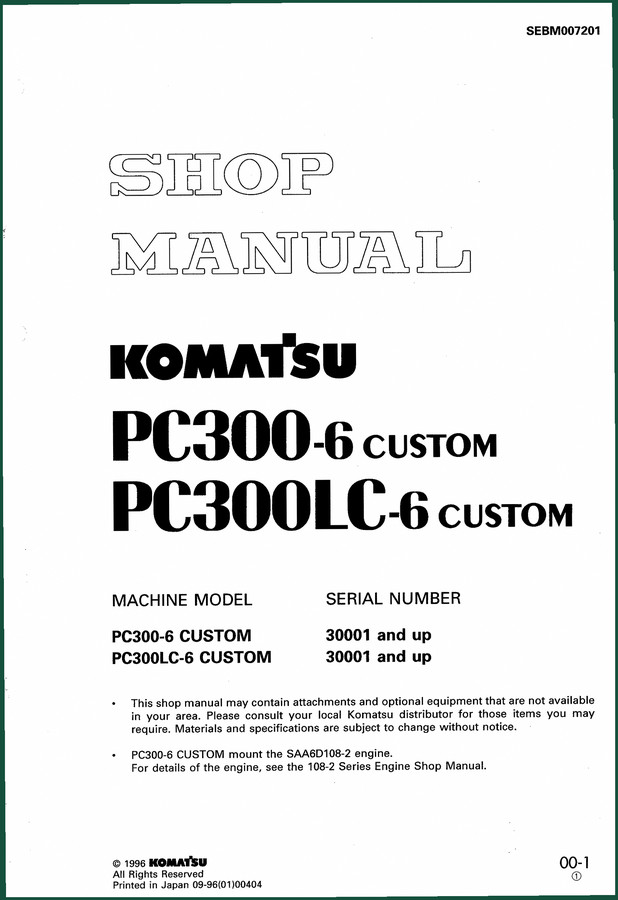
Komatsu PC300LC-6, PC300-6 1996 Workshop Manual – Factory Specs
Original price was: $44.70.$30.00Current price is: $30.00.
Factory 1996 Komatsu PC300LC-6 / PC300-6 Workshop Manual: 582 pages of OEM diagnostic charts, torque specs, and rebuilding procedures.
Description
Komatsu PC300LC-6, PC300-6 1996 Workshop Manual
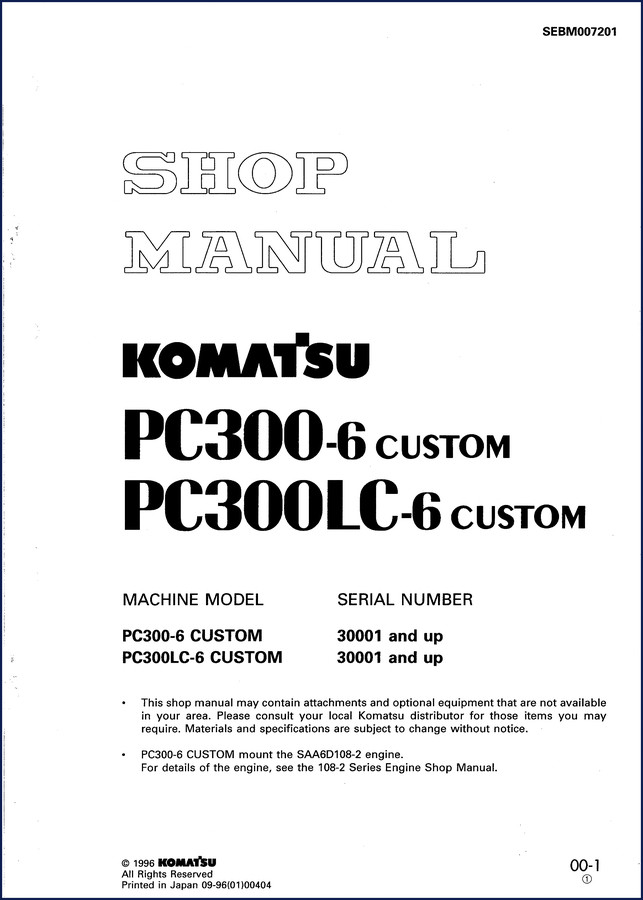
If you have ever been halfway through a valve adjustment on a PC300-6 and realized the aftermarket manual you bought online has the wrong clearance numbers, you know the kind of waste I’m talking about. That burned hour, the trip back to the parts store, the risk of bending a pushrod. This is the OEM factory manual from Komatsu, printed in 1996 for the PC300LC-6 and PC300-6. It runs 582 pages of actual engineering data, not somebody’s guesswork. That matters when a 0.002-inch error on a valve lash turns a good running engine into a noisy headache. I have torqued enough head bolts to know that trusting the wrong source costs real money. So here is exactly what shows up when you Access the Factory Manual.
Komatsu PC300LC-6, PC300-6 Workshop Manual: What You Get
The table of contents splits into five main sections: GENERAL, STRUCTURE AND FUNCTION, TESTING AND ADJUSTING, DISASSEMBLY AND ASSEMBLY, and MAINTENANCE STANDARD. GENERAL starts with specification drawings, weight tables, and the fuel, coolant, and lubricants chart. That last part alone saves you from guessing which oil goes in the hydraulic tank. STRUCTURE AND FUNCTION runs over 100 pages covering everything from the parts related to the engine all the way through the actual electric wiring diagram. You get the hydraulic circuit diagram, the electric circuit diagram, the engine control system, and the sensor locations. Every wire, every solenoid valve position is drawn out. No vague symbols. Komatsu prints it like they expect a technician to read it with a multimeter in hand.
Engine and Fuel System: Factory Specs You Can Trust
Under TESTING AND ADJUSTING, the manual gives you the standard value tables for engine, chassis, and electrical parts. Then it walks you through measuring engine speed, exhaust color, adjusting valve clearance, measuring compression pressure, blow-by pressure, and testing fuel injection timing. The valve clearance procedure on page 20‑21 lists the exact cold lash for intake and exhaust valves. Fuel injection timing has its own step-by-step procedure with specific timing marks. If you have ever rebuilt a Komatsu engine and fought with the injection pump alignment, those pages are worth the price of the whole manual. The fuel system details in the fuel, coolant and lubricants section also tell you what grade of diesel to run in which ambient temperature range. That is the kind of detail that prevents a no-start in January.
Do You Need the Hydraulic Circuit Diagram?
If you are working on the swing motor, travel motor, control valve, or any PPC valve, you need the hydraulic circuit diagram. This manual includes it in the STRUCTURE AND FUNCTION section, along with the hydraulic piping drawing. For a DIYer, understanding which line feeds the boom holding valve versus the PPC safety lock valve can be the difference between a productive afternoon and a hydraulic oil bath. The diagram uses standard Komatsu symbols, and there is a legend for every component. I have seen too many guys guess at which port is which on a control valve and end up with a machine that drops the boom. This manual ends that guesswork.
3 Reasons to Choose OEM Documentation Over Aftermarket
1. Torque specs are factory-verified. The MAINTENANCE STANDARD section lists every critical torque value for engine, final drive, and swing circle bolts. Aftermarket reprints often transpose numbers. One wrong ft-lb on a connecting rod cap can seize an engine. 2. Wiring diagrams are color-coded and connector-specific. The E MODE troubleshooting pages include a judgement table for electrical system, hydraulic and mechanical system. You get connector arrangement diagrams and pin connection tables. No generic harness drawings. 3. Troubleshooting follows OEM logic. The S MODE charts cover 16 engine problems – from poor start to excessive vibration. Each chart leads you through a sequence of events that Komatsu engineers wrote. That is not something a third-party compiler can replicate.
Troubleshooting: The S-Mode Engine Charts
Starting from S-1 (starting performance poor) through S-16 (vibration excessive), the manual gives you a method for each condition. For example, S-2 covers engine does not start, broken into sub‑steps: engine does not turn, engine turns but no exhaust smoke (fuel not injected), and exhaust smoke but no start (fuel injected). Each sub‑step lists the probable causes in order of likelihood, then tells you where to test. That structured approach saves you hours on a machine that won’t fire. The E MODE section handles electrical abnormalities with a separate judgment table. If you want to understand how the CLSS (Closed-center Load Sensing System) interacts with the TVC valve, the TESTING AND ADJUSTING section has a procedure for testing LS valve output pressure and LS differential pressure. All step‑by‑step with the required tools listed at the front of the section.
Related manuals you might need: Komatsu PC300LC-6 PC300HD-6 1996 Service Manual, Komatsu PC300LC-6 PC300HD-6 1999 Workshop Manual, Komatsu PC300-6 PC350-6 2002 Workshop Manual. For those who want to understand the Manual Transmission aspects of similar equipment, the Manual Transmission principles apply across many Komatsu models.
FAQ
- Does this manual cover both the PC300-6 and PC300LC-6?
- Yes. Both models are included in the same book.
- What year was this manual originally published?
- 1996. The revision pages show updates up to 1996. It matches the 1996 model year machines.
- Are the wiring diagrams clear enough for a home garage mechanic?
- Yes. The actual electric wiring diagram and electric circuit diagram are drawn to factory standard. Connector types are identified, pin numbers are listed in a connection table, and the arrangement diagram shows where each connector lives on the machine. If you can read a basic schematic, you can trace a circuit. The troubleshooting section even tells you how to use the charts – read the sequence, check voltages at specific pins, move through the decision tree. It is not a simplified version; it is the exact same drawing a Komatsu dealer technician would pull up.
- Can I use this manual for the PC350-6 or other models?
- Not directly. The PC350-6 has different final drive and hydraulic pump specsthat require a separate manual.
This is the factory documentation that belongs on your workbench, not a scanned copy from some auction site. Every page – all 582 of them – came from Komatsu’s own print. If you work on these machines, you know the difference between a manual that has the real numbers and one that makes you guess. Access the Factory Manual and get back to turning wrenches.
Additional information
| Brand | Komatsu |
|---|---|
| Language | English |
2 reviews for Komatsu PC300LC-6, PC300-6 1996 Workshop Manual – Factory Specs
You may also like…
-
Sale!
Komatsu HD1200 1980 Workshop Manual – Factory Specs & Procedures
Original price was: $91.50.$75.00Current price is: $75.00. -
Sale!
Komatsu PC5500E-6 Workshop Manual – 1378 Pages
Original price was: $150.00.$100.00Current price is: $100.00. -
Sale!
Komatsu PC600LC-6 Workshop Manual – Factory Service Data for 732-Page Excavator Guide
Original price was: $112.80.$80.00Current price is: $80.00. -
Sale!
Komatsu D65EX, D65PX, D65WX Workshop Manual – 2820 Pages
Original price was: $108.75.$75.00Current price is: $75.00.
Related products
-
Sale!

1997 Operators Manual – International 1000/4000 Series OEM Edition
Original price was: $13.49.$9.99Current price is: $9.99. -
Sale!
1993 Operators Manual – International Bus 1000-3000 OEM Specs
Original price was: $12.30.$7.99Current price is: $7.99. -
Sale!
Acura NSX 1991 Service Manual – 1420 Pages OEM
Original price was: $102.05.$65.00Current price is: $65.00. -
Sale!
1994 Troubleshooting Manual – International 1000-4000 FBC
Original price was: $60.00.$50.00Current price is: $50.00.
Robert M. –
Outstanding! It is very easy to read on my iPad without losing quality. Every spec sheet is provided for Komatsu PC300LC6,. Saved my repair job! Thanks.
John S. –
Five stars! Instant access after checkout. A must-have for any Komatsu PC300LC6, mechanic doing maintenance. I will recommend this shop to others.