
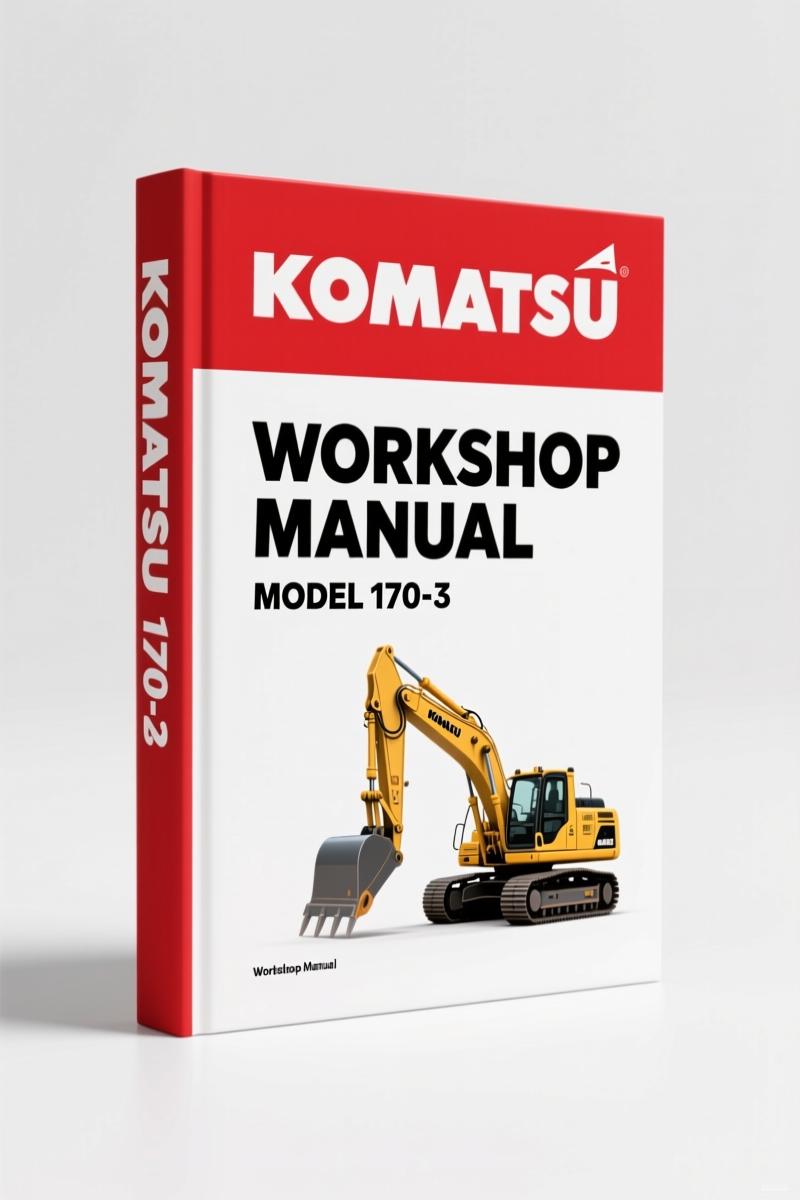
Komatsu 170-3 2008 Workshop Manual – Factory Specs for Diesel Engine
Original price was: $56.80.$40.00Current price is: $40.00.
Factory-authored 2008 workshop manual for Komatsu 170-3 series diesel engine. 454 pages of OEM specs: valve clearances, compression pressures, HPI fuel injection, and troubleshooting.
Description
Komatsu 170-3 2008 Workshop Manual – Factory Diesel Engine Repair Specs
Listen, I’ve been turning wrenches for 28 years. Seen enough aftermarket manuals that leave out a critical torque value or skip half the diagnostic steps. If you’re sticking a Komatsu 170-3 diesel engine – whether it’s in a truck, generator set, or construction equipment – you need the actual factory procedure, not some condensed rewrite. This Workshop Manual dated 2008 runs 454 pages and it’s the same book the Komatsu dealer techs use. No guessing on cylinder head bolt sequence, no wondering about valve lash. It’s all there.
Every machine series has its own quirks. The 170-3 engine uses an HPI fuel injection system with emissions controls and a controller that throws specific error codes. Without the factory diagnostic trees you’re burning billable hours chasing your tail. This manual covers the entire engine – from the air cleaner to the flywheel housing – with part numbers and clearances that came off the assembly line. I’ve used these for years, and they never let me down.
What the 454 Pages Actually Cover
The table of contents isn’t a list of vague promises. It’s laid out like a real shop manual: 01 GENERAL includes applicable machine, specs, overall drawing, weight table, and engine performance curve. Then 11 STRUCTURE AND FUNCTION dives into intake/exhaust (air cleaner, turbocharger, after cooler), engine body (cylinder head, cylinder block, main circulation, flywheel, vibration damper, gear train, timing gear, valve system), lubrication system, fuel system (HPI injection, pump, injector, cooler, filter), cooling system, and electrical equipment. Each section has diagrams and cutaway views so you see how the oil pump feeds the bearings and how the timing gear meshes with the cam. That’s the kind of detail that saves you from misaligning a new timing gear and trashing an engine.
Section 12 TESTING AND ADJUSTING alone is worth the price. Standard value tables for troubleshooting and electrical parts, tools list, measuring intake boost pressure, exhaust temperature, adjusting valve clearance, adjusting injector set load, compression pressure, blow-by pressure, oil pressure, fuel circuit pressure, bleeding air, speed sensor adjustment, belt replacement, run-in standards, performance test standards – it’s all documented. Page 12-1 starts the troubleshooting charts for mechanical system (S Mode) and engine controller system (EA Mode). If your engine won’t start, black smoke, oil contaminated, overheating – the manual walks you through each symptom with step-by-step decision trees.
Valve Clearance Adjustment – Why the Factory Specs Matter
On a 170-3 diesel, the valve system uses a pushrod and rocker arm arrangement. If you set clearance too tight you burn the valve; too loose and you lose power and hammer the seat. The manual tells you the exact feeler gauge thickness and whether to measure hot or cold. Most aftermarket sources give a generic range – this one gives the factory tolerance. I’ve seen guys ruin a good head because they used “close enough” specs from a website. Don’t be that guy.
Beyond clearance, the manual covers valve system structure – the arrangement of valves, springs, retainers, and the timing gear that drives the cam. You’ll find the assembly order and the wear limits for valve stem diameter and guide clearance. That’s in the maintenance standard section (14). If you’re rebuilding the head, you need those numbers.
HPI Fuel Injection System – Don’t Guess the Tolerances
This Engine uses Komatsu’s HPI (High Pressure Injection) system with an engine controller, timing rail actuator, and fuel pump pressure control circuit. The manual has a full subsystem section FUEL SYSTEM with diagrams of the HPI injection system, injector cross sections, and the controller control system. Need to adjust injector set load? That’s in 12 TESTING AND ADJUSTING. There’s also a specific TROUBLESHOOTING FOR INJECTOR procedure. If you get error code 116 (timing rail pressure sensor high level) or 119 (fuel pump pressure sensor low level), the EA mode charts tell you exactly which pins to probe and the expected voltage range. Compare that to a generic “check fuel pressure” tip – night and day.
Speaking of fuel circuit, the manual includes handling precautions for equipment in the fuel circuit, measuring fuel circuit pressure, visual inspection of return fuel, and bleeding air from the fuel circuit. One missing O-ring on the HPI pump can drop rail pressure and send you on a wild goose chase. The factory procedure shows the correct assembly and bleed sequence.
Troubleshooting Charts for S Mode and EA Mode
The manual has two complete troubleshooting sections: S Mode (mechanical system) and EA Mode (engine controller system). S Mode covers 16 failure categories from S-1 (starting performance poor) through S-16 (excessive vibration). Each has sub-branches with yes/no decisions. For example, S-2 engine does not start splits into engine does not turn, turns but no exhaust smoke (fuel not injected), and exhaust smoke but no start (fuel injected). This is real diagnostic logic, not a list of common fixes. EA Mode lists every error code from 111 (controller memory abnormality) to 122 (boost pressure sensor high level), plus the action taken by the controller and machine condition. If you’re working on a machine that goes to limp mode, you need these codes decoded. The Komatsu 170-3 2008 Workshop Manual gives you that.
One thing I appreciate: the manual includes points to remember when troubleshooting and the method of using the charts. Too many techs jump straight to parts replacement without following the logic. This manual forces you to think through the symptoms. That’s the difference between a mechanic and a parts-swapper.
Torque Specs and Standard Value Tables
The STANDARD VALUE TABLE FOR TROUBLESHOOTING and STANDARD VALUE TABLE FOR ELECTRICAL PARTS in section 12 have the numbers you need for diagnostics – compression pressure, oil pressure, boost pressure, fuel pressure, injector set load, valve clearance, and blow-by pressure. These are the baselines. If you don’t know what normal looks like, you can’t find abnormal. Page 12-3-1 gives the specific values for the 170-3 engine. I’ve seen guys order new injectors only to find out the actual problem was a plugged fuel filter. The standard values help you verify before you start replacing parts.
If you also work on other Komatsu equipment, check out the Komatsu 170-3 2002 Workshop Manual – Factory Engine Specs for earlier models, or the Komatsu 170-3 2005 Workshop Manual – OEM Factory Specs in case your engine serial falls between revisions. For wheel loaders, the Komatsu WA65-5 WA70-5 WA80-5 2005 Workshop Manual covers a different drivetrain but shares the same engine family principles. And if you’re ever comparing diesel engine fundamentals like gear train and lubrication systems, the Manual Transmission articles on Wikipedia give a solid background, though nothing beats a factory manual for exact specs. The Manual Transmission section there also explains helical vs straight-cut gears – useful when you’re inspecting your timing gear wear.
FAQ – Quick Answers from the Shop Floor
- Does this manual cover the cylinder head removal and installation?
- Yes. Section 13 (Disassembly and Assembly) includes the cylinder head. You’ll find the bolt tightening sequence and torque steps. Section 15 covers repair and replacement of parts, including cylinder head gasket replacement.
- What error codes are listed in the EA mode troubleshooting?
- The manual covers codes 111 through 122, plus sub-codes for timing rail pressure sensor, fuel pump pressure sensor, engine speed sensors, and boost pressure sensor. Each code includes the controller action and step-by-step troubleshooting charts.
- Is there a table for injector set load?
- Yes.
- How do I measure blow-by pressure on the 170-3?
- Section 12 has a procedure MEASURING BLOW-BY PRESSURE. It specifies which port to use on the cylinder block, the required manometer or pressure gauge, and the acceptable range under full load. The standard value table gives the limit in kPa (or inH2O if you follow the imperial conversion note in the general section). Don’t skip the run-in standard before taking measurements – a new engine needs time to seat the rings. This manual includes a run-in procedure and performance test standards to ensure your rebuild passes factory acceptance. If you’ve only ever used aftermarket “rebuild kits” that skip these steps, you’re going to appreciate the thoroughness.
That’s the kind of detail that keeps an engine running 10,000 hours without a tear-down. If you’re serious about working on Komatsu 170-3 engines, get the factory documentation. Access the Factory Manual now and keep it on your shop tablet – you’ll reach for it every time a code pops up or a valve cover comes off.
Additional information
| Brand | Komatsu |
|---|---|
| Language | English |
2 reviews for Komatsu 170-3 2008 Workshop Manual – Factory Specs for Diesel Engine
You may also like…
-
Sale!
Komatsu PC5500E-6 Workshop Manual – 1378 Pages
Original price was: $150.00.$100.00Current price is: $100.00. -
Sale!
Komatsu D65EX, D65PX, D65WX Workshop Manual – 2820 Pages
Original price was: $108.75.$75.00Current price is: $75.00. -
Sale!
Komatsu HD1200 1980 Workshop Manual – Factory Specs & Procedures
Original price was: $91.50.$75.00Current price is: $75.00. -
Sale!
Komatsu PC600LC-6 Workshop Manual – Factory Service Data for 732-Page Excavator Guide
Original price was: $112.80.$80.00Current price is: $80.00.
Related products
-
Sale!

1992 Electrical Schematic – International 1000/3000/4000/2554 OEM Wiring Diagrams (132 Pages)
Original price was: $26.40.$20.00Current price is: $20.00. -
Sale!

Technical Manual – International DT 530 & HT 530 (118 Pages)
Original price was: $37.00.$25.00Current price is: $25.00. -
Sale!
1993 Operators Manual – International Bus 1000-3000 OEM Specs
Original price was: $12.30.$7.99Current price is: $7.99. -
Sale!

2012 Service Manual – Body Builder Electrical Systems 480 Pages
Original price was: $48.28.$34.00Current price is: $34.00.
Michael T. –
I am extremely satisfied with this transaction. It is easily zoomable on my laptop without losing quality. Every spec sheet is provided for Komatsu 1703. Saves me hundreds of time.
Richard G. –
Five stars! It is easily zoomable on my phone without losing quality. It assisted me to fix my Komatsu 1703 engine. I will definitely buy again.