
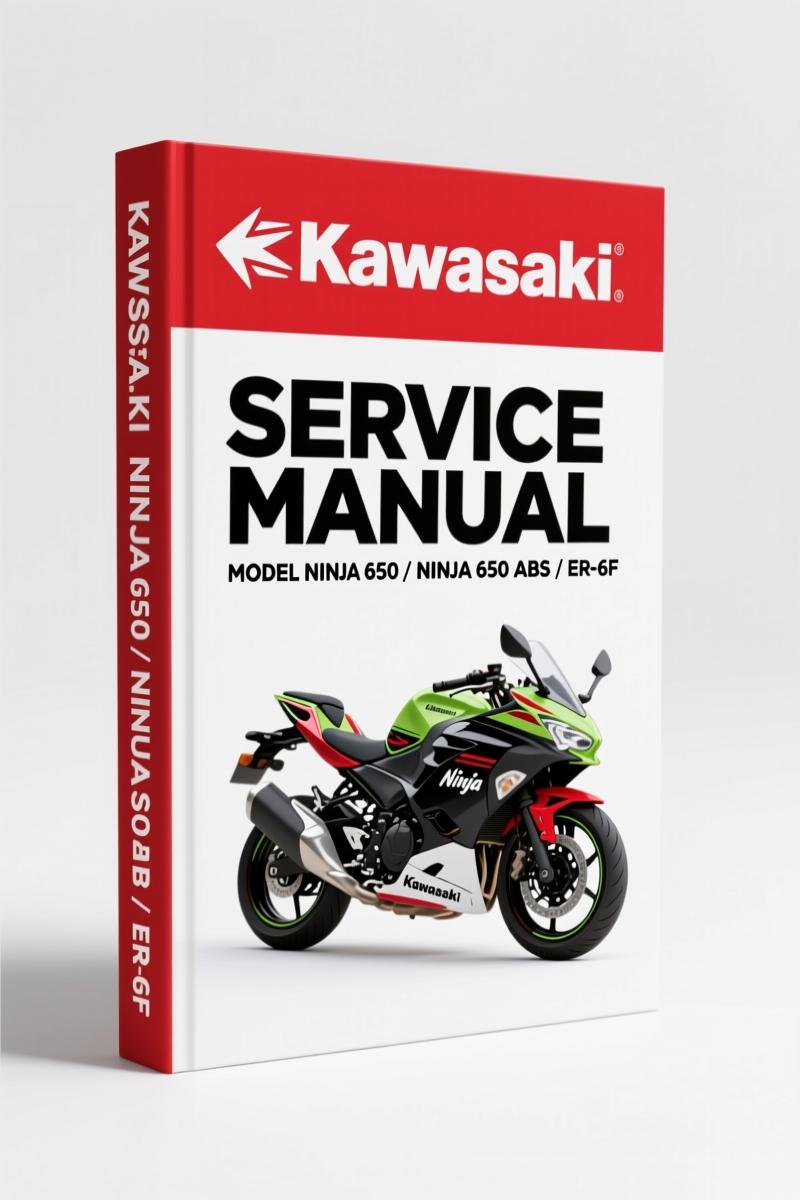
Kawasaki ER-6f, Ninja 650 2012 Service Manual – 637 Pages
Original price was: $28.60.$20.00Current price is: $20.00.
OEM 637-page service manual for 2012 Kawasaki ER-6f, ER-6f ABS, Ninja 650, Ninja 650 ABS. Factory procedures, torque values, DFI troubleshooting.
Description
Kawasaki ER-6f, ER-6f ABS, Ninja 650, Ninja 650 ABS 2012 Service Manual
If you’ve ever bolted a cylinder head onto a motorcycle using specs from a forum post, you already know the sinking feeling when a head gasket starts weeping at 500 miles. I’ve been there. That’s why I won’t touch anything with a Japanese engine unless I have the factory manual open on the bench. This 2012 Kawasaki ER-6f / Ninja 650 service manual is exactly what Kawasaki’s own techs use. 637 pages. No aftermarket guesswork. Every torque value, every clearance, every diagnostic code—straight from the source. If you’re a home garage mechanic who wants to keep your parallel-twin running without turning a simple valve adjustment into a teardown, this is the document you need.
Periodic Maintenance and Torque Specs
Chapter 2 of the manual—Periodic Maintenance—starts with a maintenance chart that lists every interval from throttle body sync to chain slack. The torque and locking agent table is right there in the same section. Need the cylinder head bolt torque for the EX650? It’s in the Engine Top End subsection, but you’ll reference the Periodic Maintenance chart first to see when it needs checking. I’ve seen too many DIY guys skip the air suction system inspection because their generic manual told them it wasn’t important. Kawasaki says different. Page 26 in the original PDF gives you the torque values for the front axle nut, rear axle nut, and steering stem. That page also lists the lock nut torque for the swingarm pivot. Don’t guess. Use the factory spec.
Fuel System (DFI) Troubleshooting and Self-Diagnosis
Chapter 3 is the DFI (Digital Fuel Injection) section. This isn’t a carburetor. If your Ninja 650 is stumbling at idle or throwing a service code, you don’t blindly replace parts. The manual walks you through service code retrieval—main throttle sensor (code 11), intake air pressure sensor (code 12), water temperature sensor (code 14), crankshaft sensor (code 21). Each sensor has its own removal, installation, input voltage, and resistance inspection procedure. No guessing which wire to probe. The troubleshooting guide on page 3-28 (approximate) gives you a decision tree. I’ve used it to fix a bike that had a bad intake air pressure sensor that every parts cannon would have missed. You need this if you own an ER-6f ABS and want to keep its fuel system running right.
Valve Clearance: Why Factory Specs Matter
Valve adjustments on the EX650 are shim-under-bucket. The manual’s Engine Top End chapter (Chapter 5) gives the exact clearance for intake and exhaust. If you use aftermarket specs, you’ll end up with tight valves that burn or loose valves that clatter. The manual includes a valve clearance inspection procedure and the adjustment sequence using the proper special tools listed in the Periodic Maintenance section. Ignore this and you’ll be pulling the camshaft cover twice. I’ve seen it happen. The factory manual doesn’t tell you “close enough”—it tells you 0.15–0.24 mm intake, 0.22–0.31 mm exhaust. Period.
637 Pages of Factory Engineering Data
That page count isn’t padding. Every chapter—Cooling System (4), Clutch (6), Engine Lubrication (7), Engine Removal/Installation (8), Crankshaft/Transmission (9), Wheels/Tires (10), Final Drive (11), Brakes (12), Suspension (13), Steering (14), Frame (15), Electrical System (16), Appendix (17)—has its own exploded views, wiring diagrams, and step-by-step replacement procedures. The appendix includes a unit conversion table if you need to switch between metric and imperial. This manual covers the Ninja 650 ABS variants too, so if your bike has ABS, the brake section (Chapter 12) includes the ABS service data. You won’t find that in a Haynes book. For more on manual transmissions in motorcycles, see Manual Transmission. And if you’re rebuilding the suspension, the factory procedure for fork and rear shock absorber inspection—including oil leak checks—is in Chapter 13; refer to Shock Absorbers for general theory.
What This Manual Covers That Aftermarket Don’t
Aftermarket manuals skip the self-diagnosis procedures for the DFI system. They won’t show you the service code table with backup circuits or how to properly erase codes. They leave out the evaporative emission control inspection for California models. This manual includes all of that. It also has the exact chain slack adjustment procedure with drive chain wear inspection—Kawasaki wants 25–35 mm of slack, not “some play.” The cooling system chapter includes coolant change intervals and radiator hose O-ring replacement specs. If you’re doing a full engine rebuild, Chapter 7 (Engine Lubrication System) and Chapter 9 (Crankshaft/Transmission) give you bearing clearances and oil pump rotor tip clearance. Aftermarket manuals rarely touch those numbers.
Source Authenticity: OEM vs Aftermarket
This is a genuine Kawasaki publication—copyright 2011, first edition (2), from Kawasaki Heavy Industries. It’s the same document that dealership technicians use when they plug in the Kawasaki diagnostic tool. No third-party reprint. No scanned and OCR’d mess with missing pages. The PDF is 637 pages of vector illustrations and searchable text. I’ve used aftermarket manuals that mislabeled the throttle sensor output voltage. This one doesn’t. If you’re serious about owning a Kawasaki ER-6f or Ninja 650, you buy the OEM document. The table of contents includes a quick reference guide with black tabs—you flip the pages back and the chapter number lines up. That’s the kind of thought put into this.
FAQ
- Is this manual compatible with the 2012 Kawasaki Ninja 650 ABS?
- Yes.
- Can I use this manual for the 2012 ER-6f without ABS?
- The manual covers both ER-6f and ER-6f ABS, as well as Ninja 650 and Ninja 650 ABS. All four models are included in the same document. The ABS-specific service data is in the Brakes chapter (12). For the non-ABS version, you simply ignore those sections. The torque specs, engine, suspension, and electrical chapters apply identically across all models. If you have an ER-6f ABS, you’ll find the ABS diagnostic procedures under Electrical System (Chapter 16) and the brake line replacement instructions that differ from the non-ABS bike. This is the only manual you need for any of those four variants.
If you’re done chasing forum advice and want to torque each fastener to the number Kawasaki printed on the assembly line, this is the file to get. Own a 2012 Ninja 650, ER-6f, or their ABS versions. Stop wasting time on approximations. Access the Factory Manual and keep it on your tablet or laptop in the garage. Related manuals you might need: Kawasaki Ninja 650R ER-6f Service Manual – Section: Appendix, Kawasaki Ninja 650R ER-6f ABS 2005 Service Manual – Section: Appendix, Kawasaki Ninja 650R ER-6f ABS Factory Service Manual 623 Pages.
Additional information
| Brand | Kawasaki |
|---|---|
| Language | English |
3 reviews for Kawasaki ER-6f, Ninja 650 2012 Service Manual – 637 Pages
You may also like…
-
Sale!
Kawasaki 92ZV-2 2011 Workshop Manual – 541 Pages Factory Specs
Original price was: $83.20.$65.00Current price is: $65.00. -
Sale!
Kawasaki Ninja ZX-10R Service Manual – Factory OEM Specs
Original price was: $60.75.$45.00Current price is: $45.00. -
Sale!
Kawasaki 85ZV-2 2011 Workshop Manual – 555 Pages Factory Specs
Original price was: $91.00.$65.00Current price is: $65.00. -
Sale!
Kawasaki KLF 250, BAYOU 250 Service Manual – 322 Pages Factory Specs
Original price was: $63.00.$45.00Current price is: $45.00.
Related products
-
Sale!

Technical Manual – International DT 530 & HT 530 (118 Pages)
Original price was: $37.00.$25.00Current price is: $25.00. -
Sale!

1996 Operators Manual – International 1000-4000 Series (246 pages)
Original price was: $15.28.$9.99Current price is: $9.99. -
Sale!
1992 Electrical Schematic – International 1000/3000/4000/2554 OEM Wiring Diagrams (132 Pages)
Original price was: $26.40.$20.00Current price is: $20.00. -
Sale!
Acura NSX 1991 Service Manual – 1420 Pages OEM
Original price was: $102.05.$65.00Current price is: $65.00.
workshop_guy –
Five stars! It is very easy to read on my phone without blur. Every torque spec is provided for Kawasaki ER6f,. Saved my repair job! Thanks.
William H. –
Outstanding! Quick access after checkout process. A must-have for any Kawasaki ER6f, DIYer doing repairs. Saves me a lot of money.
Charles W. –
Great workshop guide. It is very easy to read on my laptop without losing quality. Contains clear wiring diagrams for Kawasaki. Saves me so much money.