
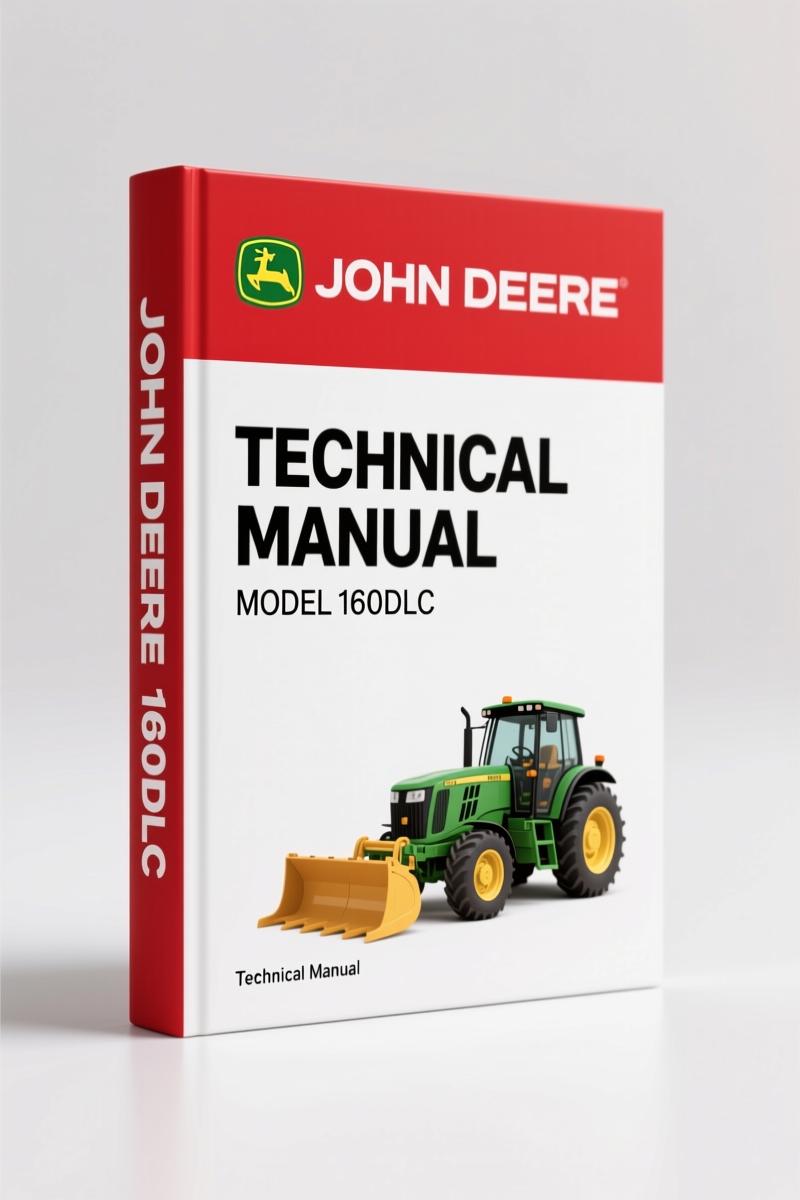
John Deere 160DLC 2008 Technical Manual – OEM Service Data for Excavator Repair
Original price was: $100.10.$65.00Current price is: $65.00.
OEM technical manual for John Deere 160DLC excavator. 406 pages covering engine, tracks, hydraulics, torque values. Factory specifications.
Description
John Deere 160DLC 2008 Technical Manual – Factory Specs for Real Work
I’ve lost count of how many times a junior tech handed me a torque wrench and said “I think it’s tight enough.” That’s how you get pulled threads, blown seals, and a machine that bleeds hydraulic oil on the customer’s driveway. If you’re working on a John Deere 160DLC 2008 Technical Manual – and I mean the actual OEM manual, not some aftermarket PDF that swapped metric for inch – you get the numbers that keep the machine together. This 406-page factory document from 2008 is what I keep on the bench next to the JDE 160DLC excavators. No guesswork, no “close enough.”
Safety: More Than a Checklist
Open the manual to page 2 and you’ll hit the safety section. I don’t care if you’ve been swinging wrenches for twenty years – read it. “Recognize Safety Information,” “Follow Safety Instructions,” “Operate Only If Qualified.” These aren’t lawyer lines. I’ve seen a guy lose two fingers because he skipped the part about high-pressure oils. The manual tells you exactly how to avoid battery explosions, prevent tip-overs, and handle chemical products. You want to weld on the frame? It tells you to remove paint first and how to do it without turning the excavator into a fireball. Skip this chapter and you’re betting your shop floor against a lawsuit.
Torque Values You Can Trust
Aftermarket manuals love to print generic torque charts. This Technical Manual gives you factory numbers for every fastener on the 160DLC. Metric bolt and cap screw torque values on page 5. Unified inch bolt values right after that. Then it gets specific – service recommendations for 37° flare fittings, O-ring boss fittings, flat face O-ring seals, and four-bolt flange fittings. I’ve had to redo entire travel motor installations because some kid used the wrong torque on a face seal fitting. That’s billable hours you don’t get back. The manual also tells you the exact specs for aluminum housings on excavators – different from steel, so pay attention.
Track System Repairs: Step-by-Step
The track system section is where most DIY guys get in over their heads. “Track Roller Remove and Install,” “Track Chain Disassemble and Assemble,” “Front Idler Disassemble and Assemble.” Each procedure lists the required tool list – sprocket pullers, seal drivers, pressure test adapters. You want to replace a track roller? The manual walks you through the metal face seals repair and the pressure test sequence. I once watched a guy try to hammer off a track roller without reading the part about the recoil spring. The spring shot across the shop and buried itself in a drywall. That’s a 911 call waiting to happen. Follow the manual, use the right tools.
Engine Removal and Installation
Pulling the engine on a 160DLC is a two-day job if you work clean. The manual dedicates a full group to “Engine Remove and Install.” It specifies the lifting points, the coolant and oil drain procedures, and the reinstallation sequence. Don’t forget the auxiliary systems – radiator, intercooler, fuel cooler, hydraulic oil cooler. Those come out in a specific order. The manual also covers the intake system, air cleaner removal, and the external fuel supply system including the primary fuel filter (water separator) and final fuel filter. I keep a copy of this manual in the bay because the torque spec for the fuel filter housing can crack the plastic if you overdo it. Page 5 lists that spec? No, that’s the torque values index – the actual numbers are in the body of the section. Look it up. Don’t guess.
Which Technician Needs This Manual?
If you’re a home garage enthusiast who bought a used 160DLC to clear brush, you need this manual. Fear of breaking expensive components? That’s exactly why you buy the OEM document. Professional mechanics – you waste billable hours chasing down leaks because someone handed you an aftermarket wiring diagram that’s off by two pins. This manual is for experienced technicians, as stated in the foreword. It doesn’t hold your hand, but it gives you the exact data – torque specs, wear tolerances, service parts kits. Shop owners: your liability drops when the tech uses factory procedures. The manual includes a feedback form on page 3 – John Deere actually wants your input. That’s the level of engineering behind it.
Source Authenticity: OEM vs Aftermarket
I don’t trust aftermarket documentation. Ever. I’ve seen reprints where the torque values got transposed – foot-pounds written as inch-pounds. That’s a snapped bolt waiting to happen. This 2008 John Deere manual is the original factory print, published by Worldwide Construction and Forestry Division. It’s the same document the dealer techs use. No third-party editing. No added “tips” that send you down a dead end. The manual is 406 pages of OEM spec data, including the “Service Recommendations for O-Ring Face Seal Fittings with Metric Hex Nut and Stud End for Standard Pressure” – those are the fittings that leak if you look at them wrong. Aftermarket manuals don’t even list those.
Related Manuals
- John Deere 160DLC 2008 Technical Manual – 406 Pages of Factory Specs”>John Deere 160DLC 2008 Technical Manual – 406 Pages of Factory Specs
- John Deere 220 1993 Technical Manual – 718 Pages of Factory Specs”>John Deere 220 1993 Technical Manual – 718 Pages of Factory Specs
- John Deere 240, 250 2000 Technical Manual – Factory Specs”>John Deere 240, 250 2000 Technical Manual – Factory Specs
External Resources
For background on mechanical power transmission, see the Wikipedia article on Manual Transmission”>Manual Transmission. Also check the Manual Transmission”>Manual Transmission page for gear basics – though nothing beats the factory torque specs in this manual.
FAQ – Two Questions You Should Ask
- Does this manual include wiring diagrams for the electronic fuel system?
- No. The manual states that wiring diagrams are in the separate POWERTECH ETM (CTM502). This manual covers mechanical repair only.
- What’s the difference between this technical manual and the operator’s manual?
- The operator’s manual (OMT226911) tells you how to run the machine and do daily checks. This technical manual – TM10091 – is the repair bible. It contains disassembly, assembly, torque values, wear limits, and service procedures for every major component. The Operator’s Manual won’t tell you how to rebuild a travel motor or set track tension. This one will, with step-by-step instructions and required tool lists. If you plan to open anything beyond the hood, you need this manual. The safety sections alone cover 22 sub‑topics, from battery explosions to welding precautions. I wouldn’t touch a 160DLC without it.
Torque specs matter. I’ve seen one missing decimal point cost a shop $4,000 in hydraulic repairs. You want to work on a John Deere 160DLC the right way? Access the Factory Manual – the OEM 2008 Technical Manual with 406 pages of verified data. Keep it on your bench, not your browser history.
Additional information
| Brand | John Deere |
|---|---|
| Language | English |
4 reviews for John Deere 160DLC 2008 Technical Manual – OEM Service Data for Excavator Repair
You may also like…
-
Sale!
John Deere JD450 1987 Service Manual – OEM Factory Specs
Original price was: $97.50.$65.00Current price is: $65.00. -
Sale!
John Deere JD450 1987 Service Manual – OEM Factory Specifications
Original price was: $79.95.$65.00Current price is: $65.00. -
Sale!
John Deere 400 1974 Service Manual – Factory Specs for Technicians
Original price was: $92.30.$65.00Current price is: $65.00. -
Sale!
John Deere 325J 2011 Repair Manual — Factory Specs for Backhoe Loader
Original price was: $109.60.$80.00Current price is: $80.00.
Related products
-
Sale!
Acura NSX 1991 Service Manual – 1420 Pages OEM
Original price was: $102.05.$65.00Current price is: $65.00. -
Sale!

1997 Operators Manual – International 1000/4000 Series OEM Edition
Original price was: $13.49.$9.99Current price is: $9.99. -
Sale!

1991 Operators Manual – International Truck OEM Specs (108 Pages)
Original price was: $13.63.$10.99Current price is: $10.99. -
Sale!
2004 Acura TSX Wiring Diagram – 73-Page Factory Electrical Schematics
Original price was: $15.88.$9.99Current price is: $9.99.
William H. –
Excellent workshop guide. It is easily zoomable on my iPad without losing quality. Every spec sheet is included for John Deere Deere. Highly recommended for mechanics.
Michael T. –
This is just what I was looking for. The text is searchable and easy to navigate. Every torque spec is provided for John Deere Deere. I will definitely buy again.
David K. –
This is exactly what I needed. It is easily zoomable on my iPad without blur. It assisted me to fix my John Deere Deere transmission. Saves me hundreds of dollars.
Robert M. –
Highly recommended! The PDF is very clear. It helped me to repair my John Deere Deere transmission. Saves me so much time.