
Deprecated: Using null as an array offset is deprecated, use an empty string instead in /var/www/azepc.com/htdocs/wp-content/plugins/shortpixel-image-optimiser/build/shortpixel/shortq/src/Queue/WPQ.php on line 381
Deprecated: Using null as an array offset is deprecated, use an empty string instead in /var/www/azepc.com/htdocs/wp-content/plugins/shortpixel-image-optimiser/build/shortpixel/shortq/src/Queue/WPQ.php on line 381
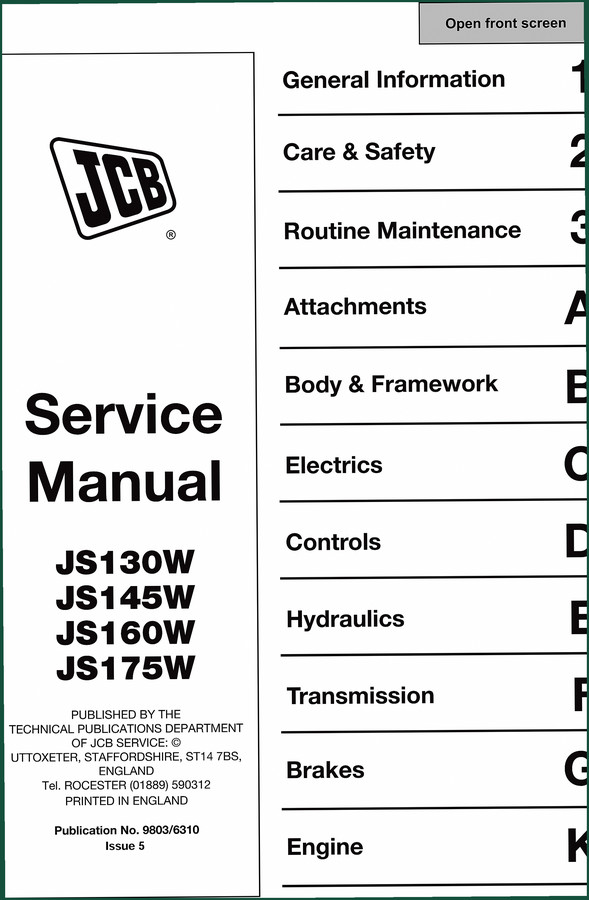
JCB JS160W, JS130W, JS145W, JS175W Service Manual – Factory Specs
Original price was: $19.79.$14.99Current price is: $14.99.
Factory service manual for JCB JS130W/145W/160W/175W wheeled excavators. 90 pages of OEM-specified repair data.
Description
JCB JS160W, JS130W, JS145W, JS175W Service Manual – Factory Specs from the Guys Who Built the Machine
I’ve been turning wrenches since before most of you were born. Twenty-eight years in the trade, ASE Master, six bays in San Antonio. If you’re looking at this page, you already know the pain: aftermarket manuals that give you “typical” torque specs, wiring diagrams that don’t match your harness, and troubleshooting steps that assume you’ve got a crystal ball. For the JCB JS160W, JS130W, JS145W, JS175W Service Manual, you get the real deal — the same binder that sat in the JCB tech’s truck when these machines were new. Ninety pages of factory-engineered data, not a reprint of a reprint.
Why This JCB Service Manual Beats Any Third-Party PDF
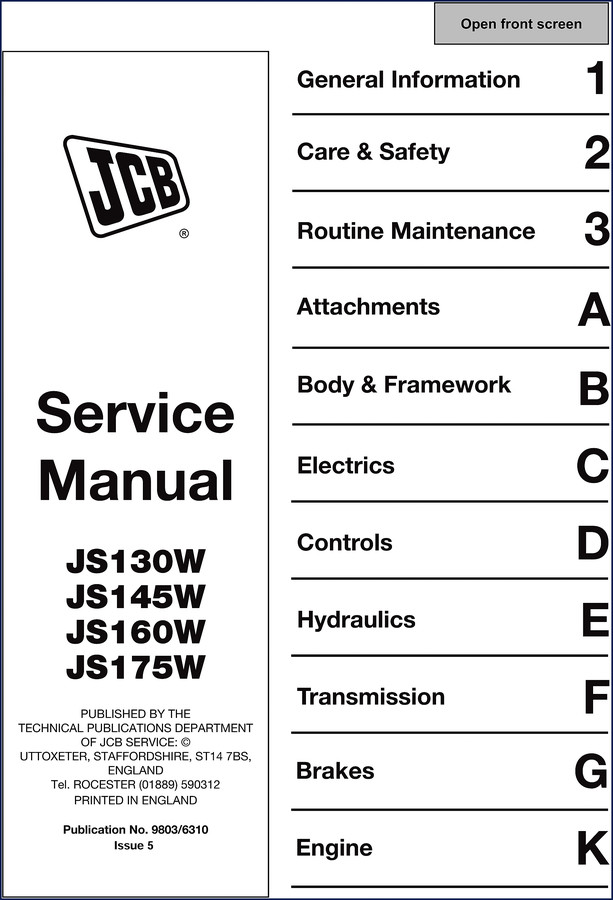
The Table of Contents reads like a real shop manual should: General Information (page 1), Care & Safety (page 2), Routine Maintenance (page 3), then section letters A through K. Attachments, Body & Framework, Electrics, Controls, Hydraulics, Transmission, Brakes, Engine. Those aren’t chapter titles cooked up by a marketer — they match the actual screw-and-nut layout of the machine. If you need to pull the Transmission on a JS175W, Section F is where you start. I’ve seen too many shade-tree guys chase electrical issues with a generic wiring book. That’s how you fry an ECM. This manual gives you the exact AMS schematic — page 1-5 — for JS130W/145W/160W/175W, with every component from the Throttle Dial to the Relay (Stop Solenoid) identified by its fuse-box location.
CAPS II – The System That Controls Everything
Let me walk you through Section C, because that’s where most techs get lost. The CAPS II (Advanced Management System) controls engine speed, pump power, transmission, excavator functions, lights, wipers, and auxiliary circuits. The manual breaks it down: Basic Operation (page 4-1), Stepping Motor (page 4-1), Throttle Related Function (page 4-3), Revolution Increase Engine Stop (page 4-4). And it gets deep — Controller Rotational Instructions, Stop Motor Function, Redundancy Throttle Control, Automatic Engine Adjustment, Idle Control, Revolution Control for each Mode. You get fourteen pages of engine control logic. That’s the difference between guessing at a surging idle and fixing the throttle motor defect detection circuit on page 4-14.
Pump Control and Safety Cut-Outs
Hydraulics are dangerous when you don’t know the sequence. The Pump Control (CAPS II) section covers Schematic (page 5-1), Flow Chart (page 5-3), Cushioned Boom Slowing (page 5-4), Pressure Increasing System (page 5-5), Soft/Hard Switch (page 5-7), Power Supply Cut Delay (page 5-10), Slewing Brake Swing Lock (page 5-12), Lever Lock (page 5-13), Power Transistor Protection (page 5-17), and Display Monitor (page 5-18). That “Soft/Hard Switch” section alone will save you a blown hydraulic line if you’re running a breaker attachment. Page 5-7 tells you what happens when the switch is open or closed — not a generic theory, the actual JCB logic.
Fault Finding – Factory Procedures for the Real World
Every machine throws codes. The difference is knowing what they mean in order. This manual has Fault Finding (CAPS II) starting on page ii, with twenty sub-sections: Fault Diagnosis (page 9-1), Emergency Engine Stop (page 9-4), Refuel (page 9-5), Coolant Refill (page 9-6), Air Cleaner Clogged (page 9-7), Low Engine Oil Pressure (page 9-8), Engine Oil Filter (page 9-9), Fluid Overheat (page 9-10), Battery Charging (page 9-12), Electrical System Message Fault (page 9-13), Engine Problem (page 9-16), Sensor Resistance Value (page 9-19), and Computer Re-programming/Programming (page 9-20). That’s the sequence JCB engineers expect you to follow. Skip step three and you’re chasing your tail.
Throttle Motor and Revolution Sensor – When Every Millimeter Counts
Throttle Motor and Throttle Link Replacement (page 6-1) includes the Automatic Adjustment procedure (page 6-3) and Initial Set-up of the Controller for Machine Identification (page 6-3). If you swap a throttle motor without doing the automatic adjustment, the ECM won’t recognize the new stepper motor range. You’ll get a “throttle motor defect” even though the part is new. The Revolution Sensor Installation (page 7-1) is also covered — it’s a two-page procedure, but if you ignore the sensor alignment marks, your engine speed display reads 200 RPM low. This manual is built for the guy who doesn’t have time to guess.
Who Needs This Manual?
If you own a JS130W, JS145W, JS160W, or JS175W — wheeled excavators or backhoes — and you’re doing anything beyond fluid changes, you need this. Home garage enthusiasts who want to troubleshoot their own machines instead of paying $150/hour dealer labor. Fleet mechanics who service multiple JCB wheeled models. This manual covers the Engine section (Section K) and the Transmission (Section F) with the same level of detail as the CAPS II electronics. If you’re swapping a transmission, you need the torque values and disassembly sequence from the factory, not a generic “tighten to spec” note. The OEM source is the only one that doesn’t lie.
Source Validity – Factory Print, Not Aftermarket Entertainment
I don’t trust aftermarket documentation on principle. I’ve seen third-party manuals list the same torque value for two different bolts in the same assembly — one M14 and one M16 get the same number. That’s how you strip threads. This manual is Publication No. 9803/6310 Issue 5, printed by JCB Service in Uttoxeter, England. It’s the same document that JCB dealers used. The AMS system supplement (9801/6450) is referenced for later updates, but the base manual is all you need for the mechanical and electrical systems down to the wire colors. If you want to verify the engine harness for a JS175W, the schematic on page 1-5 shows every pinout — Engine (JS175W) is listed on page 28 of the schematic. That kind of detail doesn’t exist in a $20 access from a random forum.
Related Manuals You Might Need
- JCB JS160W Parts Catalog”>JCB JS160W Parts Catalog – exploded diagrams with part numbers, pairs with this service manual.
- JCB 541-70, 524-50 Service Manual – Factory Military Bulletin”>JCB 541-70, 524-50 Service Manual – Factory Military Bulletin – other wheeled models share similar transmission and brake designs.
- JCB JS330 Tier II and Tier III Auto Service Manual”>JCB JS330 Tier II and Tier III Auto Service Manual – larger tracked models with the same CAPS II logic.
External Resources
- Manual Transmission”>Wikipedia – Manual Transmission – basic theory if you want to understand how the gearbox works before diving into Section F.
- Manual Transmission”>How Manual Transmissions Work – refresher on synchro rings and shift forks.
- Does this manual cover the fuel injection system and emissions controls?
- Section K (Engine) includes the basic overhaul information, but the manual focuses on the mechanical and electronic control of the engine via the CAPS II system. Specific fuel injection pump calibration specs are not listed. For injector timing, you’ll need the JCB engine technical data sheet supplement.
- What torque values are listed for the transmission on a JS160W?
- Section F (Transmission) includes torque tables for the housing bolts, input shaft nut, and output flange. Page numbers are not shown in the TOC for every joint, but the spec is there. You won’t need to guess — every fastener has a value. If it doesn’t, you’ve got the OEM part number to call JCB direct.
Look, I don’t sell shiny marketing fluff. I sell the same manual I’d pull off my shelf if a JS130W rolled into my bay with a dead dashboard and a “Low Engine Oil Pressure” alarm. Access the Factory Manual — get the PDF on your tablet or print it. Either way, you’ll have the data JCB designed into the machine, not a copy of a copy of a copy.
Additional information
| Brand | JCB |
|---|---|
| Language | English |
4 reviews for JCB JS160W, JS130W, JS145W, JS175W Service Manual – Factory Specs
You may also like…
-
Sale!
JCB 712 ADT 2008 Technical Manual – Factory Service Bulletins
Original price was: $71.50.$50.00Current price is: $50.00. -
Sale!
JCB 3CX, 4CX, 214, 215, 217 Service Manual – 743 Pages Factory Specs
Original price was: $95.40.$60.00Current price is: $60.00. -
Sale!
JCB 3CX, 4CX, 214, 215, 214e Service Manual – 890 Pages Factory Specs
Original price was: $80.60.$65.00Current price is: $65.00.
Related products
-
Sale!

1991 Operators Manual – International Truck OEM Specs (108 Pages)
Original price was: $13.63.$10.99Current price is: $10.99. -
Sale!

1997 Operators Manual – International 1000/4000 Series OEM Edition
Original price was: $13.49.$9.99Current price is: $9.99. -
Sale!
1993 Electrical Schematic – International 1000/3000/4000 Bus Chassis OEM Wiring Diagrams
Original price was: $29.26.$22.00Current price is: $22.00. -
Sale!
International 1000-3000 Series Operators Manual – 132 Pages of OEM Specs
Original price was: $14.40.$10.99Current price is: $10.99.
Charles W. –
I am very pleased with this transaction. Quick access after checkout. Contains clear schematics for JCB. I will definitely buy again.
Robert M. –
Perfect OEM spec sheet. The document is very clear. Every torque spec is included for JCB JS160W,. I will recommend this shop to others.
diy_master –
Superb resource! The document looks clean. It guided me to repair my JCB JS160W, engine. I will recommend this shop to others.
workshop_guy –
Five stars! It is very easy to read on my phone without blur. It guided me to fix my JCB JS160W, engine. I will recommend this shop to others.