
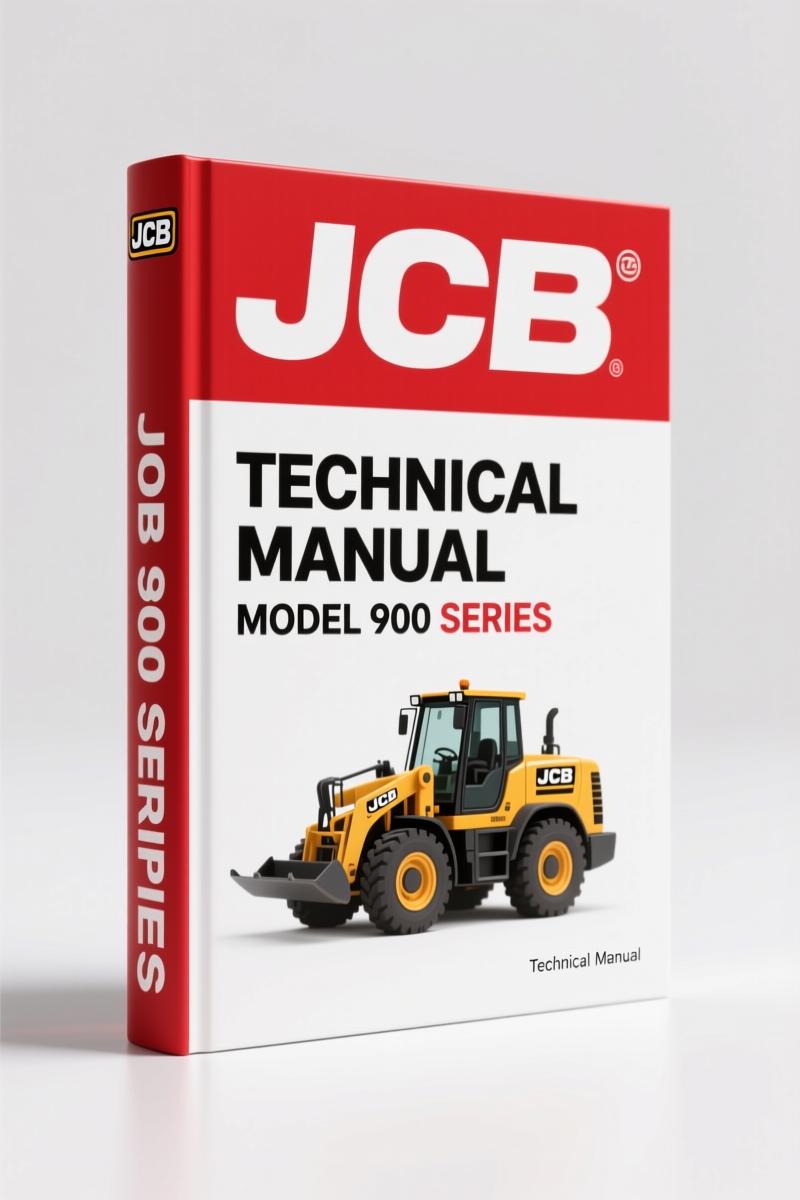
JCB 900 Series 1990 Technical Manual – Factory Axle Setting Specs
Original price was: $38.10.$30.00Current price is: $30.00.
OEM JCB 900 Series 1990 Technical Manual (57 pages) covering axle setting stamp, crownwheel/pinion shim calculations, service procedures.
Description
JCB 900 Series 1990 Technical Manual – What You Get on the Bench
I’ve built a lot of differentials over thirty years, and the one thing I can’t stand is a missing axle setting stamp. You pull an epicyclic axle apart on a 900 Series machine, go to order a crownwheel and pinion set, and the casing has no data – that’s a dead stop. This 57-page JCB 900 Series 1990 Technical Manual is exactly what you need when the factory stamp is absent. It gives you the shim-pack math, the inspection procedures, and the part numbers straight from the JCB tech bulletins. No aftermarket nonsense – this is the same document the dealer’s service manager pulls up when a machine comes in with a growling rear axle.
What’s Inside the Technical Manual – Bulletin Index 9/001
The manual is built around JCB’s Technical Information Bulletin Index, starting with bulletin 9/001 issued March 1990. It covers all 900 Series machines fitted with epicyclic axles. You get five bulletins: 023 through 027. Each one has three sections – Service Information, Service Procedure, and Parts Information. Page 2 of the index spells out the exact problem: “Omission of Axle Setting Stamp From The Axle Casing.” Page 3 walks you through two complete examples of crownwheel and pinion replacement, one with original bearings, one with new bearings, including the shim-pack calculations using feeler gauges and service tool 892/00174. That kind of precision is why I keep a printed copy on my toolbox.
Crownwheel & Pinion Shim Procedure – Example 1
You get the old pinion out, measure the shim pack thickness (recorded as 0.91 mm in the example), then look at the etched figure on the old pinion face (0.02 mm) and the new pinion face (0.01 mm). The manual shows you the arithmetic: subtract the new from the old, get a 0.01 mm difference, then add that to the shim pack if the replacement pinion deviation is less. Final shim pack: 0.92 mm. That’s the kind of step-by-step procedure that keeps backlash correct and prevents a $1,200 gear set from whining. No guesswork – just follow the math.
Inspection Procedures for Axle Rebuilds
Bulletin 026 has two distinct Inspection Procedures – Procedure 1 and Procedure 2. Procedure 1 deals with the case where you’re only swapping the crownwheel and pinion set and reusing the original bearings. Procedure 2 covers the full replacement: new gears plus new pinion bearings. In Example 2 on page 3, the manual measures old bearing width (30.26 mm) versus new bearing width (30.40 mm), calculates the bearing-width difference (0.14 mm), and subtracts it from the shim pack because the new bearing is wider. That’s the kind of factory spec that keeps your pinion depth correct. If you’re a home-garage enthusiast trying to rebuild an axle for the first time, this manual saves you from a $2,000 mistake.
Does This Manual Cover My JCB 900 Series Machine?
If you own a 900 Series wheel loader or backhoe loader with an epicyclic axle – yes. The bulletin index specifically states “All 900 Series Machines Fitted With Epicyclic Axles.” It does not cover non-epicyclic axles or other JCB models. For those, check the JCB Vibromax 2006 Technical Manual – Factory Service Bulletins for Vibratory Com or the JCB Teletruk Technical Manual – Factory Bulletin Index (145 pages). If your machine has a Manual Transmission, the procedure for gear backlash and shimming is similar, but this manual is specific to the axle system. Always verify your machine serial number against the bulletin scope listed in the document.
Why Factory Documentation Beats Aftermarket Reprints
I have seen aftermarket “manuals” that copy the TOC but omit the actual inspection formulas – or they round 0.92 mm to 0.9 mm and call it close enough. That’s how you end up with a pinion that’s too deep and a differential that overheats. This one is a direct scan of the original 1990 JCB technical bulletin, complete with the part number references to service tool 892/00174. No third-party editing. The Parts Information sections in every bulletin (023 through 027) list the actual crownwheel, pinion, bearing, and shim part numbers you need to order. I trust OEM data because I’ve seen the consequences of using a generic spec sheet. If you want to keep your 900 Series working for another 20 years, this is the source.
3 Reasons to Choose the OEM JCB Manual
- Shim-pack calculations based on etched pinion figures – not a one-size-fits-all chart.
- Explicit inspection procedures for bearing width measurement with factory tools.
- Direct reference to JCB Technical Information Bulletins – up-to-date as of March 1990.
The manual also includes a link to the JCB Technical Information Bulletin Index and Door Gas Strut Service for related machine body maintenance. For broader transmission reference, the Manual Transmission article on Wikipedia explains fundamental gear geometry, but this 57-page manual keeps you in the JCB ecosystem.
- Is the manual in imperial or metric units?
- Metric. The JCB factory uses millimeters for shim thickness and bearing width measurements. North American techs working on these machines will need a set of metric feeler gauges and a micrometer. I keep a conversion chart taped to my box, but the manual’s numbers are all mm.
- What if my axle casing already has the stamp – do I still need this?
- Yes. The stamp gives you the original pinion depth figure, but the manual’s inspection procedures (bulletin 026) show you how to verify that figure against the actual bearing wear. I’ve seen cases where the stamp is correct but the bearings have settled 0.05 mm after 5,000 hours – the manual’s procedure catches that. Plus, without the Parts Information tables, you’re guessing which crownwheel set to order. Stick with it.
You’re a step away from having the same data that JCB trained technicians use. Access the Factory Manual now and keep a copy on your workbench. It’s 57 pages of real factory procedure – no fluff, no guessing. Just the shim math and part numbers that get your 900 Series back in the dirt.
Additional information
| Brand | JCB |
|---|---|
| Language | English |
3 reviews for JCB 900 Series 1990 Technical Manual – Factory Axle Setting Specs
You may also like…
-
Sale!
JCB 3CX, 4CX, 214, 215, 214e Service Manual – 890 Pages Factory Specs
Original price was: $80.60.$65.00Current price is: $65.00. -
Sale!
JCB 712 ADT 2008 Technical Manual – Factory Service Bulletins
Original price was: $71.50.$50.00Current price is: $50.00. -
Sale!
JCB 3CX, 4CX, 214, 215, 217 Service Manual – 743 Pages Factory Specs
Original price was: $95.40.$60.00Current price is: $60.00.
Related products
-
Sale!

1994 Troubleshooting Manual – International 1000-4000 FBC
Original price was: $60.00.$50.00Current price is: $50.00. -
Sale!

Service Manual – International HS 2.8L Engine – 130 Pages of Factory Specs
Original price was: $56.40.$40.00Current price is: $40.00. -
Sale!

1989 Service Manual – International 2000-8000 Electrical Systems
Original price was: $72.00.$50.00Current price is: $50.00. -
Sale!

1991 Operators Manual – International Truck OEM Specs (108 Pages)
Original price was: $13.63.$10.99Current price is: $10.99.
William H. –
I am extremely satisfied with this purchase. Immediate link after checkout process. A must-have for any JCB 900 mechanic doing repairs. Saved my weekend project! Thank you.
Thomas B. –
Outstanding! The document is high resolution. Every spec sheet is included for JCB 900. I will definitely buy again.
workshop_guy –
Outstanding! The document looks clean. It assisted me to troubleshoot my JCB 900 transmission. Saves me hundreds of time.