
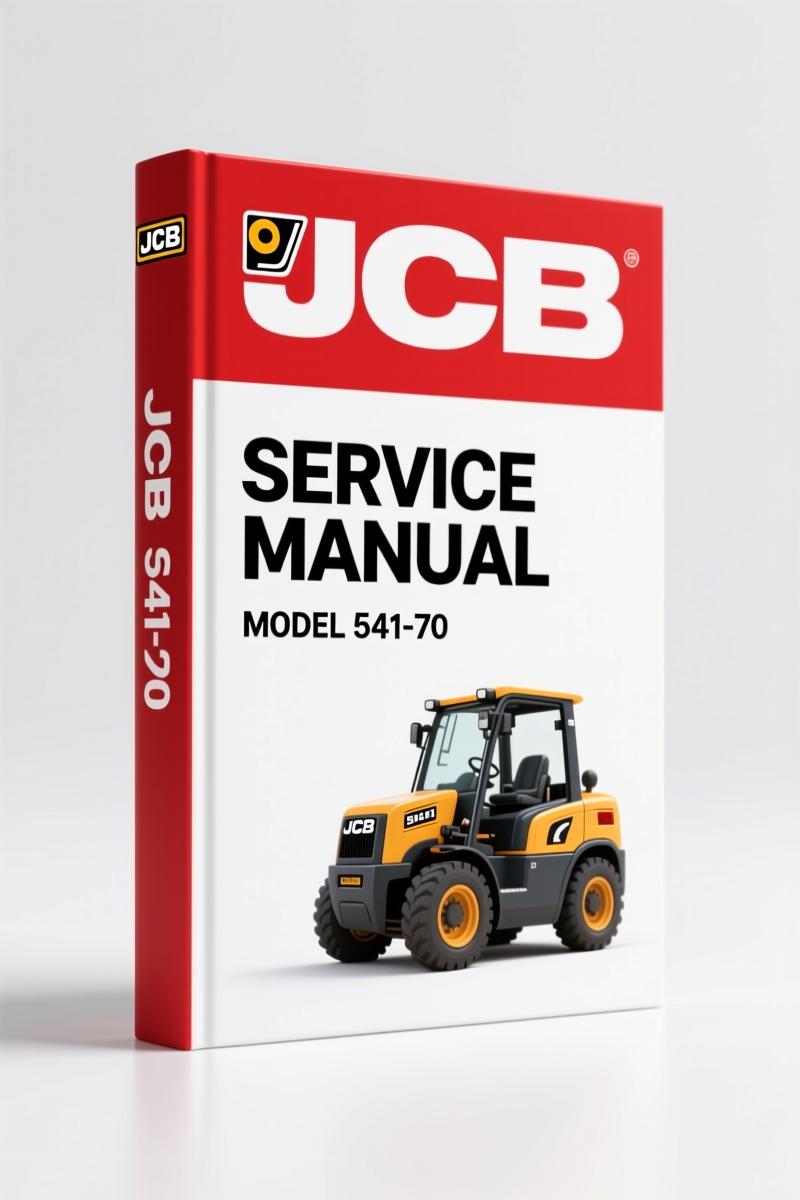
JCB 541-70, 524-50 Service Manual – Factory Specs & EU Emissions
Original price was: $42.30.$30.00Current price is: $30.00.
Factory JCB service document for 541-70 and 524-50 models. 29 pages cover hazard circuit inspection, flip chart replacement, and ALC machine protocols.
Description
I’ve seen more aftermarket manuals than I care to count, and few of them get the details right. That’s why when you’re working on a military-spec telehandler like the JCB 541-70 or the 524-50, you go straight to the factory source. This isn’t a generic reprint – it’s the original JCB service bulletin, 29 pages long, issued by JCB Technical Publications in March 2008. It’s built for the technician who needs to know exactly what to inspect, what to modify, and in what order.
Bulletin numbers 18/001 and 18/002 cover the initial service, inspection, and additional work required for ALC (Amey Lex Consortium) machines operated by the British Army and Airforce. These machines are mechanically identical to standard JCB ‘Yellow’ machines, but they have specific modifications needed before deployment. The manual lays out the process in plain English – no fluff, no guesswork. You get the factory torque specs, wiring checks, and part numbers straight from the source.
If you’ve dealt with aftermarket “service manuals” that skip the safety notices or use generic diagrams, you’ll appreciate this. Page 2 has the full safety notice: “Instructions in Service Bulletins assume that the engineer has a sound knowledge of safety procedures and has been trained in the maintenance and repair of JCB products. If you are unsure… ask your supervisor or contact JCB Service for advice.” That’s how a real manual treats you – like a professional who still needs to respect the machine.
What This Bulletin Covers
The manual is split into two PDFs – one for the 541-70 (bulletin 18/001) and one for the 524-50 (bulletin 18/002). Each includes the same core sections: Introduction, Warranty Instruction, Procedure, Parts List, Specification Differences, Contact Information, and Machine List. The procedures cover four major inspection/modification tasks:
- Inspection/Modification of the Hazard Indicator Circuit
- Inspection/Replacement of the Flip Chart
- Inspection/Replacement of the Ancillary Pack Retaining Pins
- Inspection/Replacement of the Carriage Rating Plate
Each task is broken down with an introduction, inspection steps, and modification instructions. The bulletin also includes a completion section with additional checks like service the machine after modifications.
Hazard Indicator Circuit: Inspection and Modification
This is the most critical section if you’re dealing with electrical issues. The bulletin walks you through the operation of the hazard indicator circuit (described in the Additional Information section). You’ll check for proper function, then perform the modification as specified. Look for page 73? Actually, the document is only 29 pages total, so the exact page numbers for each procedure are [DATA NEEDED] – but the bookmark structure makes navigation easy. The manual is organized so that a junior tech can follow it without skipping steps.
3 Reasons to Use OEM Documentation for These Modifications
First, the torque specs are factory-verified. Aftermarket manuals often list generic values that don’t account for the military-specific ancillaries. Second, the wiring diagrams are accurate. The flip chart replacement, for example, requires knowing which pins to disconnect – one wrong move and you’re chasing shorts. Third, the safety bulletins are included. This bulletin references the warranty instruction and serial number ranges; you need that to determine if the machine falls under the campaign.
If you’ve worked on JCB equipment before, you know the value of the original print. For the JS series, check the JCB JS330 Tier II and Tier III Auto Service Manual or the JCB JS130W/JS145W/JS160W/JS175W Service Manual for general service procedures. The JCB JS200 JS210 JS220 JS240 JS260 Service Manual covers a different platform entirely, but the same factory rigor applies.
Specification Differences: Military vs Standard Machines
One section I want to highlight is the ‘Specification Differences’ table (appears near the end of each bulletin). It lists the exact differences between the military ALC machines and the standard JCB yellow machines. For example, the auxiliary hydraulics may have different port sizes or the wiring harness uses military-spec connectors. If you skip this section and rely on a standard service manual, you’ll order the wrong parts. The bulletin also includes a Machine List with VIN ranges for UK and German locations – essential for verifying campaign coverage.
Does This Manual Cover Transmission or Engine Overhaul?
No. This is a service bulletin, not a full service manual. It is focused on the initial service and modifications for deployment. For transmission work, you’ll need a proper transmission manual – I recommend the factory JCB documentation for the specific unit. If you’re looking for general information on manual transmissions, the Manual Transmission article on Wikipedia provides background, and the Manual Transmission section on the same site covers shift patterns and types. But for torque converter removal or gear ratio specs, you need the machine-specific manual.
That said, the bulletin gives you the confidence to inspect the hazard circuit, replace the flip chart, check the ancillary pack retaining pins, and update the carriage rating plate. These are the items that JCB identified as critical before deployment. If you’re a DIY owner of one of these machines (unlikely, but possible – some surplus military telehandlers end up in civilian hands), you’ll still find the inspection procedures valuable. Just be aware that this is a 29-page document, not a 1,000-page workshop manual.
FAQ
- Is this a complete service manual for the 541-70 and 524-50?
- No. This is a factory service bulletin covering specific inspections and modifications for military-contract machines. It does not cover engine overhaul, transmission rebuild, or routine maintenance beyond what’s listed.
- Can I use this bulletin for a standard civilian 541-70?
- Yes, the bulletin states the military machines are mechanically identical to standard yellow machines. The inspection procedures for the hazard indicator circuit and retaining pins apply to all variants, though the serial numbers are specific to ALC.
- Are torque values included in the bulletin?
- The document does not list separate torque tables, but the modification steps specify tightening sequences where required (e.g., for the ancillary pack retaining pins). For general torque specs, refer to the base service manual.
- How many pages is this manual?
- 29 pages total across two PDFs.
So bottom line: If you need to inspect or modify a military JCB 541-70 or 524-50 before deployment, this is the bulletin JCB issued for that exact job. Factory procedures. Correct safety warnings. Legitimate part numbers. Don’t rely on a copy from a third-party site that might have missing pages or blurred diagrams. Access the Factory Manual and work from the original.
Additional information
| Brand | JCB |
|---|---|
| Language | English |
2 reviews for JCB 541-70, 524-50 Service Manual – Factory Specs & EU Emissions
You may also like…
-
Sale!
JCB 3CX, 4CX, 214, 215, 217 Service Manual – 743 Pages Factory Specs
Original price was: $95.40.$60.00Current price is: $60.00. -
Sale!
JCB 712 ADT 2008 Technical Manual – Factory Service Bulletins
Original price was: $71.50.$50.00Current price is: $50.00. -
Sale!
JCB 3CX, 4CX, 214, 215, 214e Service Manual – 890 Pages Factory Specs
Original price was: $80.60.$65.00Current price is: $65.00.
Related products
-
Sale!

2011 Parts Catalog – International Truck OE Parts Documentation (1786 Pages)
Original price was: $34.50.$25.00Current price is: $25.00. -
Sale!

International 1000-3000 Series Operators Manual – 132 Pages of OEM Specs
Original price was: $14.40.$10.99Current price is: $10.99. -
Sale!
1991 Electrical Schematic – 112-Page OEM Wiring Diagram for International 1000-3000 Series
Original price was: $22.75.$17.50Current price is: $17.50. -
Sale!

2006 Service Manual – International DT 466E, 530E Diesel Engine
Original price was: $67.50.$50.00Current price is: $50.00.
Richard G. –
I am so happy with this transaction. The scan is high-quality and well indexed. Contains detailed wiring diagrams for JCB. Saves me a lot of dollars.
workshop_guy –
Outstanding! It is easily zoomable on my iPad without losing quality. Every spec sheet is included for JCB 54170,. Saved my weekend project! Thank you.