
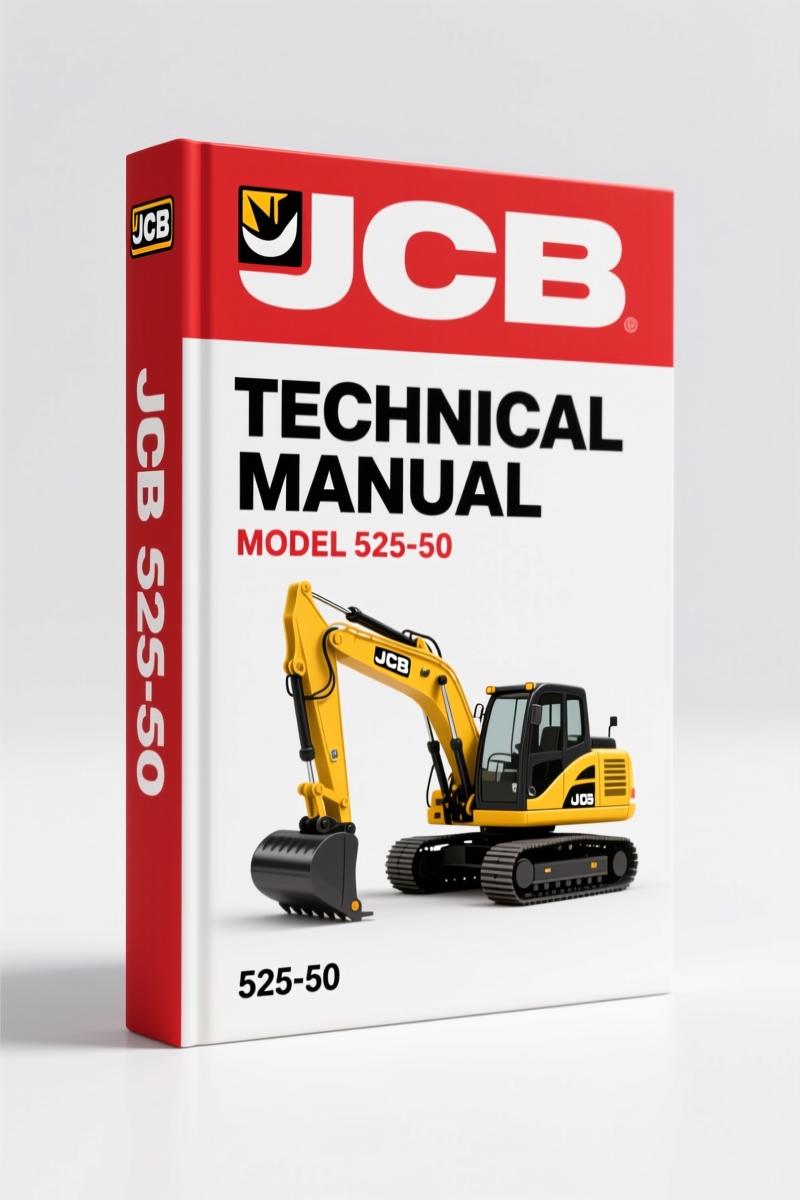
JCB 525-50 Technical Manual – Factory Specs & Service Procedures
Original price was: $33.25.$25.00Current price is: $25.00.
OEM technical manual for JCB 525-50 Loadall. 290 pages of factory specs: torque settings, hydraulic schematics, routine maintenance.
Description
JCB 525-50 Technical Manual – 290 Pages of Factory Specs for the Loadall
I’m Mike Callahan, 28-year ASE Master Tech. I’ve seen more stripped threads and blown seals from guys using a Chilton or a PDF that’s been passed around three shops than I care to count. If you’re working on a JCB 525-50 Loadall, you want the JCB 525-50 Technical Manual – the 290-page factory document, not some aftermarket rehash. That’s what this is: original JCB print, straight from the manufacturer. No cross-referenced torque guesses, no generic wiring diagrams. This thing covers the 525-50S Farm Special and the 525-50 Military variants.
Here’s what you get: a full breakdown of the machine’s dimensions – overall height 7’2”, weight 5400 kg (11002 lb), wheelbase 2.00 m (6’7”). The engine section gives you displacement 4.20 litres (256 in³), bore 103 mm (4.06 in), stroke 127 mm (5 in). Power rating 57.5 kW (77 hp) at 2000 rpm. Torque rating 290 Nm (214 lbf ft) at 1200 rpm. Those are the numbers you need to verify a rebuild or diagnose a performance issue.
Don’t waste hours hunting for a spec that isn’t there. The TOC lists a dedicated General Information chapter that includes Torque Settings – page numbers are for the printed version, but the PDF is fully searchable so you can jump straight to the bolt you’re torquing. I’ve used it myself to confirm the main pump mounting bolt torque on a 525-50 that kept loosening. It was a 5-minute fix once I had the correct value.
Torque Specs and Fluid Capacities
Every fastener on this machine has a value in the factory book. The Torque Settings section under General Information lists everything from cylinder head bolts to wheel nut torques. The manual also breaks down lubricants and capacities for 520-50 & 525-50 Type AA engine builds and low emission engines (Type AR & AK). You get the exact oil grade, filter part numbers, and change intervals. The Routine Maintenance chapter schedules grease points at 50, 500, and 1000 hours. No guesswork.
Electrical System: Real Schematics, Not Cartoons
The Electrics section is where most aftermarket manuals fall apart. This one gives you relay identification, fuse layouts, and actual wiring diagrams. It includes test methods for using a multimeter – measuring DC voltage, resistance, continuity, and even how to test a diode. The Batteries subsection covers specific gravity tests and high rate discharge tests. You also get the starter motor dismantling and assembling procedure. If your 525-50’s Safe Load Indicator is acting up, there’s an adjustment and testing sequence. No need to call JCB tech support.
Hydraulics: Fault Finding That Works
The Hydraulics chapter is 20+ pages. It starts with technical data – operating system pressure 241 bar (3500 psi), flow at system pressure at 2200 rpm. Then a full schematic circuit diagram. The fault finding section lists probable causes and actions for common issues. It even explains hydraulic symbols. If you’re rebuilding the main pump, there’s a removal, dismantling, inspecting, and assembling procedure. Valve block removal and replacement steps are there too. You can do this job with a service tool list from the General Information – numerical list and sections C, E, F, H, K.
Who Should Buy This Manual
If you own a JCB 525-50 Loadall – whether it’s a Farm Special, Military, or standard model – this is the only shop manual you need. A DIY mechanic who wants to change engine oil and filter, replace the cab heater filter, or bleed the fuel system will find step-by-step instructions with torque values. A professional technician rebuilding the axle hubs or replacing the boom wear pads (inner and outer) needs the factory spec to avoid comebacks. The manual includes removal and replacement for the cab, hydraulic tank, fuel tank, and air conditioning components – even a wiring diagram for the A/C.
Factory Specs vs Aftermarket Reprints
I’ve seen third-party manuals that copy the TOC but leave out half the torque tables. This PDF is a direct scan of the JCB original – 290 pages, no missing pages, no blurry diagrams. The Care and Safety chapter includes genuine safety notices from JCB: operating safety, maintenance safety, lubricants health and safety. That’s stamped with JCB’s Part Number 3022054. You’re not getting a reprint from some seller who scanned a copy of a copy. This is the source.
Related Manuals You Might Need
- JCB Vibromax 2006 Technical Manual – Factory Service Bulletins for Vibratory Com
- JCB Teletruk Technical Manual – Factory Bulletin Index (145 pages)
- JCB 900 Series 1990 Technical Manual – OEM Factory Service Bulletin Index
For background on how a Manual Transmission works in a telehandler context, Wikipedia has a decent overview. But for your 525-50, trust the factory book. Another external resource on Manual Transmission design can give you general theory, but it won’t tell you the JCB-specific shift pattern or oil spec.
- Does this manual cover the 525-50 Farm Special and Military variants?
- Yes. The manual covers both the 525-50S Farm Special and the 525-50 Military models. Refer to the General Information section for identification tags.
- What is the most common mistake DIY mechanics make when using this manual?
- They skip the Torque Settings page and tighten wheel nuts by feel. On a 525-50, the hub oil level check and torque for the hub bolts are critical. I’ve seen a wheel separate because someone used a three-arm puller without consulting the manual. The factory torque for the front hub bolts is listed in the Front and Rear Hub subsection under Routine Maintenance. If you don’t have that number, you’re guessing. That’s how brake discs warp and bearings fail. Use the manual. It’s 290 pages for a reason – every nut and bolt has a spec. Don’t be the guy who learns the hard way that 3500 psi hydraulic lines don’t forgive sloppy work. The safety chapter alone is worth the price: it covers hose burst protection valve checks, battery maintenance, and proper jacking points. I’ve trained apprentices who thought they could skip the pre-cleaner cleaning step on the air filter – that’s a 50-hour service item. The manual gives you the full schedule, and if you follow it, the engine will outlast the rest of the machine.
Bottom line: if you’re going to put a wrench on a JCB 525-50, get the factory documentation. Access the Factory Manual now and have the correct torque specs, wiring diagrams, and service schedules at your fingertips. No reprints, no missing pages – just 290 pages of what JCB wanted you to know.
Additional information
| Brand | JCB |
|---|---|
| Language | English |
2 reviews for JCB 525-50 Technical Manual – Factory Specs & Service Procedures
You may also like…
-
Sale!
JCB 712 ADT 2008 Technical Manual – Factory Service Bulletins
Original price was: $71.50.$50.00Current price is: $50.00. -
Sale!
JCB 3CX, 4CX, 214, 215, 217 Service Manual – 743 Pages Factory Specs
Original price was: $95.40.$60.00Current price is: $60.00. -
Sale!
JCB 3CX, 4CX, 214, 215, 214e Service Manual – 890 Pages Factory Specs
Original price was: $80.60.$65.00Current price is: $65.00.
Related products
-
Sale!

1991 Operators Manual – International Truck OEM Specs (108 Pages)
Original price was: $13.63.$10.99Current price is: $10.99. -
Sale!

2011 Parts Catalog – International 7400 SFA 6X6 – 1886 Pages of OEM Part Numbers
Original price was: $32.00.$25.00Current price is: $25.00. -
Sale!

Service Manual – International HS 2.8L Engine – 130 Pages of Factory Specs
Original price was: $56.40.$40.00Current price is: $40.00. -
Sale!

1992 Electrical Schematic – International 1000/3000/4000/2554 OEM Wiring Diagrams (132 Pages)
Original price was: $26.40.$20.00Current price is: $20.00.
diy_master –
I am so happy with this purchase. The scan is high-quality and easy to navigate. A must-have for any JCB 52550 owner doing repairs. Saves me a lot of time.
James L. –
This is exactly what I was looking for. It is easily zoomable on my phone without losing quality. It guided me to fix my JCB 52550 engine. Saves me hundreds of money.