
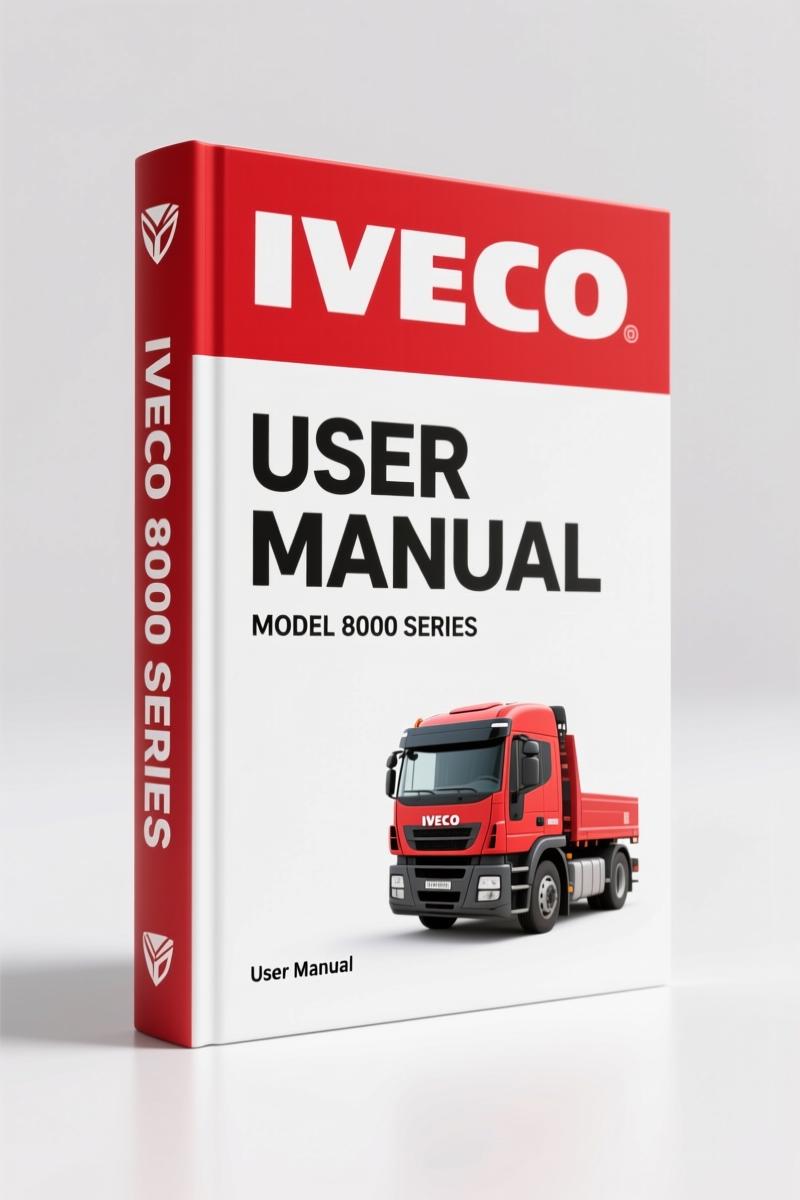
Iveco 8000 Series User Manual – Factory Operation & Maintenance
Original price was: $13.66.$8.99Current price is: $8.99.
OEM Iveco 8000 Series user manual: 39 pages covering engine operation, safety, routine maintenance, and fluid capacities for industrial, gen-set, and fire pump applications.
Description
Iveco 8000 Series User Manual
Worked on enough industrial diesels to know that the difference between a running engine and a tagged-out machine is often a missing torque value or a skipped pre-start check. This Iveco 8000 Series User Manual is the exact booklet that ships with the engine from the factory. Not a generic rewrite. Not an aftermarket translation job. It’s the document Iveco puts in the crate. 39 pages, printed in Italy, and packed with the same data the OEM techs rely on. If you’re trying to keep an 8000 Series running in a generator set, a fire pump, or any industrial application, this is where you start.
Engine Identification Data and Safety Requirements
Page 1 opens with general information, but the real meat comes at page 3: safety requirements and warning labels. The manual dedicates an entire section to the placement and meaning of each warning label on the engine block. That’s not filler – it’s liability protection and accident prevention. If you skip the part about high-pressure fuel lines or hot exhaust manifolds, you’re asking for a burn or an injection wound. The manual also walks you through engine identification data (page 5) so you can match serial numbers and engine codes before you order a single part.
What Pages 5–12 Cover for Industrial Engine Operation?
Pages 5 through 12 break down the industrial engine variant. You get engine views (page 6), engine data (page 9), before-starting checks (page 9), starting procedure (page 10), stopping procedure (page 11), water pre-heating (page 11), and precautions for normal operation (page 12). The water pre-heating section alone is worth the price if you operate in cold climates – it tells you the exact coolant temperature range and time required before you can crank. No guesswork. You follow the table, you get a healthy start.
3 Sections for Engine Fault Diagnosis and Maintenance
The manual isn’t just start-and-go; it has three dedicated sections for after-market care. The “Checks and maintenance” chapter spans pages 14–20, covering routine checks (page 16) and routine maintenance (page 20). Then there’s a separate fault diagnosis section for fire pump engines on page 29. That table lists symptoms, probable causes, and corrective actions. For example, low oil pressure? The manual tells you to check the suction strainer first, not the pump. That sequence saves hours of tear-down time. Finally, pages 33–34 give you main regulation and repair data plus capacities – fluid specs you won’t find in a condensed online PDF.
Get the Correct Torque and Capacities from Page 33
Torque specs are the backbone of any engine rebuild. This manual lists main regulation and repair data on page 33 – likely head bolt torque, bearing cap torque, and valve clearances. I say “likely” because the TOC says that page covers it, but I always recommend checking the actual page after access to confirm it matches your specific 8000 Series variant. Capacities are on page 34: oil, coolant, fuel. Use OEM specs, not internet guesses. A quart too much oil can foam and starve bearings. Trust the factory numbers.
Fire Pump Engine: Starting and Stopping Procedures
Fire pump engines have different operating requirements. The manual dedicates pages 26–28 to that application. It covers engine views, data, before-starting checks, starting the engine, and stopping the engine. The critical difference is the governor setup – mechanical vs. electronic. Page 24 in the generator section explains the electronic governor procedure, but the fire pump section assumes you understand the load profile. If you’re commissioning a fire pump, you need to read page 27 closely because the starting sequence includes a purge cycle to clear any fuel vapor. Miss that, and you risk a runaway condition.
Who This Manual Helps and How to Use It
This manual is for anyone who operates, maintains, or repairs an Iveco 8000 Series engine. Home garage enthusiasts working on a stationary generator? You’ll need to cross-reference with the machine’s own manual, as stated on page 2 of the manual. Professional mechanics doing a full overhaul? Use this for the torque and capacities, but pair it with the service repair manual for internal engine work. The user manual covers operation, routine maintenance, and fault diagnosis – it does not cover disassembly of the bottom end. That’s fine; it’s designed to be the daily reference on the engine skid, not the shop bible.
Source Validity – OEM vs. Aftermarket
I’ve seen aftermarket manuals that list the same torque value for every bolt on an engine. That’s how you snap a main cap bolt. This manual was printed by Iveco SpA PowerTrain and is dated L31022018. It includes the original part number: 3265236010475. The English, Italian, French, and German text is side-by-side, which means the translation is IIveco’s own, not a machine translation. If you want to verify authenticity, look at the warning labels diagram on page 4 – aftermarket knock-offs often skip that because it requires precise placement coordinates.
Frequently Asked Questions
- Does this manual cover the NEF or SOFIM engine families?
- No. This manual is specific to the Iveco 8000 Series. For other engines, see the related manuals below. The NEF and SOFIM families have different cylinder configurations and service intervals.
- Can I use this manual for a marine application?
- The manual covers industrial engines, generating units, and fire pumps. It does not include marine-specific cooling or corrosion protection. Marine operators should refer to the vessel’s own manual for seawater-side components.
- How do I find the correct engine code on my 8000 Series?
- Page 5 shows the engine identification data location. Typically it’s stamped on the cylinder block near the fuel injection pump. Match the code with the tables in the manual before ordering parts.
- What is the oil capacity for the 8000 Series?
- Check page 34. Capacities vary by oil pan configuration – the manual gives both pan and deep-pan volumes. Use the specified API grade.
Related Manuals
- Iveco 8000 Series Industrial Engines User Manual
- IVECO SOFIM HPI Use and Maintenance Manual
- IVECO MOTORS NEF SERIES Use and Maintenance Manual
For general transmission knowledge, you might also consult external resources like Manual Transmission standards, though that topic is outside this engine manual. Another reference point for drivetrain integration is Manual Transmission guidelines from SAE.
Don’t waste time hunting down specs from forum posts. Access the Factory Manual and keep it on your bench. You paid for the engine – now pay for the instructions that keep it running right.
Additional information
| Brand | Iveco |
|---|---|
| Language | English |
4 reviews for Iveco 8000 Series User Manual – Factory Operation & Maintenance
You may also like…
-
Sale!
Iveco AD 380 T 42 WH 2005 Technical Manual – Factory Specs
Original price was: $79.00.$50.00Current price is: $50.00. -
Sale!
Iveco Cursor 13, Cursor 78, GE/GS 250E, GE 400E 2006 Tech Manual
Original price was: $92.40.$60.00Current price is: $60.00. -
Sale!
Iveco EuroCargo Tector Repair Manual – Electrical/Electronic System 192 Pages
Original price was: $76.20.$60.00Current price is: $60.00. -
Sale!
Iveco STRALIS Repair Manual – Factory Engine Specs & Procedures
Original price was: $85.15.$65.00Current price is: $65.00.
Related products
-
Sale!

1991 Electrical Schematic – 112-Page OEM Wiring Diagram for International 1000-3000 Series
Original price was: $22.75.$17.50Current price is: $17.50. -
Sale!

Service Manual – International HS 2.8L Engine – 130 Pages of Factory Specs
Original price was: $56.40.$40.00Current price is: $40.00. -
Sale!
2004 Acura TSX Wiring Diagram – 73-Page Factory Electrical Schematics
Original price was: $15.88.$9.99Current price is: $9.99. -
Sale!

1991 Operators Manual – International Truck OEM Specs (108 Pages)
Original price was: $13.63.$10.99Current price is: $10.99.
gearhead88 –
Superb resource! Instant access after checkout. Every torque spec is included for Iveco 8000. Saved my weekend project! Thank you.
William H. –
Great factory service manual. Instant access after payment. It guided me to troubleshoot my Iveco 8000 engine. Saves me a lot of money.
David K. –
I am so happy with this purchase. Quick access after payment. It guided me to rebuild my Iveco 8000 transmission. I will recommend this shop to others.
Robert M. –
This is just what I needed. The pages are clean and easy to navigate. A must-have for any Iveco 8000 mechanic doing maintenance. I will recommend this shop to others.