
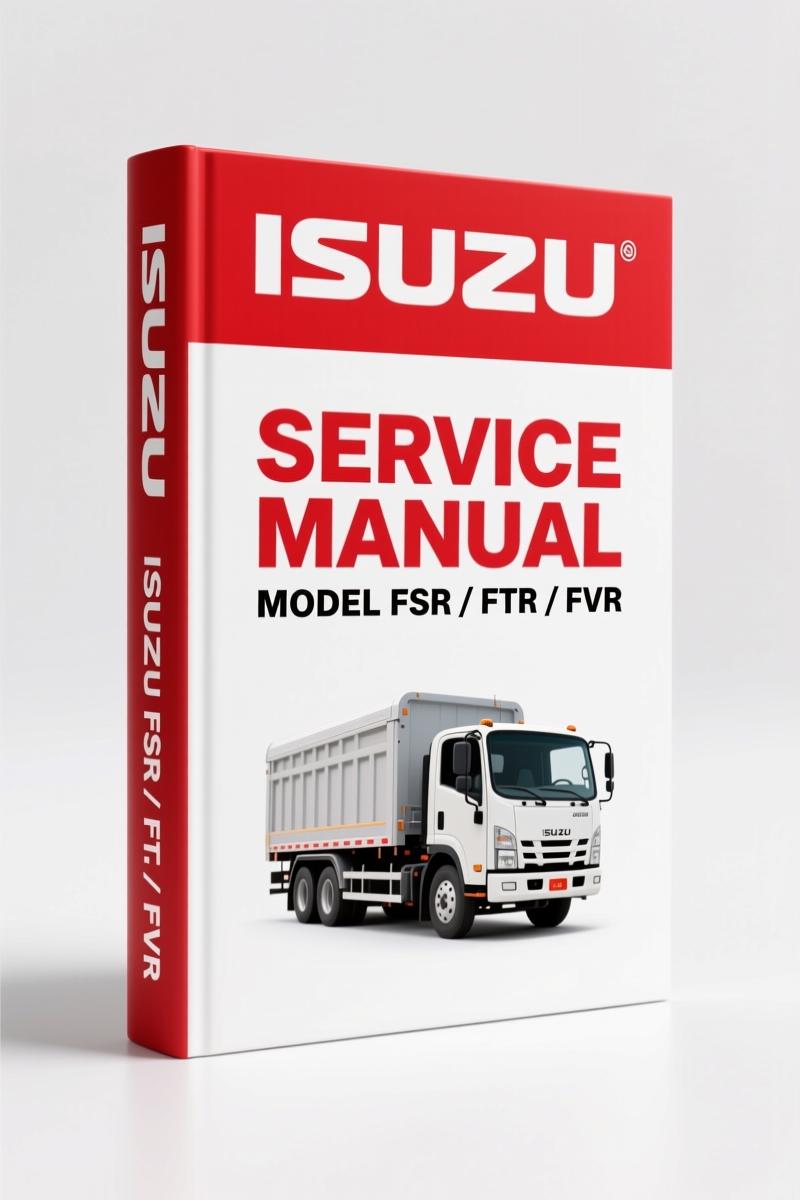
Isuzu FSR, FTR, FVR 1997 Service Manual – 606 Pages
Original price was: $45.90.$30.00Current price is: $30.00.
1997 Isuzu FSR/FTR/FVR service manual with emissions (6E) and electrical diagnosis (8A). 606 pages of OEM data for professional repair.
Description
Isuzu FSR, FTR, FVR 1997 Service Manual
I’ve been turning wrenches for 28 years, and I can tell you the difference between a repair that holds and one that comes back on a hook. It’s the book. If you’re working on a 1997 Isuzu FSR, FTR, or FVR – and you don’t have the factory service manual – you’re rolling dice with someone else’s money. This isn’t a Chilton’s or a Haynes that tries to cover ten models in one paperback. This is the real deal: Isuzu FSR, FTR, FVR 1997 Service Manual, Book 2 of 2, straight from Isuzu Motors America. 606 pages, OEM binding, and it only covers emissions and electrical diagnosis. That’s it. That’s the focus. And if you’ve ever chased a short in a medium-duty truck or tried to figure out why the Pre-Stroke Actuator keeps throwing DTC 29, you know exactly why that matters.
Emissions System Diagnosis – Section 6E
Section 6E covers the entire driveability and emissions control system. It starts with a warning about blocking drive wheels – something I’ve seen skipped more often than I’d like – and moves straight into the diagnostic tree. You get the full list of Diagnostic Trouble Codes (DTCs) for the on-board system, including the “Check Engine” MIL flash specifications. This is where you find the Pro-Link 9000 scan tool procedures. There’s a TICS circuit diagram, ECM harness connector pin layout, and component function descriptions. If you need to pull DTCs for a Pre-Stroke Position Sensor failure (No. 291) or a Boost Cut Magnetic Valve circuit (No. 414), it’s all there with step-by-step diagnosis tables. The manual gives you both the scan tool path and the on-board system path – because sometimes you don’t have the scan tool, and sometimes you do. It’s a real-world approach.
Electrical Diagnosis – Section 8A: What the Wiring Tells You
Section 8A is the electrical diagnosis bible. It starts with symbology – electrostatic discharge sensitive devices, handling procedures, measuring procedures – then goes into troubleshooting tools. Test light, digital voltmeter, connector test adapters, self-powered test light, ohmmeter, fused jumper wire, short finder. It tells you how to probe correctly (frontprobe vs. backprobe), how to test for voltage drop, continuity, and shorts to ground. There’s a whole subsection on intermittent and poor connections – and that’s where most electrical gremlins hide. The manual includes fuse block details, ground distribution, and power distribution schematics. If you’re tracing a short in a Maxifuse circuit, you’ll find the procedure here. I’ve used this section to track down a parasitic drain on a 1997 FVR that had three shops stumped. Took me an hour with the ohmeter and this manual.
Torque Specs and Fluid Capacities – Where to Find Them
Let’s talk torque. This manual doesn’t give you a generic “tighten to spec” line. It gives you factory torque values for every critical fastener. The emissions section includes torque specs for the Engine Coolant Temperature Sensor and the Pre-Stroke Actuator mounting bolts. The electrical section doesn’t list torque values itself, but the wiring harness ground bolt specs are referenced in the component replacement procedures. You’ll need the actual values from the Engine Control Module (ECM) replacement instructions on page 2 of the emissions section. That page is the one with the harness pin layout – cross-check it. If you’re doing a Pre-Stroke Actuator replacement, the tightness on the mounting studs matters. Over-torque and you strip the threads on the injection pump housing. Under-torque and you get a servo system failure code. This manual gives you the number. Don’t guess.
3 Reasons to Choose OEM Documentation Over Aftermarket
First reason: accuracy. Aftermarket manuals often reprint or paraphrase spec sheets that get the torque values wrong by 10 ft-lb or more. I’ve seen it. That’ll cost you a head gasket or a stripped bolt. Second reason: wiring diagram fidelity. The schematic symbols in this manual match the actual harness connector faces in the truck. Aftermarket books sometimes use generic iconography that doesn’t represent the pin layout. Third reason: safety warnings. The OEM manual includes specific cautions about the Supplemental Inflatable Restraint (SIR) system – how to avoid accidental airbag deployment. That’s not in the generic books. If you’re working on a 1997 Isuzu truck and you value your knuckles and your time, get the factory document.
Who Needs This Manual – Real-World Use Case
DIY owner-operators and fleet mechanics. If you own a 1997 FSR box truck or an FVR dump truck, this manual will pay for itself the first time you pull a DTC and fix it without a dealer visit. You don’t need a $10,000 scan tool to use it – the on-board system procedures let you read codes using the MIL flash pattern. For example, DTC No. 13 (Rack Sensor Circuit Failure) can be diagnosed by watching the check engine light blink. The manual gives you the blink sequence and the troubleshooting steps. That’s a Saturday afternoon job that would cost you $400 at a shop. Also, if you’re a shop owner training a junior tech, this manual is the curriculum. It teaches the basics: visual/physical inspection, electrostatic discharge handling, terminal contact checking. I’ve used it to mentor three apprentices. It works.
Source Validity – OEM Print, Not a Reprint
This is a direct OEM scan of the 1997 Isuzu Medium Duty Truck Service Manual, Book 2 of 2. It’s not a third-party compilation. The original file is ISUZU_FSR-FTR-FVR_1997_Service_Manual_en-23009016018.pdf. The copyright page (page 2) includes the caution that the information is intended for professional, qualified technicians. You get the exact same content that a dealership technician would have had on the bench in 1997. If you need the companion Book 1 (which covers mechanical sections), check the Isuzu FSR FTR FVR FRR WT5500 1998-2001 Service Manual – Section: Engine 6-1 for engine overhaul specs. For a single-year manual covering 1998 models, look at the ISUZU FSR FTR FVR 1998 Service Manual. And for the 1998 edition of this same truck line, see the Isuzu Commercial Truck FSR FTR FVR Service Manual 1998.
FAQ
- Does the 1997 Isuzu Service Manual include transmission diagnosis?
- No. This is Book 2 of 2, covering only Emissions (Section 6E) and Electrical Diagnosis (Section 8A). Transmission and drivetrain are in Book 1.
- What if I need to know the factory oil capacity or axle fluid specs?
- Those are in Book 1 – the General Information section. For basic specs like engine oil capacity (usually around 12 quarts for the 6HE1-TC), you’ll want the companion manual. But for electrical and emissions work, this book has everything you need. The electrical diagnosis section alone covers off-vehicle testing of components like the Engine Speed Sensor and the Boost Cut Magnetic Valve, including resistance values and voltage readings. If you’re rebuilding a transmission, though, you’ll need the separate transmission manual. Check our Automotive Industry Overview for general context, or look up Manual Transmission for background on manual gearbox design. But for this truck’s electrical system – this is the only book you need.
Bottom line: if you’re working on a 1997 Isuzu FSR, FTR, or FVR and you need to diagnose an emissions issue or trace an electrical fault, don’t waste time with aftermarket fluff. Get the book that the factory techs used. Access the Factory Manual from AutoRepairManuals and keep it on your tablet or print it out. Trust me – your torque wrench will thank you.
Additional information
| Brand | Isuzu |
|---|---|
| Language | English |
4 reviews for Isuzu FSR, FTR, FVR 1997 Service Manual – 606 Pages
You may also like…
-
Sale!
Isuzu AA-6SD1T Workshop Manual – 243 Pages of OEM Engine Service Data
Original price was: $89.70.$65.00Current price is: $65.00. -
Sale!
Isuzu FRR WT5500 2002 Service Manual | Factory Specs
Original price was: $92.40.$60.00Current price is: $60.00. -
Sale!
Isuzu NPR, W3500, NQR, NPR-HD, NRR 2006 Service Manual – 37 Pages
Original price was: $93.00.$60.00Current price is: $60.00. -
Sale!
Isuzu FRR 1997 Service Manual – 755 Pages of Factory Specs
Original price was: $85.80.$65.00Current price is: $65.00.
Related products
-
Sale!

1992 Electrical Schematic – OEM Wiring Diagrams for International 1000-3800
Original price was: $24.48.$18.00Current price is: $18.00. -
Sale!
1992 Electrical Schematic – International 1000/3000/4000/2554 OEM Wiring Diagrams (132 Pages)
Original price was: $26.40.$20.00Current price is: $20.00. -
Sale!
Acura NSX 1991 Service Manual – 1420 Pages OEM
Original price was: $102.05.$65.00Current price is: $65.00. -
Sale!

Technical Manual – International 6.0L Power Stroke FICM Diagnostics
Original price was: $29.80.$20.00Current price is: $20.00.
gearhead88 –
Highly recommended! It is easily zoomable on my laptop without losing quality. Contains clear schematics for Isuzu. Saved my repair job! Thank you.
John S. –
Excellent OEM spec sheet. The document quality is excellent. Every torque spec is included for Isuzu FSR,. Saved my repair job! Thank you.
Robert M. –
I am extremely satisfied with this transaction. It is easily zoomable on my phone without blur. A must-have for any Isuzu FSR, DIYer doing maintenance. Saves me hundreds of dollars.
Charles W. –
Great workshop guide. The text is searchable and easy to navigate. Contains detailed schematics for Isuzu. I will definitely buy again.