
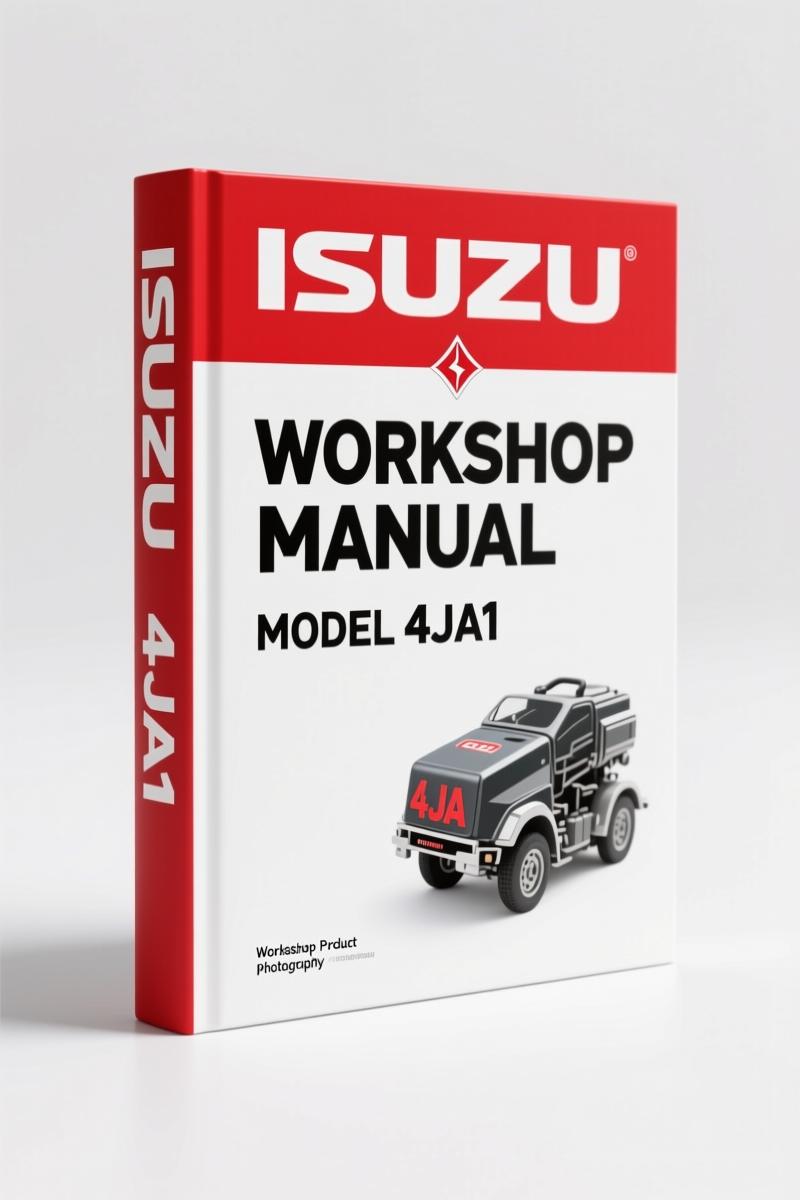
Isuzu 4JB1, 4JA1 2003 Workshop Manual – 231 Pages of OEM Specs
Original price was: $57.60.$45.00Current price is: $45.00.
OEM workshop manual for Isuzu 4JB1/4JA1 (2003). 231 pages covering engine overhaul, fuel system, cooling, valve clearance, and troubleshooting. Factory data only.
Description
Isuzu 4JB1, 4JA1 2003 Workshop Manual – Factory Specs & Procedures
If you’ve cracked open an aftermarket manual and found torque values that don’t match reality, or skipped a step because the instructions were vague, you know the cost. Hours lost, parts ruined, and a job you have to do twice. The Isuzu 4JB1, 4JA1 2003 Workshop Manual stops that nonsense cold. This is the factory-issued document for Isuzu’s industrial diesel line – the same one dealers used to keep these engines running under load for years. 231 pages of OEM data, not a reprint from some third-party that guessed the specs. 2003 publication date means it covers the later revisions of these workhorse engines. If you’re rebuilding a 4JB1 or 4JA1, you need this manual open on your bench, not some generic PDF that leaves you guessing about valve clearance or injection timing.
Isuzu 4JB1, 4JA1 2003 Workshop Manual: What You Get
Thirteen sections cover everything from general repair instructions to conversion tables. Section 1 lays out the main data and specifications – crank rotation, firing order, fluid capacities. Section 2 is where most of the regular work lives: injection pump identification, valve clearance adjustment, injection timing, compression pressure measurement. Section 2 also lists recommended lubricants and the engine repair kit part numbers. For a full teardown, Sections 3, 4, and 5 walk you through disassembly, inspection/repair, and reassembly of the engine assembly. That’s 80+ pages dedicated to the block and head. Then Sections 6 (Lubricating System), 7 (Cooling System), and 8 (Fuel System) give you the subsystem data – oil pump specs, water pump procedure, injection nozzle details. Section 9 covers the starter and alternator. Section 10 is the troubleshooting guide: hard starting, unstable idling, insufficient power, excessive fuel consumption, overheating, smoke color diagnosis. Section 11 lists the special tools you’ll actually need. Section 12 provides the repair standards chart (page 205), which includes wear limits and clearances. Section 13 has conversion tables for length, area, volume, mass, pressure, torque, and temperature.
3 Critical Sections for Diesel Engine Rebuild
Section 5 (Engine Assembly 3, REASSEMBLY) is where amateur builders make mistakes – improper bearing clearance, wrong bolt sequence, overtightened head bolts. The manual gives you the factory tightening torque specs in the repair standards chart. Page 205. You don’t guess. Also Section 8 (Fuel System) – the injection pump data and nozzle specs are unique to these engines. Using aftermarket data here can cause hard starting or smoke. Section 10 – the troubleshooting flowcharts cut diagnostic time in half if you follow them step by step. For example, the list covers “white exhaust smoke” and “dark exhaust smoke” separately, each with its own root cause progression.
Section 6 includes the oil pump and the oil filter with built-in oil cooler – critical differences between the 4JB1 and 4JA1. The manual identifies which engine uses which cooler configuration. Section 7 gives you the cooling system specs: thermostat opening temperature, water pump impeller clearance. If you’ve ever swapped a water pump and had the belt misalign, you’ll appreciate the factory mounting procedure.
Torque Specs and Repair Standards
The repair standards chart (Section 12, page 205) lists every critical measurement in imperial units: cylinder bore diameter, piston ring gap, valve stem clearance, injector protrusion. Don’t trust a Chilton or Haynes reprint – those often round numbers or omit the variance window. Isuzu’s original data includes both standard and limit values. For example, the valve clearance adjustment spec (Section 2) is given with the engine cold, and the injection timing mark alignment is shown in a diagram. No ambiguity. The conversion table at the back (Section 13) lets you switch between metric and imperial when you’re using an inch-pound torque wrench.
Does This Manual Cover Both the 4JB1 and 4JA1?
Yes. The manual is officially designated “INDUSTRIAL DIESEL ENGINE A-4JA1, A-4JB1 MODELS.” The two engines share the same basic architecture but differ in displacement (4JA1 is 2.5L, 4JB1 is 2.8L or 3.1L depending on variant) and some fuel system components. The manual calls out injection pump identification (Section 2) separately for each model. The repair standards chart includes separate rows for each engine. When you see a spec that applies only to one, it’s marked. This is why buying the OEM manual matters – aftermarket sources often conflate the two and give you a generic number that fits neither.
If you need parts data, the Isuzu 4JB1 2006 Parts Catalog – OEM Factory Specs complements this workshop manual perfectly. For a broader engine family reference, check the Isuzu 4JB1 4JG2 4JH1-TC 4HF1 4HE1-TC Service Manual PDF. The Isuzu 4JB1 Diesel Engine Service Manual also covers earlier variants if you’re working on a pre-1998 model.
Why OEM Documentation Beats Aftermarket Copies
This manual is a direct scan from Isuzu Motors Limited, 2003 copyright. No reprint, no reformatting, no assembled-from-miscellaneous-sources PDF. The OCR excerpt shows the foreword states “Information contained in this Workshop Manual is the latest available at the time of publication.” That means torque specs, wear limits, and part numbers are the actual factory release. Aftermarket manuals often leave out the special tool list (Section 11) or the troubleshooting section (Section 10). Without that list, you’ll waste time improvising tools or miss a critical diagnostic step. For example, compression pressure measurement – Section 2 gives you the equipment and procedure. An aftermarket book might just say “check compression” without telling you the adapter for the 4JB1’s injector hole.
For broader context on why OEM documentation matters in the automotive industry, read the Automotive Industry Overview and also this Automotive Industry Overview – both highlight how factory specs prevent costly errors.
FAQ
- Is this manual suitable for a beginner working on a 4JB1 in a water pump application?
- If you can read a torque wrench and follow numbered steps, yes. The manual assumes you understand basic engine mechanics but doesn’t skip explanations.
- Does the manual include wiring diagrams for the starter and alternator?
- Section 9 covers engine electricals – starter and alternator. It includes component testing procedures, terminal identification, and output specs. No full-vehicle wiring diagrams, but for the engine-mounted electricals you’ll find everything needed to troubleshoot a no-crank or low-charge condition. The troubleshooting section also includes causes for no-start related to electrical faults. If you need the starter’s pull-in coil test data, it’s in that section.
Stop wasting time on manuals that leave you second-guessing. When you Access the Factory Manual, you get the same data Isuzu engineers wrote for their own service network. No shortcuts, no missing pages, no guessed torque values.
Additional information
| Brand | Isuzu |
|---|---|
| Language | English |
3 reviews for Isuzu 4JB1, 4JA1 2003 Workshop Manual – 231 Pages of OEM Specs
You may also like…
-
Sale!
Isuzu FRR WT5500 2002 Service Manual | Factory Specs
Original price was: $92.40.$60.00Current price is: $60.00. -
Sale!
Isuzu FRR 1997 Service Manual – 755 Pages of Factory Specs
Original price was: $85.80.$65.00Current price is: $65.00. -
Sale!
Isuzu AA-6SD1T Workshop Manual – 243 Pages of OEM Engine Service Data
Original price was: $89.70.$65.00Current price is: $65.00. -
Sale!
Isuzu NPR, W3500, NQR, NPR-HD, NRR 2006 Service Manual – 37 Pages
Original price was: $93.00.$60.00Current price is: $60.00.
Related products
-
Sale!

1989 Service Manual – International 2000-8000 Electrical Systems
Original price was: $72.00.$50.00Current price is: $50.00. -
Sale!

2012 Service Manual – Body Builder Electrical Systems 480 Pages
Original price was: $48.28.$34.00Current price is: $34.00. -
Sale!

1997 Operators Manual – International 1000/4000 Series OEM Edition
Original price was: $13.49.$9.99Current price is: $9.99. -
Sale!
1994 Troubleshooting Manual – International 1000-4000 FBC
Original price was: $60.00.$50.00Current price is: $50.00.
Robert M. –
Perfect workshop guide. The text is searchable and well indexed. A must-have for any Isuzu 4JB1, mechanic doing repairs. Saves me hundreds of money.
James L. –
This is just what I was looking for. The PDF quality is excellent. Contains precise wiring diagrams for Isuzu. Great value for money.
Charles W. –
I am very pleased with this manual. It is easily zoomable on my laptop without losing quality. Every torque spec is included for Isuzu 4JB1,. Saved my repair job! Thanks.