
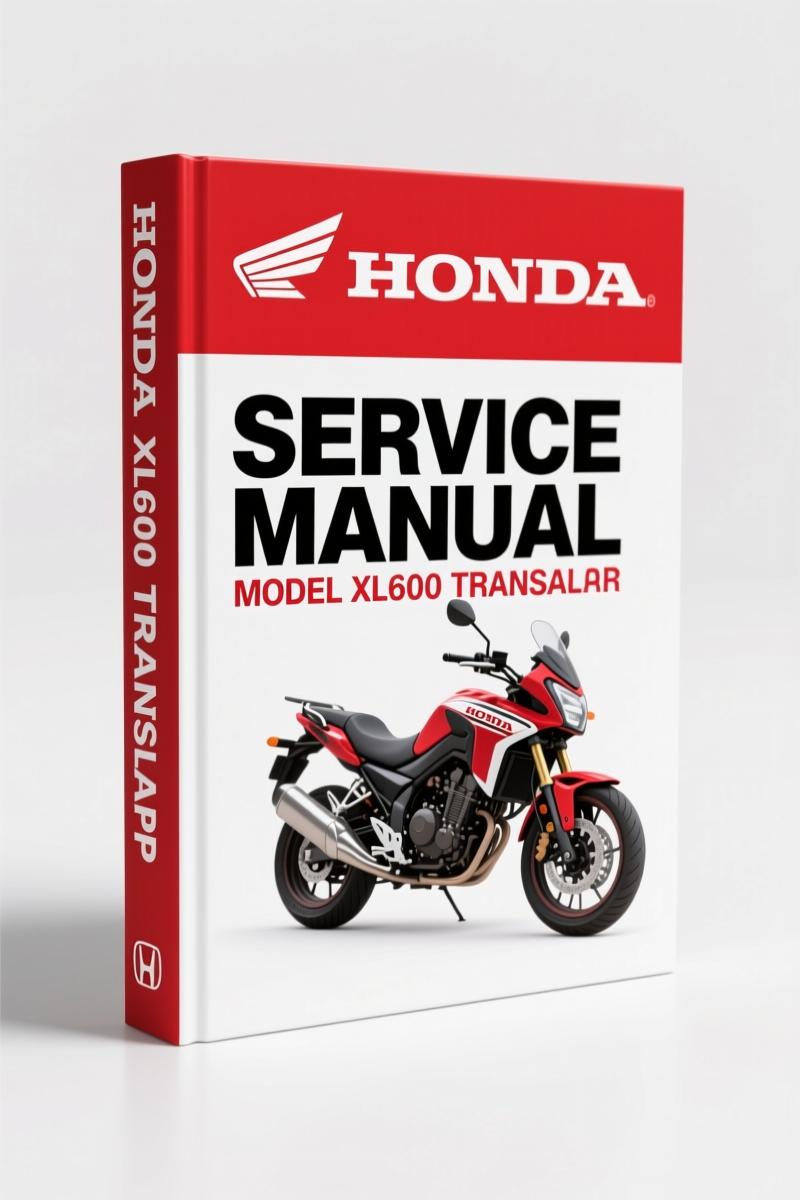
Honda XL600 Transalp Service Manual – 499 Pages Factory Specs
Original price was: $40.50.$30.00Current price is: $30.00.
Factory Honda XL600 Transalp Service Manual: 499 pages of OEM torque values, wiring diagrams, and maintenance schedules for certified mechanics.
Description
Honda XL600 Transalp Service Manual – Factory OEM Repair Guide
If you’re pulling wrenches on a Honda XL600 Transalp and you don’t have the factory Service Manual on the bench, you’re asking for trouble. I’ve seen too many guys guess at torque specs or skip the coolant bleeding procedure and end up with a blown head gasket. This manual is 499 pages of Honda’s own documentation – no reprints, no aftermarket garbage. It tells you exactly how Honda intended the bike to be serviced, from the fuel system to the wiring diagram. That’s the difference between a job that holds and one that comes back on a flatbed.
Beginners and home garage guys: this is your insurance policy. You don’t call a shop when you have the factory procedure in front of you. You don’t round off a bolt because you used the wrong tool – the manual lists required tools upfront. And you sure as hell don’t mix up the transmission shift linkage alignment because the exploded views are right there. Page 1 shows you how to navigate the book. Section 1 covers general safety – read it. Asbestos in brake assemblies is real, and Honda warns you about it on page 2 with an OSHA-approved method.
Engine Overhaul: Cylinder Head/Valve and Cylinder/Piston Sections
When the top end comes off, you need the valve clearance specs, the tightening sequence for the cylinder head bolts, and the piston ring gap tolerances. The Cylinder Head/Valve section gives you the factory procedure for removing the camshaft, checking valve stem wear, and lapping valves. The Cylinder/Piston section covers bore measurement and piston-to-cylinder clearance. Honda designed these engines with specific break-in maintenance – skip that first scheduled service and you’re eating oil. The manual spells it out on page 1 under “How to Use This Manual”: follow the maintenance schedule to keep emission levels within EPA and CARB standards. That’s not just legal talk – it keeps your transalp running right.
Fuel System and Cooling – Don’t Skip the Bleed Procedure
Carbureted bikes are finicky. The Fuel System chapter walks through carburetor removal, disassembly, float level adjustment, and vacuum synchronization. If you’ve ever fought a lean surge on a Transalp, you know the value of having the stock jetting specs. The Cooling System section includes the correct coolant capacity, thermostat testing, and the bleed screw location. Air in the cooling system causes hot spots and head warpage. Honda gives you the sequence – don’t improvise. I’ve seen guys skip the bleed and wonder why the fan runs constantly. It’s in the manual.
Wiring Diagram: Factory Electrical Schematics
Electrical gremlins waste hours. The Wiring Diagram section (page 20 of the TOC) gives you a full schematic with color codes. Verify your grounds, check the alternator/starter clutch circuit, and trace the ignition system without guessing. The Battery/Charging System chapter explains the Regulator/Rectifier test with actual resistance values. You don’t need to buy aftermarket troubleshooting charts – it’s all here. And if you’re a pro, you know that factory wiring diagrams are worth their weight in gold because they show the actual routing, not a simplified version. I’ve used this manual to chase a no-start on a 1986 Transalp and found the starter relay wiring error inside five minutes.
Why Factory Torque Values Matter (Page 2)
Page 2 lists the general torque values for the entire bike. Those numbers aren’t guesswork – they’re Honda’s engineering specs. Using the wrong torque on the cylinder head bolts, suspension pivot bolts, or brake calipers means leaks, stripped threads, or worse. The manual explicitly says to use metric tools only. English fasteners don’t belong on this bike. If you’re a shop owner or a tech, you know liability lives in the torque wrench. This manual eliminates that risk. The Rear Wheel/Brake/Suspension section has specific torque for the rear axle nut and brake caliper bolts. Don’t rely on internet forums – use the book.
Suspension and Brake: Proper Rebuild Steps
Front Suspension fork rebuild requires the correct oil weight, level, and air gap. The Front Wheel/Suspension/Steering chapter covers disassembly, seal replacement, and steering head bearing adjustment. Rear Suspension linkage pivot torque is critical – over-tighten and you bind the swingarm, under-tighten and it wears out fast. The Hydraulic Brake section gives the bleeding procedure, pad replacement specs, and master cylinder rebuild steps. Brake safety is not negotiable. Honda includes a warning about brake fluid damaging painted surfaces – common sense, but people still spill it. The manual tells you how to avoid it.
Source Authenticity – Direct OEM Scan, Not a Reprint
This is the actual Honda factory service manual, scanned from an original print. It’s not a third-party copy with missing pages or blurry diagrams. The 499 pages include every section from General Information through Troubleshooting, plus microfichas for later model years (87-88, 89-96, 97-99, 01-02). If you’ve ever bought an aftermarket manual and found a step was skipped or the torque spec was off by 5 Nm, you know why OEM matters. Automotive Industry Overview – that’s the kind of standard you want. Not generic hand-waving. Real specs. Real procedures. Automotive Industry Overview is another resource to understand why factory documentation is the gold standard, but this manual is the one you need on the bench.
FAQ
- Does this manual cover the 1986 Honda XL600 Transalp?
- Yes. It covers the 1986 model year and includes additional microfichas for 87-88, 89-96, 97-99, and 01-02.
- Are the wiring diagrams complete and readable?
- The wiring diagram is a full black-and-white schematic with all wire colors indicated by Honda code (e.g., Gr for Gray, Bu for Blue, W for White). Every connector pin assignment is shown, and the manual includes the battery/charging system and ignition system schematics separately. I’ve used it to trace a faulty ground on a 1986 Transalp – it’s clear enough for someone who knows how to read a schematic, but beginners should start with the troubleshooting section (Section 21) to identify the problem first. The scan quality is high enough that you can zoom in on the diagram without losing detail.
Related Manuals
- Honda VT600C 1998 Service Manual – Factory OEM Repair Guide
- Honda VFR800/A 2002 Service Manual – OEM Factory Repair Guide
- 1994 Honda Civic Service Manual OEM Factory Specs
Stop wasting billable hours or weekend garage time on guesswork. Access the Factory Manual and get the real Honda specs for your XL600 Transalp. This is the only service documentation you need – 499 pages, factory-correct, no aftermarket junk.
Additional information
| Brand | Honda |
|---|---|
| Language | English |
3 reviews for Honda XL600 Transalp Service Manual – 499 Pages Factory Specs
You may also like…
-
Sale!
Honda NSS250, NSS250A, NSS250S, NSS250AS Service Manual – 401 Pages Factory Specs
Original price was: $67.95.$45.00Current price is: $45.00. -
Sale!

Honda NSF250R 2012 Parts Catalog – OEM Exploded Views & Part Numbers
Original price was: $55.80.$45.00Current price is: $45.00. -
Sale!
Honda RSX 2005 Service Manual – Factory Specs for Engine, SRS & Emissions
Original price was: $71.10.$45.00Current price is: $45.00. -
Sale!
Honda BF75D, BF90D 2011 Service Manual – Factory Shop Manual
Original price was: $89.70.$65.00Current price is: $65.00.
Related products
-
Sale!

1991 Operators Manual – International Truck OEM Specs (108 Pages)
Original price was: $13.63.$10.99Current price is: $10.99. -
Sale!

2012 Service Manual – Body Builder Electrical Systems 480 Pages
Original price was: $48.28.$34.00Current price is: $34.00. -
Sale!

Technical Manual – International 6.0L Power Stroke FICM Diagnostics
Original price was: $29.80.$20.00Current price is: $20.00. -
Sale!
2004 Acura TSX Wiring Diagram – 73-Page Factory Electrical Schematics
Original price was: $15.88.$9.99Current price is: $9.99.
John S. –
Perfect factory service manual. It is very easy to read on my laptop without blur. It assisted me to troubleshoot my Honda XL600 engine. Saved my weekend project! Thanks.
David K. –
Superb resource! Quick access after payment. Contains precise schematics for Honda. Saves me so much time.
workshop_guy –
Great factory service manual. It is easily zoomable on my laptop without losing quality. Contains clear schematics for Honda. Saves me hundreds of money.